BOTANICAL IDENTITY
The right name is the first step.
Also known as: No synonyms listed.
Distillate, alcoholic extract and decoction are not interchangeable. No homemade eye drops.
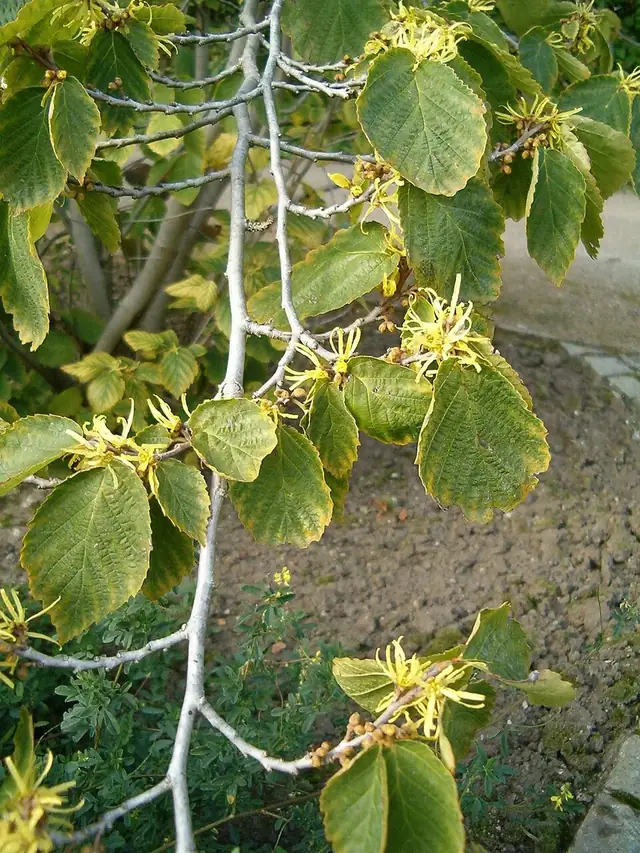
An illustration is not enough to identify a plant for consumption. Do not forage for a species based solely on this profile.
01 · UNDERSTAND
Properties & uses.
Minor skin irritations
Traditional use of suitable external preparations.
Read the sourceMouth irritation
Certain leaf or bark preparations have traditional local use.
Read the sourceThe traditional uses described are not clinical proof of effectiveness. Evidence for one preparation cannot automatically be applied to another.
02 · UNDERSTAND THE ACTION
How does the plant act?
Witch hazel is studied in several forms: leaf, bark and distillate. Their composition differs; distilled water is not interchangeable with a tannin-rich extract. The documentation mainly supports traditional local uses for minor irritation of the skin or mucous membranes. Some human studies explore specific formulations, without constituting general evidence for treating eczema or any venous disease.
Constituents to know.
Their presence and quantity depend on the plant part and preparation.
- Tannins and polyphenols
- Hamamelitannins, proanthocyanidins and gallic acid are discussed for extracts; the report does not identify a single constituent as the active therapeutic marker.Read the reference
Local astringent action
Leaf and bark preparations are traditionally used locally; astringency should not be confused with deep tissue repair.
Read the referenceExperimental inflammation
Anti-inflammatory activities have been observed with hydroalcoholic leaf or bark extracts. They do not validate all cosmetic witch hazel waters.
Read the referenceWhat this means for preparation.
Choose a product explicitly intended for the area concerned. A cosmetic does not become a mouthwash or eye drop because it contains witch hazel.
03 · EXAMINE THE EVIDENCE
What the research shows.
A laboratory or animal result alone does not demonstrate a benefit in humans. Each result must be read alongside the preparation studied and its limitations.
Different formulations and comparators
- Type of research
- Small randomized, double-blind trial described in the EMA report: 22 patients.
- Preparation concerned
- Leaf extract ointment compared with a bufexamac ointment for bilateral eczema.
- Observed results
- Symptoms improved with both treatments, with no overall difference between them.
- Limitations to consider
- Small sample and active comparator; an absence of difference does not prove equivalence and does not describe a homemade distillate.
What can we take from this?
Traditional local use demonstrates neither general treatment of venous insufficiency nor a replacement for eczema care. Tolerability must continue to be monitored: a herbal preparation can itself cause irritation or sensitization.
Documentary review dated 09/10/2026. The references remain available to check the context.
04 · CHOOSE A PREPARATION
One plant, several preparations.
Only forms documented in this profile’s sources are presented.
Topical preparationLeaves, bark or distillate depending on the product · Route: topical
Preparations formulated from leaf, bark or distillate.
Please note: Follow the product's package leaflet; preparations are not interchangeable.
Read the sourceSuitable mouthwashLeaves or bark depending on the product · Route: mouth
Preparation intended exclusively for the oral mucosa.
Please note: Do not swallow; do not use a cosmetic as a mouthwash.
Read the source05 · BEFORE ANY USE
Precautions & contraindications.
This guidance does not cover every individual situation. Missing information is not a guarantee of safety.
Contraindications
- Allergy to witch hazel.
Medicine interactions
- No established interaction is included in this entry; this does not guarantee compatibility with a treatment.
Adverse effects
- Contact dermatitis or allergic reactions possible.
Pregnancy & breastfeeding
Pregnancy and breastfeeding: medicinal use is not recommended because of insufficient data.
Children & adolescents
Age limits vary by part, indication and route; have the product checked.
If symptoms persist, worsen or are unusual, consult a healthcare professional. In an emergency, contact the emergency services.
06 · PUTTING KNOWLEDGE INTO PRACTICE
Preparations & recipes.
A DOCUMENTED PREPARATION
Witch hazel compress — external haemorrhoidal discomfort
Traditional use for itching and burning associated with haemorrhoids. Consider only after a professional confirms the cause, and only on the intact external area.
Plant part: Dried, fragmented bark
Ingredients & quantities
- 5–10 g quality-controlled, dried Hamamelis virginiana L. bark
- 250 ml cold drinking water
- A clean, single-use compress
Preparation steps
- Have a professional confirm haemorrhoids as the cause, and ask a pharmacist to check the product.
- Place the weighed bark in the 250 ml cold water.
- Bring to the boil, then simmer for 15–30 minutes: the EMA glossary’s general method, as the monograph gives no preparation-specific time. Follow the leaflet first.
- Strain carefully and allow to cool to a comfortable temperature before use.
- Soak the compress and apply externally, without rectal insertion.
Use: Adults aged 18+ only. EMA reference: up to 3 applications daily. Contact time is not specified: follow the leaflet or pharmacist’s advice. Seek advice if symptoms persist, worsen or exceed 2 weeks; any rectal bleeding requires assessment.
Storage: Prepare immediately before use. The monograph establishes no storage period for this water-based preparation; do not make a stock batch.
Before you start. Contraindicated with witch hazel allergy; contact dermatitis is possible. Medicinal use is not recommended during pregnancy or breastfeeding because data are insufficient. Do not apply to a fissure, wound or infected area. This decoction is not an eye preparation, hydrosol or drink.
07 · CHECK THE SOURCES
Sources for this profile.
- EMA — Hamamelidis cortex: assessment and documentsAccessed on 09/10/2026
- EMA — Hamamelidis folium: assessment and documentsAccessed on 09/10/2026
- EMA — Hamamelidis folium et cortex aut ramunculus destillatum: assessment and documentsAccessed on 09/10/2026
- ANSES — summary of precautions for food supplements (June 2023)Accessed on 09/10/2026
- EMA — assessment report: bark, leaf and distillate of Hamamelis virginianaAccessed on 09/10/2026
- EMA — Monograph on Hamamelis virginiana L., cortexAccessed on 09/10/2026
- EMA — Glossary on herbal teas, general method (§4)Accessed on 09/10/2026
Illustration: BotBln — Wikimedia Commons · CC BY-SA 3.0. View the original image and its licence. Image resized and converted to WebP.
A TOUCH OF SOLÉA
Myriam’s tip
Myriam is reviewing the tip for this profile.
Myriam