
Identity & origin
BOTANICAL IDENTITY
The right name is the first step.
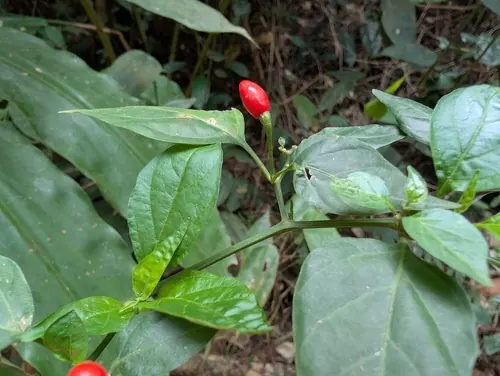
Kew describes this taxon as a subshrub or shrub. This notice concerns Capsicum frutescens, family Solanaceae. The pharmacopoeial material is: fruits.
Botanical and documentary notice: the inventory alone is insufficient to propose a therapeutic use.
Also known as: Piment de Cayenne Piment enragé Piment (petit), Capsicum frutescens
Medicinal skin preparations concern defined extracts and certain small-fruited varieties. Kitchen chilli is not a substitute for a medicinal plaster.A photograph alone does not guarantee identification for consumption.
An illustration is not enough to identify a plant for consumption. Do not forage for a species based solely on this profile.
Uses & evidence
UNDERSTANDING THE USES
Properties & uses.
Muscle pain: topical medicines
Well-established medicinal use concerns topical plasters or semisolid products containing precisely defined extracts for certain muscle pain. It does not validate oral chilli for pain or a homemade balm.
EMA status applies only to the described preparation and indication, not every form of the plant.
Read the sourceThe traditional uses described are not clinical proof of effectiveness. Evidence for one preparation cannot automatically be applied to another.
Precautions before use
BEFORE ANY USE
Precautions & contraindications.
This guidance does not cover every individual situation. Missing information is not a guarantee of safety.
Contraindications & precautions
- Source-listed contraindicationAllergy to the substance or other capsaicinoid sources; broken skin, wounds or eczema.Source
- PrecautionAvoid eyes, mucous membranes and extra heat. Stop for excessive burning or allergic reactions; these precautions concern defined topical medicines.Source
Medicine interactions
- Possible interactionDo not layer other rubefacients or pain-relieving gels on the same area. Local interaction may remain possible after a plaster is removed; the monograph reports no general interaction studies.Source
“Reported” does not prove causality; “possible” may reflect indirect evidence. “None reported” means none in the cited source, not that all combinations have been studied. Do not stop a prescribed treatment based on this profile.
Adverse effects
- Burning, redness, hypersensitivity; stop for significant reactions.
Pregnancy & breastfeeding
Pregnancy/breastfeeding: only after medical benefit-risk assessment under the EMA monograph; no home preparation.
SourceChildren & adolescents
Topical medicinal use is not recommended below 18 years because data are insufficient.
SourceIf symptoms persist, worsen or are unusual, consult a healthcare professional. In an emergency, contact the emergency services.
Sources & last review
CHECKING REFERENCES
Sources for this profile.
- ANSM — French Pharmacopoeia, List A, January 2026, p. 28Accessed on 09/10/2026
- GBIF — taxonomy of Capsicum frutescensAccessed on 09/10/2026
- Kew POWO — Capsicum frutescens L.Accessed on 09/10/2026
- EDQM, Council of Europe — Evidence-based classification review for Capsicum annuum L. var. minimum (Miller) Heiser and Capsicum frutescens L. (2026)Accessed on 09/10/2026
- EMA — Capsici fructus : monographie des préparations cutanéesAccessed on 09/10/2026
Image: Zac Peterson · CC BY 4.0. View the original image and its licence. Image resized and converted to WebP.