
Identity & origin
BOTANICAL IDENTITY
The right name is the first step.
Informational profile devoted to cascara, the part studied and the limits of knowledge.
Also known as: No synonyms listed.
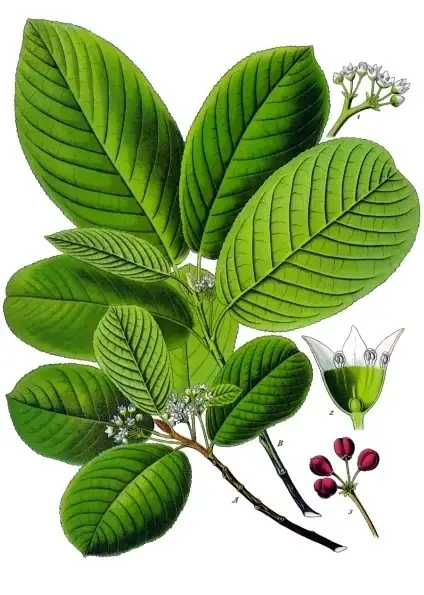
The botanical name and part used must match the profile; a photograph alone is not sufficient grounds for consuming a plant.
An illustration is not enough to identify a plant for consumption. Do not forage for a species based solely on this profile.
Uses & evidence
UNDERSTANDING THE USES
Properties & uses.
Occasional constipation
Well-established medicinal use (EMA) of defined preparations for a short period; this recognition does not correspond to a body of robust direct trials of the species alone.
EMA status applies only to the described preparation and indication, not every form of the plant.
Read the sourceThe traditional uses described are not clinical proof of effectiveness. Evidence for one preparation cannot automatically be applied to another.
Precautions before use
BEFORE ANY USE
Precautions & contraindications.
This guidance does not cover every individual situation. Missing information is not a guarantee of safety.
Contraindications & precautions
- Source-listed contraindicationContraindicated in allergy, intestinal obstruction or narrowing, atony, appendicitis, inflammatory bowel disease, unexplained abdominal pain or severe dehydration.Source
- PrecautionKidney disease increases concern about electrolyte imbalance. Avoid prolonged use; constipation requiring daily laxatives should be evaluated.Source
Medicine interactions
- Possible interactionPotassium loss, particularly with abuse or prolonged use, may increase cardiac glycoside effects and interfere with antiarrhythmics or QT-prolonging medicines. Potassium-depleting diuretics, corticosteroids and liquorice may increase this risk. Seek medical review before combining.Source
“Reported” does not prove causality; “possible” may reflect indirect evidence. “None reported” means none in the cited source, not that all combinations have been studied. Do not stop a prescribed treatment based on this profile.
Adverse effects
- Cramps, diarrhoea and allergic reactions may occur. Abuse or prolonged use can cause water and potassium loss. Dependence is a precautionary concern; its precise causality remains debated in the EMA assessment.
Pregnancy & breastfeeding
Contraindicated during pregnancy and breastfeeding under the EMA framework.
SourceChildren & adolescents
Contraindicated below 12 years under the EMA framework.
SourceIf symptoms persist, worsen or are unusual, consult a healthcare professional. In an emergency, contact the emergency services.
Available evidence
EXPLORE THE EVIDENCE
The available evidence.
Cascara is the bark of Rhamnus purshiana used in standardized laxative preparations. Its activity depends on hydroxyanthracene derivatives and their intestinal transformation. It targets occasional constipation; symptomatic relief does not mean it corrects a chronic bowel transit disorder. The name “cascara” can also refer to unrelated food products, hence the importance of the botanical name.
Constituents to know.
Their presence and quantity depend on the plant part and preparation.
- Cascarosides
- Major hydroxyanthracene glycosides in the bark, associated with laxative action; standardization avoids reasoning in terms of an undifferentiated raw quantity.Read the reference
Intestinal motility and water
The active derivatives stimulate evacuation and alter water and electrolyte exchange in the intestine.
EMA status applies only to the described preparation and indication, not every form of the plant.
Read the referenceWhy prolonged repeated use should be avoided
Cramps, diarrhea and electrolyte imbalances may accompany laxative activity; potassium losses are particularly important when other treatments are taken.
This entry describes a risk or interaction, not a beneficial property.
Read the referenceLimitations to keep in mind.
The label must specify the species and preparation. Harvested bark or herbal tea with unknown content cannot reproduce the exposure from a studied medicine.
Studies, findings & limitations
THE RESEARCH
What the research shows.
A laboratory or animal result alone does not demonstrate a benefit in humans. Each result must be read alongside the preparation studied and its limitations.
Data from the stimulant laxative class
EMA status applies only to the described preparation and indication, not every form of the plant.
- Type of research
- EMA assessment report on bibliographic data.
- Preparation concerned
- Cascara bark and standardized extracts of Rhamnus purshiana.
- Observed results
- The dossier recognises well-established use for short-term occasional constipation.
- Limitations to consider
- Part of the pharmacological rationale concerns anthraquinones; this does not allow comparative superiority of cascara to be claimed. Representative direct trials of this species alone are insufficient; recognition is based in particular on experience and data for the hydroxyanthracene laxative class.
What can we take from this?
The purgative effect proves no “detox,” weight-loss or colon-protective effect. Persistent constipation calls for investigation of its cause.
Documentary review dated 09/10/2026. The references remain available to check the context.
Sources & last review
CHECKING REFERENCES
Sources for this profile.
- EMA — Rhamni purshianae cortex: dossier and documentsAccessed on 09/10/2026
- EMA — scientific assessment report: Rhamnus purshianusAccessed on 09/10/2026
Image: Franz Eugen Köhler, Köhler's Medizinal-Pflanzen · Public domain. View the original image and its licence. Image resized and converted to WebP.