
Identity & origin
BOTANICAL IDENTITY
The right name is the first step.
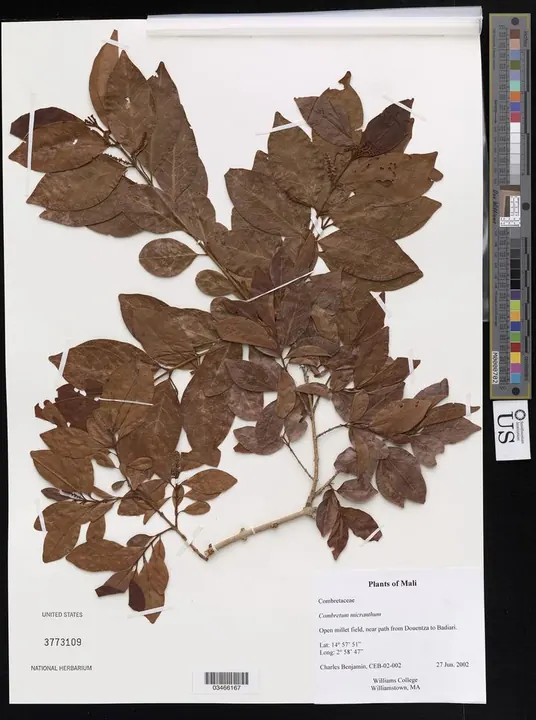
Kew describes this taxon as a scrambling shrub or tree. This notice concerns Combretum micranthum, family Combretaceae. The pharmacopoeial material is: leaves.
Results are presented to explain the research; no self-medication recommendation.
Also known as: Kinkéliba, Combretum micranthum
The listing concerns Combretum micranthum leaves. A leaf powder studied in capsules is not equivalent to every tea sold as kinkeliba.A photograph alone does not guarantee identification for consumption.
An illustration is not enough to identify a plant for consumption. Do not forage for a species based solely on this profile.
Uses & evidence
UNDERSTANDING THE USES
Properties & uses.
Blood pressure: comparative trial
A leaf powder was compared with an antihypertensive medicine. This observation does not validate all kinkeliba teas.
A human study may be positive, negative or inconclusive. Read the findings, preparation and limitations.
Read the sourceThe traditional uses described are not clinical proof of effectiveness. Evidence for one preparation cannot automatically be applied to another.
Precautions before use
BEFORE ANY USE
Precautions & contraindications.
This guidance does not cover every individual situation. Missing information is not a guarantee of safety.
Contraindications & precautions
- Insufficient dataThis targeted audit does not provide a comprehensive contraindication review; this does not mean contraindications are absent.
Medicine interactions
- Insufficient dataThis dossier cannot establish compatibility with medication. A limited study does not replace an interaction review of the exact product.
Other retained warnings · review incomplete
These existing warnings remain relevant to consult. Their exhaustive reassessment is outside this targeted review.
Restrictions and precautions
- The references in this notice do not establish a complete contraindication list. This limitation does not mean absence of risk.
Medicine interactions
- Medicine compatibility is not assessed in this notice; a pharmacist should check it before any use.
Pregnancy, breastfeeding and children
The retained data do not support recommending medicinal use during pregnancy or breastfeeding.
No paediatric use is proposed; pharmacopoeial listing does not establish a child-appropriate dose.
“Reported” does not prove causality; “possible” may reflect indirect evidence. “None reported” means none in the cited source, not that all combinations have been studied. Do not stop a prescribed treatment based on this profile.
Adverse effects
- Trial size and duration cannot rule out rare or delayed effects. Tolerability of the tested product does not apply to every preparation.
Pregnancy & breastfeeding
The retained data do not support recommending medicinal use during pregnancy or breastfeeding.
Children & adolescents
No paediatric use is proposed; pharmacopoeial listing does not establish a child-appropriate dose.
If symptoms persist, worsen or are unusual, consult a healthcare professional. In an emergency, contact the emergency services.
Available evidence
EXPLORE THE EVIDENCE
The available evidence.
A leaf powder was compared with an antihypertensive medicine. This observation does not validate all kinkeliba teas.
Blood pressure: comparative trial
Blood pressure fell, but the systolic reduction was greater with ramipril.
A human study may be positive, negative or inconclusive. Read the findings, preparation and limitations.
Read the referenceGlucose production: preclinical lead
Polyphenols reduced PEPCK expression and glucose production in a liver-cell line.
Laboratory or animal observation. A human benefit cannot be inferred from this finding alone.
Read the referenceLimitations to keep in mind.
Do not stop or replace prescribed treatment. Have any combination with blood-pressure medicine checked.
Studies, findings & limitations
THE RESEARCH
What the research shows.
A laboratory or animal result alone does not demonstrate a benefit in humans. Each result must be read alongside the preparation studied and its limitations.
Blood pressure: comparative trial
A human study may be positive, negative or inconclusive. Read the findings, preparation and limitations.
- Type of research
- Randomized trial, 125 adults, three groups, four weeks.
- Preparation concerned
- Leaf powder in capsules.
- Observed results
- Increased urinary sodium excretion was also observed.
- Limitations to consider
- Short duration, no placebo and uncomplicated hypertension: cardiovascular complications and long-term safety are not resolved.
Glucose production: preclinical lead
Laboratory or animal observation. A human benefit cannot be inferred from this finding alone.
- Type of research
- Cell experiments and a mouse study.
- Preparation concerned
- Flavonoid-rich leaf fractions.
- Observed results
- Researchers also observed blood-glucose changes in mice.
- Limitations to consider
- Animal doses and laboratory fractions do not translate into a cup of tea or diabetes treatment.
What can we take from this?
Short duration, no placebo and uncomplicated hypertension: cardiovascular complications and long-term safety are not resolved.
Documentary review dated 09/10/2026. The references remain available to check the context.
Sources & last review
CHECKING REFERENCES
Sources for this profile.
- ANSM — French Pharmacopoeia, List A, January 2026, p. 20Accessed on 09/10/2026
- GBIF — taxonomy of Combretum micranthumAccessed on 09/10/2026
- Kew POWO — Combretum micranthum G.DonAccessed on 09/10/2026
- Clinical efficacy of African traditional medicines in hypertension: A randomized controlled trial with Combretum micranthum and Hibiscus sabdariffa. — Seck SM et al. (2017)Accessed on 09/10/2026
- Bioactive polyphenols in kinkéliba tea (Combretum micranthum) and their glucose-lowering activities. — Welch C et al. (2018)Accessed on 09/10/2026
Image: Smithsonian Institution, NMNH, Botany · CC0 1.0. View the original image and its licence. Image resized and converted to WebP.