
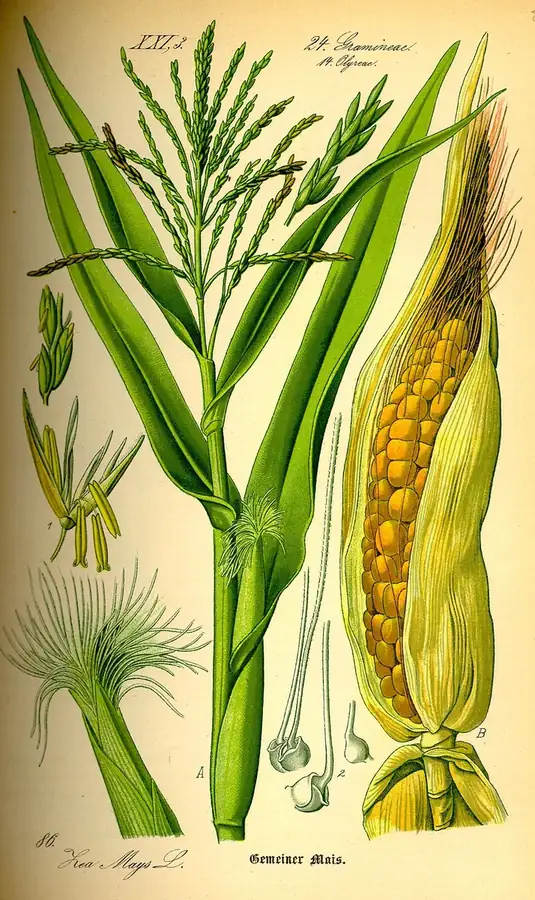
Identity & origin
BOTANICAL IDENTITY
The right name is the first step.
Documentary profile devoted to corn — stigmas, the part studied and the limits of current knowledge.
Also known as: corn silk
The botanical name and part used must match the profile; a photograph alone is not sufficient grounds for consuming a plant.
An illustration is not enough to identify a plant for consumption. Do not forage for a species based solely on this profile.
Uses & evidence
UNDERSTANDING THE USES
Properties & uses.
Dossier in progress
Corn silk appears in an EMA dossier relating to the urinary system. The dossier's status is not enough to establish a therapeutic recommendation.
The references do not establish a benefit. Lack of evidence is not assurance of safety.
Read the sourceThe traditional uses described are not clinical proof of effectiveness. Evidence for one preparation cannot automatically be applied to another.
Precautions before use
BEFORE ANY USE
Precautions & contraindications.
This guidance does not cover every individual situation. Missing information is not a guarantee of safety.
The following warnings do not constitute a complete review of interactions or contraindications. An unstudied combination cannot be considered compatible.
Contraindications & precautions
- Conditions requiring fluid restriction need medical advice.
Medicine interactions
- Interactions are not sufficiently documented in this entry.
“Reported” does not prove causality; “possible” may reflect indirect evidence. “None reported” means none in the cited source, not that all combinations have been studied. Do not stop a prescribed treatment based on this profile.
Adverse effects
- Risks insufficiently characterized to propose a preparation.
Pregnancy & breastfeeding
Pregnancy and breastfeeding: medicinal use is not recommended due to insufficient data.
Children & adolescents
No pediatric use proposed.
If symptoms persist, worsen or are unusual, consult a healthcare professional. In an emergency, contact the emergency services.
Available evidence
EXPLORE THE EVIDENCE
The available evidence.
Corn stigmas, often called “silks,” are distinct from the grain eaten as food. Their inclusion in a European dossier on urinary uses is not enough to establish an indication. A laboratory study nevertheless helps explain a specific avenue: some extracts act on digestive enzymes in an experimental system. This is not a trial in people with diabetes or proof of a herbal tea's efficacy.
Constituents to know.
Their presence and quantity depend on the plant part and preparation.
- Families detected in the extract
- The study reports flavonoids, phenolic compounds and saponins, among others; this chemical screening does not identify a clinically active substance.Read the reference
Carbohydrate-digesting enzymes
The aqueous extract inhibits alpha-amylase and alpha-glucosidase in laboratory tests; these enzymes are involved in carbohydrate processing.
Laboratory or animal observation. A human benefit cannot be inferred from this finding alone.
Read the referenceExperimental antioxidant activity
Chemical tests show activity under the experimental conditions. They do not measure kidney protection or a “detox” effect in humans.
Laboratory or animal observation. A human benefit cannot be inferred from this finding alone.
Read the referenceLimitations to keep in mind.
The part “stigmas” must be clearly identified. A urinary claim and an experiment on carbohydrate digestion are two different dossiers, which do not validate one another.
Studies, findings & limitations
THE RESEARCH
What the research shows.
A laboratory or animal result alone does not demonstrate a benefit in humans. Each result must be read alongside the preparation studied and its limitations.
A metabolic research direction, not a treatment
Laboratory or animal observation. A human benefit cannot be inferred from this finding alone.
- Type of research
- Original in vitro study, Sabiu and colleagues, 2016.
- Preparation concerned
- Aqueous extract of Zea mays silk.
- Observed results
- Enzyme inhibition depends on concentration; the researchers describe different modes of inhibition depending on the enzyme.
- Limitations to consider
- No human participants, no clinical blood glucose measurement and no established equivalence to a homemade infusion.
What can we take from this?
This profile provides neither a protocol for diabetes nor a use for infection or kidney disease. The absence of sufficient human data leaves questions about efficacy, interactions and safety open, depending on the preparation.
Documentary review dated 09/10/2026. The references remain available to check the context.
Sources & last review
CHECKING REFERENCES
Sources for this profile.
- EMA — Maydis stigma: dossier and documentsAccessed on 09/10/2026
- Sabiu et al., 2016 — in vitro study of aqueous Zea mays stigma extracts on carbohydrate-digesting enzymesAccessed on 09/10/2026
Image: Flora von Deutschland, Österreich und der Schweiz — Otto Wilhelm Thomé (1885), via Wikimedia Commons · Public domain. View the original image and its licence. Image resized and converted to WebP.