
Identity & origin
BOTANICAL IDENTITY
The right name is the first step.
Kew describes this taxon as an annual. This notice concerns Persicaria orientalis, family Polygonaceae. The pharmacopoeial material is: fruits — cutaneous-use notation.
Botanical and documentary notice: the inventory alone is insufficient to propose a therapeutic use.
Also known as: Polygonum orientale, Persicaria orientalis
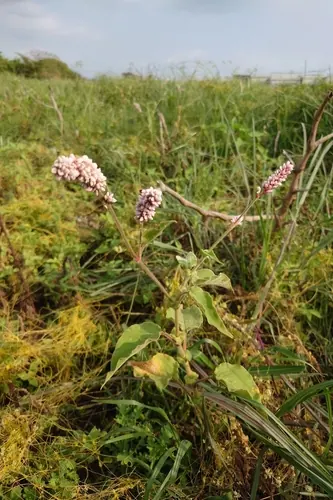
Persicaria orientalis is the retained name; the inventory also gives an older Polygonum name. Its fruit carries a cutaneous-use notation, not a recommendation for ingestion.A photograph alone does not guarantee identification for consumption.
An illustration is not enough to identify a plant for consumption. Do not forage for a species based solely on this profile.
Uses & evidence
UNDERSTANDING THE USES
Properties & uses.
Pharmacopoeial record
Traditional-use listing is documented for this material. The inventory does not establish a clinically validated indication here.
The references do not establish a benefit. Lack of evidence is not assurance of safety.
Read the sourceThe traditional uses described are not clinical proof of effectiveness. Evidence for one preparation cannot automatically be applied to another.
Precautions before use
BEFORE ANY USE
Precautions & contraindications.
This guidance does not cover every individual situation. Missing information is not a guarantee of safety.
The following warnings do not constitute a complete review of interactions or contraindications. An unstudied combination cannot be considered compatible.
Contraindications & precautions
- The references in this notice do not establish a complete contraindication list. This limitation does not mean absence of risk.
Medicine interactions
- Medicine compatibility is not assessed in this notice; a pharmacist should check it before any use.
“Reported” does not prove causality; “possible” may reflect indirect evidence. “None reported” means none in the cited source, not that all combinations have been studied. Do not stop a prescribed treatment based on this profile.
Adverse effects
- The inventory alone does not establish adverse-effect type or frequency.
Pregnancy & breastfeeding
The retained data do not support recommending medicinal use during pregnancy or breastfeeding.
Children & adolescents
No paediatric use is proposed; pharmacopoeial listing does not establish a child-appropriate dose.
If symptoms persist, worsen or are unusual, consult a healthcare professional. In an emergency, contact the emergency services.
Sources & last review
CHECKING REFERENCES
Sources for this profile.
- ANSM — French Pharmacopoeia, List A, January 2026, p. 29Accessed on 09/10/2026
- GBIF — taxonomy of Persicaria orientalisAccessed on 09/10/2026
- Kew POWO — Persicaria orientalis (L.) SpachAccessed on 09/10/2026
Image: 如此甚好 · CC BY 4.0. View the original image and its licence. Image resized and converted to WebP.