
Identity & origin
BOTANICAL IDENTITY
The right name is the first step.
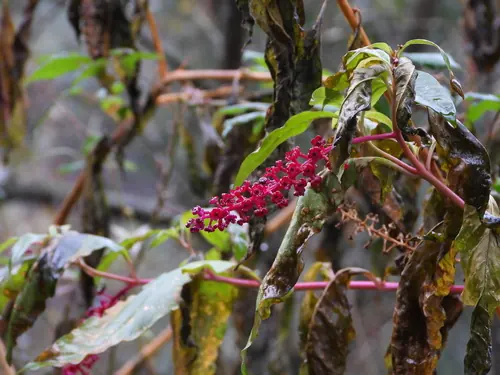
A perennial in the pokeweed family. The small berry-like fruits are not grapes. The French name raisin d’Amérique must not be read as a food recommendation.
Also known as: No synonyms listed.
The small berry-like fruits are not grapes. The French name raisin d’Amérique must not be read as a food recommendation. A photograph alone cannot validate identification for consumption.
An illustration is not enough to identify a plant for consumption. Do not forage for a species based solely on this profile.
Uses & evidence
UNDERSTANDING THE USES
Properties & uses.
Why this plant appears in the guide
ANSM lists Phytolacca americana for the following part: fruit. List B covers plants whose potential adverse effects outweigh the expected therapeutic benefit. Listing documents a tradition and a warning, not an indication to try.
The references do not establish a benefit. Lack of evidence is not assurance of safety.
Read the sourceThe whole plant is involved
NC State classifies pokeweed’s different parts as poisonous and also identifies contact risk. Its berries must not be treated as an edible fruit.
This entry describes a risk or interaction, not a beneficial property.
Read the sourceThe traditional uses described are not clinical proof of effectiveness. Evidence for one preparation cannot automatically be applied to another.
Precautions before use
BEFORE ANY USE
Precautions & contraindications.
This guidance does not cover every individual situation. Missing information is not a guarantee of safety.
The following warnings do not constitute a complete review of interactions or contraindications. An unstudied combination cannot be considered compatible.
Contraindications & precautions
- Do not self-medicate with this List B herbal material. A historical indication is not equivalent to a medically assessed contraindication profile for every preparation.
Medicine interactions
- The reviewed references do not define a complete interaction profile. Do not add this plant to treatment on the assumption of compatibility; a pharmacist must assess it.
“Reported” does not prove causality; “possible” may reflect indirect evidence. “None reported” means none in the cited source, not that all combinations have been studied. Do not stop a prescribed treatment based on this profile.
Adverse effects
- Vomiting and diarrhoea; skin irritation can occur on contact.
Pregnancy & breastfeeding
No self-directed use during pregnancy or breastfeeding. The sources in this entry do not establish a safe formulation or dose for these situations.
Children & adolescents
No paediatric use is proposed. Keep this plant material and related products out of children’s reach; never taste the plant to identify it.
If symptoms persist, worsen or are unusual, consult a healthcare professional. In an emergency, contact the emergency services.
Available evidence
EXPLORE THE EVIDENCE
The available evidence.
NC State classifies pokeweed’s different parts as poisonous and also identifies contact risk. Its berries must not be treated as an edible fruit.
The whole plant is involved
The source provides toxicity and handling warnings, not a justification for therapeutic preparation. Historical food use does not guarantee the safety of a harvested plant.
This entry describes a risk or interaction, not a beneficial property.
Read the referenceLimitations to keep in mind.
Wear gloves for necessary handling and prevent children from picking the berries as if they were grapes.
Studies, findings & limitations
THE RESEARCH
What the research shows.
A laboratory or animal result alone does not demonstrate a benefit in humans. Each result must be read alongside the preparation studied and its limitations.
Safety assessment: Phytolacca americana
This entry describes a risk or interaction, not a beneficial property.
- Type of research
- Institutional descriptive toxicity entry; this is not an efficacy trial.
- Preparation concerned
- Plant material and exposure-relevant parts described by the source; no preparation proposed.
- Observed results
- NC State classifies pokeweed’s different parts as poisonous and also identifies contact risk. Its berries must not be treated as an edible fruit.
- Limitations to consider
- The reference describes a hazard, not a predictable frequency for every person or a safe dose. The “insufficient evidence” label concerns therapeutic use; it does not minimise the reported toxicity.
What can we take from this?
The reference describes a hazard, not a predictable frequency for every person or a safe dose. The “insufficient evidence” label concerns therapeutic use; it does not minimise the reported toxicity.
Documentary review dated 09/10/2026. The references remain available to check the context.
Sources & last review
CHECKING REFERENCES
Sources for this profile.
- ANSM — French Pharmacopoeia, List B, January 2026, page 10Accessed on 09/10/2026
- Kew POWO — Phytolacca americana L.Accessed on 09/10/2026
- NC State Extension — Phytolacca americanaAccessed on 09/10/2026
Image: Duarte Frade · CC BY 4.0. View the original image and its licence. Image resized and converted to WebP.