BOTANICAL IDENTITY
The right name is the first step.
Also known as: No synonyms listed.
The botanical name, part and preparation must match. A photograph is not enough for identification intended for consumption.
An illustration is not enough to identify a plant for consumption. Do not forage for a species based solely on this profile.
01 · UNDERSTAND
Properties & uses.
Fatigue and feelings of weakness
Traditional use; persistent fatigue should be investigated, not masked with a stimulant.
Read the sourceThe traditional uses described are not clinical proof of effectiveness. Evidence for one preparation cannot automatically be applied to another.
02 · UNDERSTAND THE ACTION
How does the plant act?
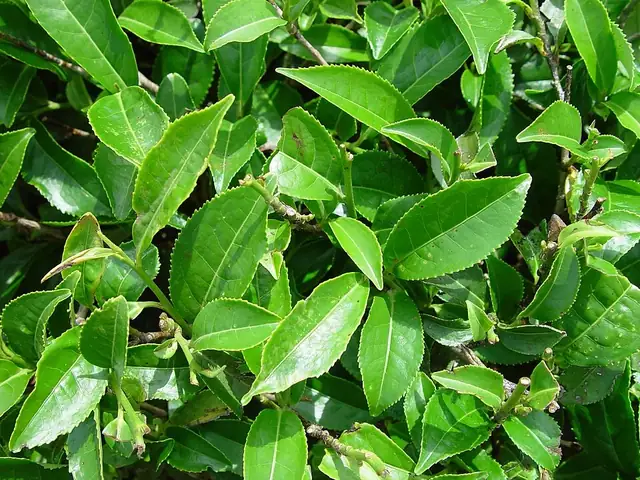
The medicinal green tea documented here is the unfermented leaf. Its traditional use against fatigue and a feeling of weakness is consistent with its caffeine content. Catechins, often highlighted, are another area of research. Antioxidant activity measured in the laboratory proves neither lasting weight loss nor general disease prevention; concentrated extracts also raise specific safety issues.
Constituents to know.
Their presence and quantity depend on the plant part and preparation.
- Caffeine
- It contributes to the stimulant effect and must be considered together with all sources consumed during the day.Read the reference
- Catechins, including EGCG
- Their concentration depends on the preparation. An enriched capsule does not have the profile of a leaf infusion.Read the reference
Stimulation and fatigue
Caffeine's pharmacology makes the traditional use plausible; masking fatigue does not determine its cause.
Read the referenceWeight: modest and inconsistent results
The report considers the effect of the extracts studied on weight loss to be small or negligible, with no demonstrated lasting benefit.
Read the referenceWhat this means for preparation.
Identifying caffeine and the type of extract is more useful than an “antioxidant” promise. Palpitations or insomnia show that the stimulant effect can also become undesirable.
03 · EXAMINE THE EVIDENCE
What the research shows.
A laboratory or animal result alone does not demonstrate a benefit in humans. Each result must be read alongside the preparation studied and its limitations.
Why distinguish leaf from extract
- Type of research
- EMA report and safety data on green tea.
- Preparation concerned
- Leaf, powder and extracts of varying composition.
- Observed results
- Liver injury has been associated with certain concentrated extracts; the data do not apply uniformly to all forms.
- Limitations to consider
- Concentration, formulation and context of use prevent products from being compared by weight alone.
What can we take from this?
No clinical “detox,” anticancer or anti-aging property follows from experiments on catechins. Habitual dietary consumption does not establish the safety of a concentrated extract.
Documentary review dated 09/10/2026. The references remain available to check the context.
04 · CHOOSE A PREPARATION
One plant, several preparations.
Only forms documented in this profile’s sources are presented.
InfusionUnfermented leaves · Route: oral
Dried leaves, whole or fragmented.
Please note: Check the preparation and its leaflet; concentrations are not interchangeable.
Read the sourcePowderUnfermented leaves · Route: oral
Solid form made from powdered leaf.
Please note: Do not confuse with a concentrated catechin extract.
Read the source05 · BEFORE ANY USE
Precautions & contraindications.
This guidance does not cover every individual situation. Missing information is not a guarantee of safety.
Contraindications
- Supplements: peptic ulcer, hypertension, arrhythmia or hyperthyroidism.
Medicine interactions
- Caffeine may counteract sedatives and increase the adverse effects of sympathomimetics.
Adverse effects
- This entry does not provide an exhaustive list of adverse effects.
Pregnancy & breastfeeding
Medicinal use is not recommended during pregnancy and breastfeeding due to insufficient data.
Children & adolescents
The medicinal use in the monograph is for adults only.
If symptoms persist, worsen or are unusual, consult a healthcare professional. In an emergency, contact the emergency services.
06 · PUTTING KNOWLEDGE INTO PRACTICE
Preparations & recipes.
No home recipe is provided in this profile. For an appropriate preparation, refer to the product leaflet and ask your pharmacist for advice.
07 · CHECK THE SOURCES
Sources for this profile.
- EMA — Camelliae sinensis non fermentatum folium: official dossierAccessed on 09/10/2026
- EMA — monograph or public statement on Camellia sinensisAccessed on 09/10/2026
- ANSES — precautions for plants in food supplements, June 2023 summaryAccessed on 09/10/2026
- EMA — Assessment report on Camellia sinensis (L.) Kuntze (unfermented leaves)Accessed on 09/10/2026
Illustration: AxelBoldt at en.wikipedia · Public domain. View the original image and its licence. Image resized and converted to WebP.
A TOUCH OF SOLÉA
Myriam’s tip
Myriam is reviewing the tip for this profile.
Myriam