BOTANICAL IDENTITY
The right name is the first step.
Also known as: No synonyms listed.
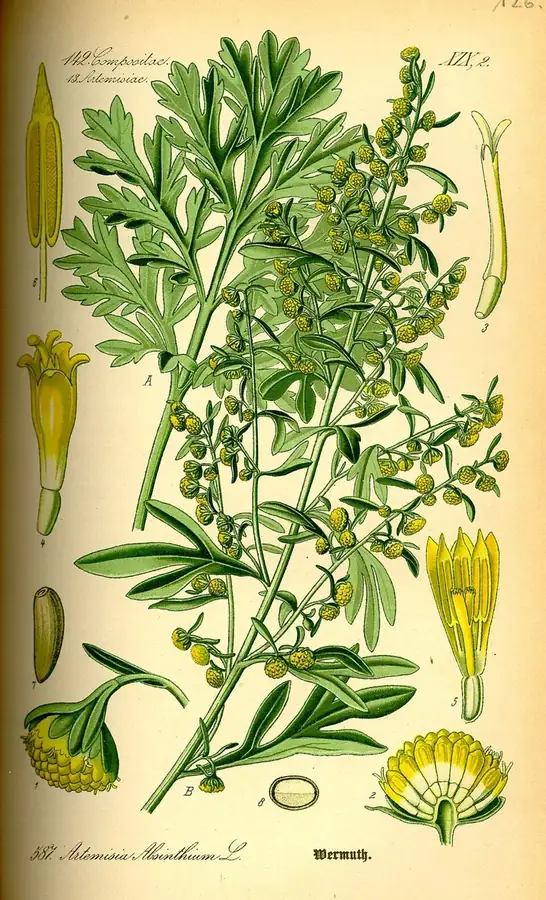
The botanical name, part and preparation must match. A photograph is not enough for identification intended for consumption.
An illustration is not enough to identify a plant for consumption. Do not forage for a species based solely on this profile.
01 · UNDERSTAND
Properties & uses.
Appetite and digestive discomfort
Traditional uses for temporary loss of appetite or mild digestive complaints.
Read the sourceThe traditional uses described are not clinical proof of effectiveness. Evidence for one preparation cannot automatically be applied to another.
02 · UNDERSTAND THE ACTION
How does the plant act?
Wormwood combines strong bitterness with traditional uses for appetite and mild digestive problems. Pharmacological studies describe stimulation of digestive secretions, among other effects, but the clinical consistency is insufficient for well-established use. Composition must be controlled: some aromatic constituents raise a safety issue separate from the intended digestive effect.
Constituents to know.
Their presence and quantity depend on the plant part and preparation.
- Bitter lactones
- Absinthin and other lactones contribute to bitterness; this sensory marker cannot measure an active or safe dose.Read the reference
- Thujone
- Its content depends on the material and extraction. At high exposure, it can cause neurological toxicity, including seizures.Read the reference
Appetite and digestive secretions
Animal data on gastric, intestinal and biliary secretions make digestive use plausible; they do not prove a benefit in every digestive disease.
Read the referenceTraditional digestive use
Temporary loss of appetite and certain mild discomforts are the recognized scope, not treatment of an ulcer or inflammatory disease.
Read the referenceWhat this means for preparation.
Distinguish between herbal tea, extract, alcoholic beverage and essential oil: their composition differs greatly. Thujone content cannot be judged by smell or bitterness.
03 · EXAMINE THE EVIDENCE
What the research shows.
A laboratory or animal result alone does not demonstrate a benefit in humans. Each result must be read alongside the preparation studied and its limitations.
Clinical benefit and toxicology considered separately
- Type of research
- EMA pharmacological and clinical assessment report.
- Preparation concerned
- Artemisia absinthium herb and defined preparations.
- Observed results
- Taken together, the evidence supports a traditional monograph without a sufficiently confirmed clinical mechanism.
- Limitations to consider
- Experiments at high doses or with different extracts do not allow a home preparation to be chosen.
What can we take from this?
Experimental digestive activity does not negate liver and biliary precautions. Essential oils and homemade concentrates are not equivalent alternatives.
Documentary review dated 09/10/2026. The references remain available to check the context.
04 · CHOOSE A PREPARATION
One plant, several preparations.
Only forms documented in this profile’s sources are presented.
InfusionLeaves and flowering tops · Route: oral
Comminuted herb in an identified product.
Please note: Do not improvise harvesting or concentrated preparations.
Read the sourceTinctureLeaves and flowering tops · Route: oral
05 · BEFORE ANY USE
Precautions & contraindications.
This guidance does not cover every individual situation. Missing information is not a guarantee of safety.
Contraindications
- Allergy to Asteraceae.
- Liver or biliary disease: do not use.
Medicine interactions
- Interactions are not detailed here: have a pharmacist check treatments and the preparation.
Adverse effects
- This entry does not provide an exhaustive list of adverse effects.
Pregnancy & breastfeeding
ANSES contraindicates the supplements concerned during pregnancy and breastfeeding.
Children & adolescents
For adults only.
If symptoms persist, worsen or are unusual, consult a healthcare professional. In an emergency, contact the emergency services.
06 · PUTTING KNOWLEDGE INTO PRACTICE
Preparations & recipes.
No home recipe is provided in this profile. For an appropriate preparation, refer to the product leaflet and ask your pharmacist for advice.
07 · CHECK THE SOURCES
Sources for this profile.
- EMA — Absinthii herba: official dossierAccessed on 09/10/2026
- ANSES — precautions for plants in food supplements, June 2023 summaryAccessed on 09/10/2026
- EMA — assessment report on Artemisia absinthium L. (Leaves and flowering tops)Accessed on 09/10/2026
Illustration: Prof. Dr. Otto Wilhelm Thomé Flora von Deutschland, Österreich und der Schweiz 1885, Gera, Germany · Public domain. View the original image and its licence. Image resized and converted to WebP.
A TOUCH OF SOLÉA
Myriam’s tip
Myriam is reviewing the tip for this profile.
Myriam