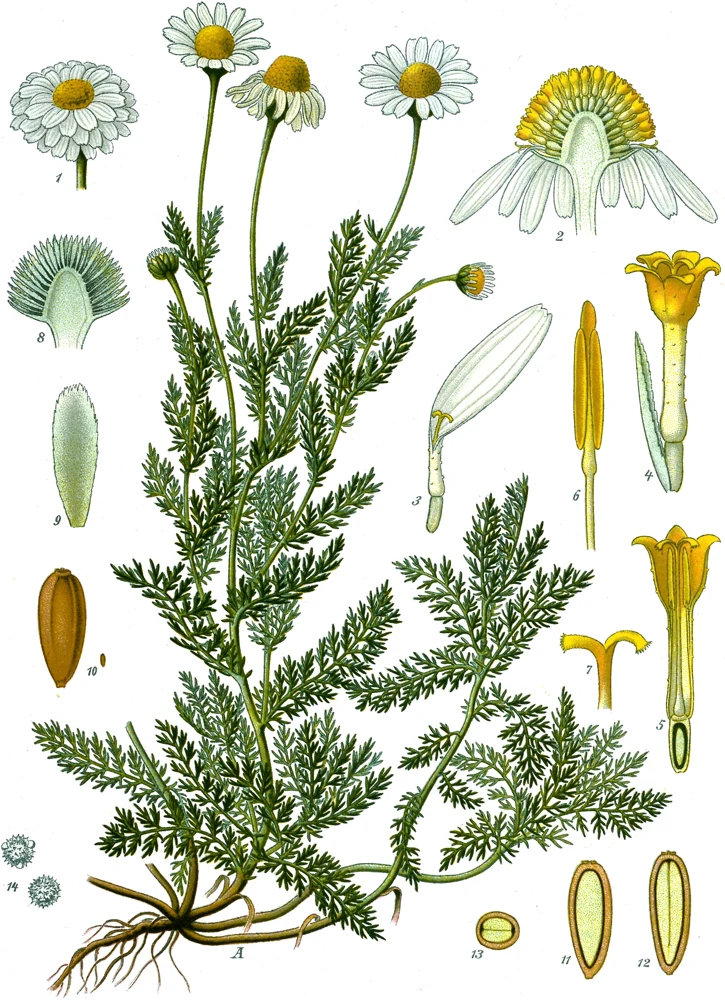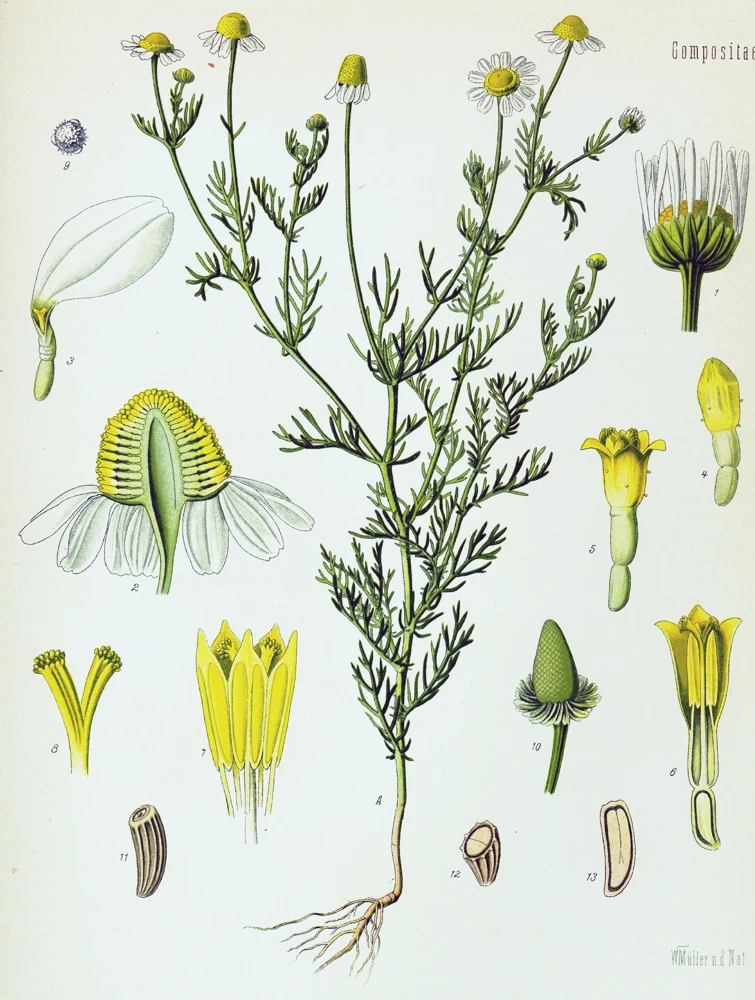
BOTANICAL IDENTITY
The right name is the first step.
Also known as: German chamomile, German chamomile, Matricaria chamomilla L.
Do not confuse with Chamaemelum nobile or feverfew. The word “chamomile” alone is not enough to select a profile.
An illustration is not enough to identify a plant for consumption. Do not forage for a species based solely on this profile.
01 · UNDERSTAND
Properties & uses.
Digestive comfort
Traditional use for bloating and minor digestive spasms; insufficient clinical evidence to conclude that efficacy has been demonstrated.
Read the sourceMinor skin irritations
Traditional use of suitable preparations for minor inflammation and superficial wounds.
Read the sourceThe traditional uses described are not clinical proof of effectiveness. Evidence for one preparation cannot automatically be applied to another.
02 · UNDERSTAND THE ACTION
How does the plant act?
German chamomile has several patterns of use: the flowers in oral preparations for minor digestive problems, and certain local preparations for mucous membranes or skin. These traditional uses must be distinguished from trials of concentrated extracts for anxiety. The plant contains water-soluble compounds and an aromatic fraction; their distribution varies with extraction. A result obtained with a pharmaceutical extract therefore does not necessarily describe a cup of infusion.
Constituents to know.
Their presence and quantity depend on the plant part and preparation.
- Flavonoids, including apigenin derivatives
- The flower heads contain, among other compounds, apigenin and its glucoside, as well as luteolin derivatives. An infusion extracts water-soluble compounds, without reproducing the profile of an essential oil.Read the reference
- Bisabolol, bisabolol oxides and chamazulene precursors
- The aromatic composition depends on the plant material. Some proazulenes, particularly matricin, turn into chamazulene during distillation: the distilled oil differs from the original flowers.Read the reference
Digestive comfort: mild spasms and bloating
Oral use of the flowers is a traditional use for minor digestive complaints involving spasms and bloating. This status does not demonstrate efficacy for inflammatory digestive disease or a diagnosed bowel syndrome.
Read the referenceLocal soothing of the skin and mucous membranes
Some preparations are traditionally used for minor skin inflammation, superficial wounds or irritation of the mouth. Local use, concentration and contraindications depend on the preparation.
Read the referenceModulation of inflammatory mediators
Cell experiments suggest that constituents may act on prostaglandins, leukotrienes or immune cell adhesion. These are experimental mechanisms; they do not prove that an infusion has a general anti-inflammatory effect in humans.
Read the referenceSleep: distinguishing reputation from evidence
The NCCIH considers information on insomnia very limited. A feeling of relaxation or the ritual use of a hot drink is not enough to demonstrate a therapeutic effect on a sleep disorder.
Read the referenceWhat this means for preparation.
Check the botanical name, the part used and the type of extract. For someone taking medication, reports of interactions, particularly with warfarin or medicines metabolized by the liver, warrant checking with a pharmacist. An herbal tea and a concentrated extract are not interchangeable.
03 · EXAMINE THE EVIDENCE
What the research shows.
A laboratory or animal result alone does not demonstrate a benefit in humans. Each result must be read alongside the preparation studied and its limitations.
Generalized anxiety: 2016 continuation trial
- Type of research
- After a 12-week open-label phase, 93 people who had responded to treatment were allocated to extract or placebo for 26 weeks.
- Preparation concerned
- Pharmaceutical-quality oral German chamomile extract; this protocol did not involve a herbal tea.
- Observed results
- Relapses occurred in 7 of 46 people receiving the extract and 12 of 47 receiving placebo. The difference in the primary outcome was not statistically significant (p = 0.16). Some secondary symptom scores favored the extract.
- Limitations to consider
- The prior selection of responders limits generalizability. The primary result does not demonstrate relapse prevention; secondary outcomes are exploratory.
An overview of the human evidence
- Type of research
- NCCIH public summary, updated in November 2024.
- Preparation concerned
- German chamomile alone or products containing it; preparations varied between studies.
- Observed results
- Preliminary findings exist for anxiety and certain oral applications. Overall evidence remains insufficient to establish many claimed uses.
- Limitations to consider
- Trials combining several plants do not allow their results to be attributed to German chamomile alone. These findings do not automatically apply to Roman chamomile.
What can we take from this?
Clinical evidence on anxiety remains limited. Traditional digestive use and cellular mechanisms cannot predict an individual response or establish an effect on all forms of anxiety or insomnia.
Documentary review dated 09/10/2026. The references remain available to check the context.
04 · CHOOSE A PREPARATION
One plant, several preparations.
Only forms documented in this profile’s sources are presented.
InfusionFlower heads · Route: oral
Fragmented flowers infused for digestive comfort.
Please note: Extracts are not dosed in the same way as an infusion.
Read the sourceExternal preparationFlower heads · Route: topical
Infusion or a preparation formulated for documented skin uses.
Please note: Do not bathe open wounds, extensive lesions, acute skin disease, or in cases of high fever or serious infection.
Read the sourceMouthwashFlower heads · Route: mouth
Preparation suitable for minor inflammation in the mouth.
Please note: Risk of an allergic reaction, sometimes severe.
Read the source05 · BEFORE ANY USE
Precautions & contraindications.
This guidance does not cover every individual situation. Missing information is not a guarantee of safety.
Contraindications
- Allergy to German chamomile or other Asteraceae.
- Full baths are also contraindicated in severe circulatory disorders or heart failure.
Medicine interactions
- Oral use: CYP450-related interactions reported after kidney transplantation with prolonged high intake. Advice from the prescriber is essential.
Adverse effects
- Allergic reactions, sometimes severe, following contact with mucous membranes; frequency unknown.
Pregnancy & breastfeeding
The EMA distinguishes the comminuted flower, whose safety is established, from extracts, which are not recommended due to a lack of data. Before breastfeeding, remove any topical product from the nipples. Have the exact preparation checked.
Children & adolescents
Approved ages vary considerably by preparation and route. For children, have a professional check the product; do not extrapolate from an adult dose.
If symptoms persist, worsen or are unusual, consult a healthcare professional. In an emergency, contact the emergency services.
06 · PUTTING KNOWLEDGE INTO PRACTICE
Preparations & recipes.
A DOCUMENTED PREPARATION
Matricaria infusion — digestive reference
Traditional use for bloating and mild digestive spasms. Robust clinical trials have not established the efficacy of this infusion.
Plant part: Dried flower heads
Ingredients & quantities
- 1.5–4 g dried flower heads of identified Matricaria recutita L., supplied for herbal tea
- 150 ml boiling drinking water
Preparation steps
- Weigh the matricaria; do not substitute another chamomile species or an extract.
- Pour the 150 ml boiling water over the flower heads.
- Steep for 5–15 minutes: the EMA glossary’s general method, as the monograph gives no plant-specific time. Follow the tea’s leaflet first.
- Strain, then allow to cool to a comfortable temperature before use.
Use: For adults aged 18+ in this collection. Monograph reference: one preparation per dose, 3–4 doses daily. Seek advice if symptoms last over one week, worsen or are substantial.
Storage: Prepare immediately before use (EMA glossary). The monograph establishes no storage period; do not prepare a stock batch.
Before you start. Contraindicated with matricaria or Asteraceae allergy; severe reactions are possible. Ask a pharmacist after transplantation or if taking medicines: interactions have been reported with high, prolonged intake after kidney transplantation. EMA considers pregnancy/breastfeeding safety established for the plain herb, unlike several extracts; nevertheless seek individual advice before regular medicinal use.
A DOCUMENTED PREPARATION
Matricaria mouth rinse
A traditional mouth preparation for minor oral irritation. This rinse does not treat a dental infection.
Plant part: Dried flower heads
Ingredients & quantities
- 1–5 g quality-controlled dried Matricaria recutita L. flower heads
- 100 ml boiling drinking water
Preparation steps
- Weigh the flower heads and pour over the 100 ml boiling water.
- Steep for 5–15 minutes: the EMA glossary’s general method, as the monograph gives no plant-specific time. Follow the tea’s leaflet first.
- Strain, then allow to cool to a comfortable temperature before use.
- Rinse the mouth with the lukewarm preparation, then spit out.
Use: Adults aged 18+. The monograph specifies several rinses daily, with no exact number or contact time. Seek advice if irritation lasts over one week or worsens.
Storage: Prepare immediately before use (EMA glossary). The monograph establishes no storage period; do not prepare a stock batch.
Before you start. Do not swallow this rinse or use it in the eyes. Contraindicated with Asteraceae allergy. Severe allergic reactions following mucosal contact have been reported: stop and seek urgent help for swelling or breathing difficulty. For pregnancy/breastfeeding, EMA distinguishes the plain herb favourably from extracts; individual advice is still appropriate.
A DOCUMENTED PREPARATION
Matricaria compress for intact skin
Traditional use for minor skin inflammation, including mild sun-related redness. This non-sterile preparation is limited here to intact skin.
Plant part: Dried flower heads
Ingredients & quantities
- 3–10 g quality-controlled, dried Matricaria recutita L. flower heads
- 100 ml boiling drinking water
- A clean, single-use compress
Preparation steps
- Pour the 100 ml boiling water over the weighed flower heads.
- Steep for 5–15 minutes: the EMA glossary’s general method where the monograph gives no duration. Follow the product leaflet first.
- Strain carefully and allow to cool to a comfortable temperature before use.
- Soak the compress, then apply to the small area of intact skin.
Use: Adults aged 18+. EMA reference: several applications daily, with no precise number or contact time stated. Seek advice if symptoms persist over one week or worsen. Blistering or extensive burns need appropriate care.
Storage: Prepare immediately before use. The monograph establishes no storage period for this water-based preparation; do not make a stock batch.
Before you start. Contraindicated with Asteraceae allergy; severe reactions are possible. Do not apply to the eyes, wounds or infected skin. EMA considers pregnancy/breastfeeding safety established for the plain herb, without extending this to extracts; seek individual advice.
A DOCUMENTED PREPARATION
Matricaria — digestive infusion, ages 6–11
Traditional use for bloating and mild digestive spasms. This is neither a treatment for unexplained abdominal pain nor a recipe to make a child sleep.
EMA/HMPC/55843/2011, section 4.2: the source labels the band “6–12 years”, 1.5–3 g per dose. This chapter applies it to ages 6–11; at age 12, confirm the leaflet’s age band with the pharmacist.
Read the complete children’s chapterPlant part: Dried flower heads
Ingredients & quantities
- 1.5–3 g dried Matricaria recutita L. flower heads (German chamomile)
- 150 ml boiling drinking water
Preparation steps
- An adult checks the botanical name, plant part and leaflet of a pharmaceutical-quality product, then weighs the amount agreed with the professional.
- Pour boiling water over the herb in a heatproof cup, out of the child’s reach.
- Steep for 5–15 minutes unless the leaflet specifies otherwise: this is the EMA glossary’s general method, not a species-specific time.
- Strain carefully and allow to cool; an adult checks the temperature before offering the preparation.
Use: EMA paediatric-band reference: one preparation, 2–4 times daily. Ask the pharmacist to specify the appropriate frequency. Consult if symptoms exceed one week, worsen or recur; seek earlier advice for significant pain.
Storage: Prepare immediately before use. This source establishes no household shelf life; discard any remainder and do not prepare a stock batch.
Before you start. Before medicinal use in a child, ask a pharmacist or doctor to confirm the product and dose. Contraindicated with matricaria or Asteraceae allergy; severe allergic reactions are possible. Medical advice is essential with medicines or after transplantation: interactions were reported after high, prolonged use following kidney transplantation. This protocol does not apply to Roman chamomile, mouthwashes or essential oil.
07 · CHECK THE SOURCES
Sources for this profile.
- EMA — Matricaria recutita L.: summary and documentsAccessed on 08/10/2026
- EMA — Matricaria — digestive infusion, ages 6–11: paediatric sourceAccessed on 09/10/2026
- Royal Botanic Gardens, Kew — botanical identityAccessed on 08/10/2026
- EMA — Assessment report on Matricaria recutita L., flos and Matricaria recutita L., aetheroleumAccessed on 09/10/2026
- NCCIH — Chamomile: Usefulness and SafetyAccessed on 09/10/2026
- Mao et al. (2016) — Long-term chamomile (Matricaria chamomilla L.) treatment for generalized anxiety disorder: A randomized clinical trialAccessed on 09/10/2026
- EMA — Glossary on herbal teas: general preparation method, §4Accessed on 09/10/2026
Illustration: Franz Eugen Köhler, Köhler’s Medizinal-Pflanzen · Public domain (Public Domain Mark 1.0). View the original image and its licence. Image resized and converted to WebP.
A TOUCH OF SOLÉA
Myriam’s tip
Myriam is reviewing the tip for this profile.
Myriam