BOTANICAL IDENTITY
The right name is the first step.
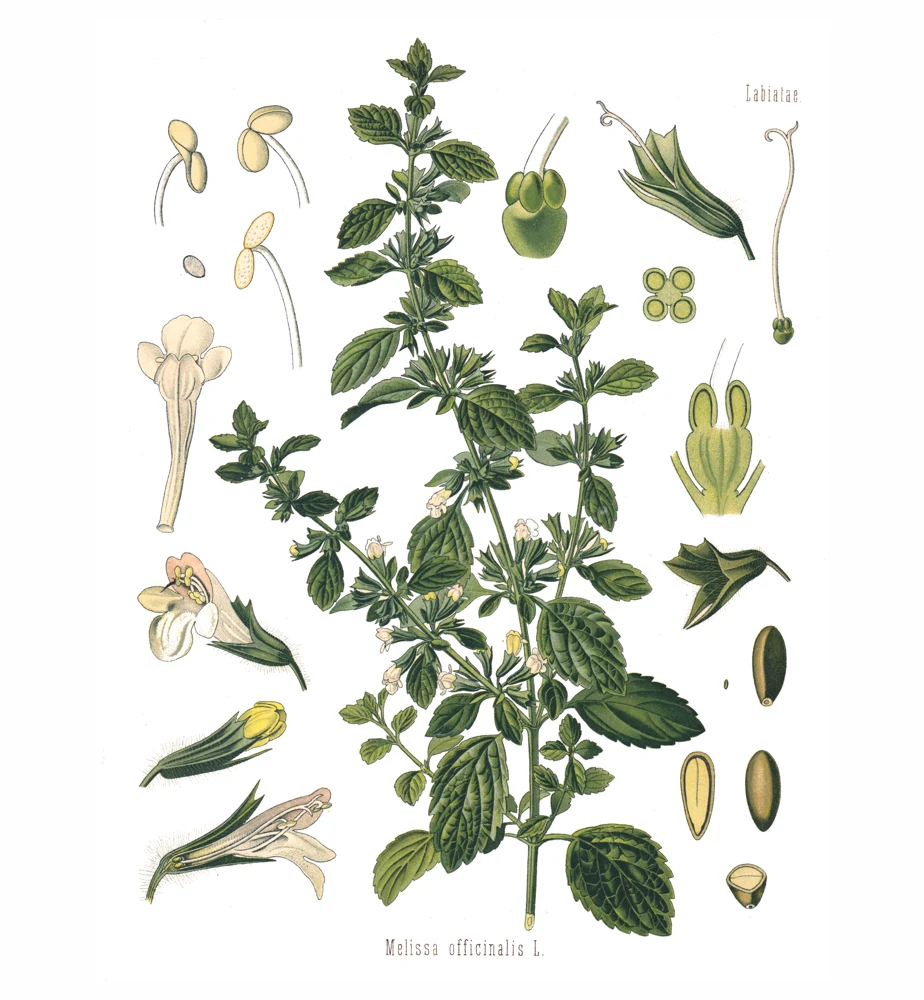
Also known as: lemon balm, lemon balm
The French name “citronnelle” also refers to other plants: check for Melissa officinalis on the label.
An illustration is not enough to identify a plant for consumption. Do not forage for a species based solely on this profile.
01 · UNDERSTAND
Properties & uses.
Relaxation and sleep
Traditional use for mild symptoms of stress and to aid sleep; clinical evidence remains insufficient.
Read the sourceDigestive comfort
Traditional use for mild digestive disorders, particularly bloating and flatulence.
Read the sourceThe traditional uses described are not clinical proof of effectiveness. Evidence for one preparation cannot automatically be applied to another.
02 · UNDERSTAND THE ACTION
How does the plant act?
Lemon balm traditionally combines two uses: soothing mild symptoms of stress and supporting digestive comfort. Its leaves contain polyphenols and a small aromatic fraction. Studies explore pathways involved in neurotransmission, but do not demonstrate the action of a herbal tea on the human brain. A few clinical experiments with extracts mainly provide information on short-term effects under controlled conditions; they are insufficient to establish a treatment for chronic anxiety.
Constituents to know.
Their presence and quantity depend on the plant part and preparation.
- Rosmarinic acid and other phenolic acids
- Rosmarinic, caffeic and chlorogenic acids are part of the leaf's profile. The presence of a characteristic compound helps describe an extract; it does not, by itself, constitute evidence of efficacy.Read the reference
- Aromatic compounds and triterpenes
- The volatile fraction includes citral, neral and citronellal. Ursolic and oleanolic acids belong to another family, the triterpenes. Extraction selects these constituents differently.Read the reference
Mild stress and sleep support
The leaf has a traditional use for mild symptoms of stress and to aid sleep. This recognition does not demonstrate that it addresses every cause of insomnia or has an effect comparable to an anxiolytic medicine.
Read the referenceBloating and gas
Traditional digestive use addresses minor complaints, including bloating and flatulence. It does not prove that lemon balm treats an underlying digestive condition or that its mechanism necessarily involves an effect on stress.
Read the referenceThe GABA pathway: an experimental hypothesis
In an enzyme model, some constituents inhibit GABA transaminase, an enzyme involved in the breakdown of GABA. This observation demonstrates neither an increase in brain GABA after an infusion nor a clinical sedative effect of the same intensity.
Read the referenceWhat this means for preparation.
Checking the plant part and extraction solvent helps clarify what was actually studied. A lemon balm–valerian combination does not provide information about lemon balm alone. Reduced alertness remains relevant to driving; also check restrictions relating to age and pregnancy.
03 · EXAMINE THE EVIDENCE
What the research shows.
A laboratory or animal result alone does not demonstrate a benefit in humans. Each result must be read alongside the preparation studied and its limitations.
Laboratory-induced stress: 2004 trial
- Type of research
- Randomized double-blind crossover trial in 18 healthy volunteers. Measurements were taken one hour after a single dose.
- Preparation concerned
- Standardized Melissa officinalis extract, at two dose levels, compared with placebo.
- Observed results
- The higher amount improved feelings of calm but reduced alertness. The other condition improved the speed of certain calculations, illustrating effects dependent on the product and exposure.
- Limitations to consider
- A small acute trial in volunteers does not demonstrate treatment of an anxiety disorder or persistent insomnia. The results do not apply to all herbal teas or all commercial formulations.
Identification of constituents in a bioassay
- Type of research
- Fractionation guided by an in vitro assay published in 2009, using a measurement of rat brain GABA transaminase.
- Preparation concerned
- Methanolic lemon balm extract and fractions containing, among other compounds, rosmarinic acid, ursolic acid and oleanolic acid.
- Observed results
- These three constituents were identified as contributors to the activity; rosmarinic acid accounted for a substantial proportion of the inhibition in the extract tested.
- Limitations to consider
- Methanol is used here as a research solvent. This preparation is not a recipe, and the test measures neither sleep nor anxiety in a patient.
What can we take from this?
The neurochemical hypotheses are plausible, but their actual importance following a usual preparation remains uncertain. The link between digestive comfort, a feeling of calm and sleep should not be presented as a definitively demonstrated mechanism in humans.
Documentary review dated 09/10/2026. The references remain available to check the context.
04 · CHOOSE A PREPARATION
One plant, several preparations.
Only forms documented in this profile’s sources are presented.
InfusionLeaves · Route: oral
Powder and dry extractsLeaves · Route: oral
Documented solid forms, with varying concentrations.
Please note: Follow the package leaflet; not automatically equivalent to herbal tea.
Read the sourceTincture and liquid extractLeaves · Route: oral
05 · BEFORE ANY USE
Precautions & contraindications.
This guidance does not cover every individual situation. Missing information is not a guarantee of safety.
Contraindications
- Allergy to lemon balm.
Medicine interactions
- Interaction data are not available in the monograph. Have combinations with medicines checked.
Adverse effects
- No known adverse effects in the monograph; alertness may be reduced. Do not drive if affected.
Pregnancy & breastfeeding
Pregnancy and breastfeeding: medicinal use is not recommended because of insufficient data. Safety has not been established.
Children & adolescents
Under 12 years: use is not recommended due to lack of data.
If symptoms persist, worsen or are unusual, consult a healthcare professional. In an emergency, contact the emergency services.
06 · PUTTING KNOWLEDGE INTO PRACTICE
Preparations & recipes.
A DOCUMENTED PREPARATION
Lemon balm infusion — adults
Traditional use for mild stress, as a sleep aid and for minor digestive complaints. This does not establish clinical efficacy for this tea.
Plant part: Dried, cut leaves
Ingredients & quantities
- 1.5 to 4.5 g of cut leaves
- 150 ml of boiling water
Preparation steps
- Check the species and plant part on the packaging; weigh the specified quantity.
- Pour the stated volume of boiling water over the herb in a heatproof cup.
- Steep for 5–15 minutes unless the leaflet says otherwise: the general EMA glossary method; this species monograph gives no specific time.
- Strain and cool to a comfortable drinking temperature.
Use: Monograph: 1 to 3 times daily. Seek medical advice after two weeks or if symptoms worsen.
Storage: Prepare immediately before use according to the EMA glossary. No household storage period is documented in the monograph; do not prepare a batch for later use.
Before you start. This guide restricts use to adults aged 18 and over. Do not use if allergic to lemon balm. Alertness may be impaired: do not drive or operate machinery if affected. Interaction data are unavailable; have concurrent medicines reviewed. Pregnancy and breastfeeding: not recommended because safety data are insufficient. Seek advice with adverse reactions.
07 · CHECK THE SOURCES
Sources for this profile.
- EMA — Melissa officinalis L.: summary and documentsAccessed on 08/10/2026
- EMA — monograph on Melissa officinalis L.Accessed on 09/10/2026
- Royal Botanic Gardens, Kew — botanical identityAccessed on 08/10/2026
- EMA — Assessment report on Melissa officinalis L., foliumAccessed on 09/10/2026
- Awad et al. (2009) — Bioassay-guided fractionation of lemon balm (Melissa officinalis L.) using an in vitro measure of GABA transaminase activityAccessed on 09/10/2026
- Kennedy et al. (2004) — Attenuation of laboratory-induced stress in humans after acute administration of Melissa officinalis (Lemon Balm)Accessed on 09/10/2026
- EMA — Glossary on herbal teas: general preparation methodAccessed on 09/10/2026
Illustration: Köhlers Medizinalpflanzen, auteur inconnu · Public domain (Public Domain Mark 1.0). View the original image and its licence. Image resized and converted to WebP.
A TOUCH OF SOLÉA
Myriam’s tip
Myriam is reviewing the tip for this profile.
Myriam