BOTANICAL IDENTITY
The right name is the first step.
Also known as: English lavender
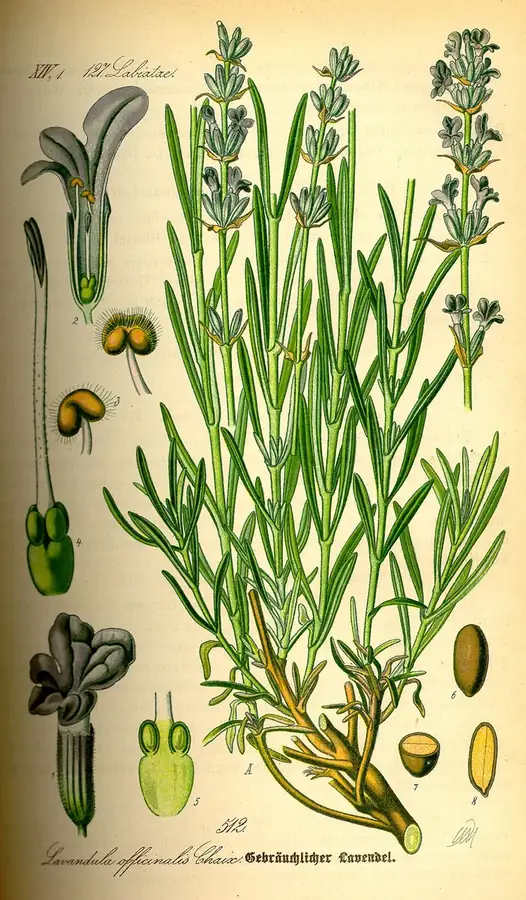
Lavandula angustifolia differs from lavandin and spike lavender.
An illustration is not enough to identify a plant for consumption. Do not forage for a species based solely on this profile.
01 · UNDERSTAND
Properties & uses.
Mild stress and sleep
Traditional use of the flowers for relaxation and to aid sleep.
Read the sourceThe traditional uses described are not clinical proof of effectiveness. Evidence for one preparation cannot automatically be applied to another.
02 · UNDERSTAND THE ACTION
How does the plant act?
For true lavender, studies concern different interventions: flowers as herbal tea, extract, an oral essential oil product, inhalation or topical application. Their results are not interchangeable. The flowers have a traditional use for mild stress and sleep. Certain oral products have been studied more extensively for anxiety, but this does not prove the same effect from a lavender scent or herbal tea.
Traditional relaxation
Flower preparations have long-standing use for mild tension and to aid sleep. Tradition does not establish a guaranteed effect on insomnia.
Read the referenceAnxiety studied with an oral product
Trials suggest a benefit of a specific lavender oil product; limitations include small samples, limited diversity and funding independence.
Read the referenceInhalation
The efficacy of aromatherapy for anxiety, stress or sleep remains uncertain; sensory pleasure alone is not therapeutic evidence.
Read the referenceWhat this means for preparation.
Look for the species and exact form. Results from a studied capsule never justify drinking an essential oil purchased for diffusion.
03 · EXAMINE THE EVIDENCE
What the research shows.
A laboratory or animal result alone does not demonstrate a benefit in humans. Each result must be read alongside the preparation studied and its limitations.
The route of use changes the interpretation
- Type of research
- NCCIH institutional summary of human research.
- Preparation concerned
- Oral Lavandula angustifolia oil products, flower preparations and aromatherapy examined separately.
- Observed results
- Encouraging results mainly concern certain oral products; other approaches remain less conclusive.
- Limitations to consider
- Data on a formulated product are not instructions for ingesting essential oil at home.
What can we take from this?
Neither treatment of depression nor improved sleep can be guaranteed through simple exposure to the scent. Pregnancy, allergies and sedative use require careful reading of the precautions.
Documentary review dated 09/10/2026. The references remain available to check the context.
04 · CHOOSE A PREPARATION
One plant, several preparations.
Only forms documented in this profile’s sources are presented.
InfusionFlowers · Route: oral
Dried flowers.
Please note: Follow the product's package leaflet; preparations are not interchangeable.
Read the sourceTinctureFlowers · Route: oral
Documented hydroalcoholic flower preparation.
Please note: Contains alcohol; follow the package leaflet without converting infusion doses.
Read the source05 · BEFORE ANY USE
Precautions & contraindications.
This guidance does not cover every individual situation. Missing information is not a guarantee of safety.
Contraindications
- Allergy to lavender.
Medicine interactions
- No established interaction is included in this entry; this does not guarantee compatibility with a treatment.
Adverse effects
- Adverse effects insufficiently documented in the sources used here.
Pregnancy & breastfeeding
Pregnancy and breastfeeding: medicinal use is not recommended because of insufficient data.
Children & adolescents
Medicinal use is not recommended under 12 years in the selected monographs.
If symptoms persist, worsen or are unusual, consult a healthcare professional. In an emergency, contact the emergency services.
06 · PUTTING KNOWLEDGE INTO PRACTICE
Preparations & recipes.
A DOCUMENTED PREPARATION
True lavender flower infusion
Traditional use for mild symptoms of stress and as an aid to sleep. Findings on particular essential-oil products cannot be transferred to this flower infusion.
Plant part: Dried flowers
Ingredients & quantities
- 1–2 g dried Lavandula angustifolia Mill. flowers, whole or fragmented
- 150 ml drinking water, brought to the boil
Preparation steps
- Check the botanical name and plant part on a product intended for herbal tea; weigh the stated quantity.
- Place the herb in a heatproof cup and pour over 150 ml boiling water.
- Steep for 5–15 minutes unless the product leaflet specifies otherwise. This is the general method in the EMA glossary; the plant monograph does not specify a particular steeping time.
- Strain, then let the infusion cool to a comfortable drinking temperature.
Use: Monograph reference: one 150 ml preparation, 3 times daily. Seek advice if symptoms persist or worsen; the monograph gives no numbered duration before this consultation.
Storage: Prepare immediately before use, as specified by the EMA glossary. The monograph does not document a household storage period; do not prepare a batch for later use.
Before you start. This guide restricts use to adults aged 18 and over. Not recommended during pregnancy or breastfeeding because safety data are insufficient. Contraindicated with allergy to lavender. Alertness may be impaired: do not drive or operate machinery if affected. Use flowers intended for herbal tea, without adding essential oil. Stop and seek advice if an adverse reaction occurs. No interactions are reported in this monograph; this does not establish compatibility with medicines. Ask a pharmacist if you take medication.
07 · CHECK THE SOURCES
Sources for this profile.
- EMA — Lavandulae flos: assessment and documentsAccessed on 09/10/2026
- EMA — Lavandulae aetheroleum: assessment and documentsAccessed on 09/10/2026
- ANSES — summary of precautions for food supplements (June 2023)Accessed on 09/10/2026
- EMA — Lavandula angustifolia Mill., flos monograph: posology and precautionsAccessed on 09/10/2026
- NCCIH — Lavender: Usefulness and SafetyAccessed on 09/10/2026
- EMA — Glossary on herbal teas, section 4: general preparation methodAccessed on 09/10/2026
Illustration: Flora von Deutschland, Österreich und der Schweiz — Otto Wilhelm Thomé (1885), via Wikimedia Commons · Public domain. View the original image and its licence. Image resized and converted to WebP.
A TOUCH OF SOLÉA
Myriam’s tip
Myriam is reviewing the tip for this profile.
Myriam