Identity & origin
BOTANICAL IDENTITY
The right name is the first step.
The monograph distinguishes medicinal preparations from simple use as a condiment.
Also known as: No synonyms listed.
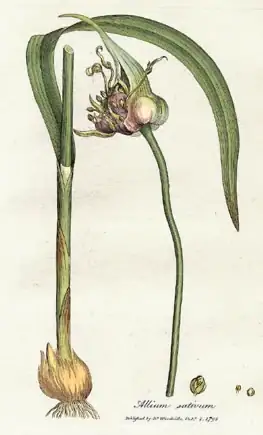
The botanical name, part and preparation must match. A photograph is not enough for identification intended for consumption.
An illustration is not enough to identify a plant for consumption. Do not forage for a species based solely on this profile.
Uses & evidence
UNDERSTANDING THE USES
Properties & uses.
Cardiovascular prevention: limited scope
Traditional adjunctive use in preventing atherosclerosis; does not replace any prescribed treatment.
Use considered plausible in a traditional-use monograph. That status alone does not demonstrate clinical efficacy.
Read the sourceThe traditional uses described are not clinical proof of effectiveness. Evidence for one preparation cannot automatically be applied to another.
Precautions before use
BEFORE ANY USE
Precautions & contraindications.
This guidance does not cover every individual situation. Missing information is not a guarantee of safety.
Contraindications & precautions
- Source-listed contraindicationAllergy to garlic.Source
- Source-listed contraindicationMedicinal preparations: concomitant saquinavir/ritonavir treatment is contraindicated.Source
- PrecautionAvoid medicinal garlic preparations in the 7 days before surgery and tell the care team because of bleeding risk.Source
Medicine interactions
- Reported interactionReduced saquinavir exposure was observed with one garlic preparation; results must not be extrapolated to every product.Source
- Possible interactionBleeding risk may increase with anticoagulants/antiplatelets; trial findings are heterogeneous. ANSES advises against combining the relevant supplements with these medicines.Source
“Reported” does not prove causality; “possible” may reflect indirect evidence. “None reported” means none in the cited source, not that all combinations have been studied. Do not stop a prescribed treatment based on this profile.
Adverse effects
- This entry does not provide an exhaustive list of adverse effects.
Pregnancy & breastfeeding
Medicinal preparations are not recommended during pregnancy/breastfeeding because data are insufficient; distinguish culinary quantities.
SourceChildren & adolescents
Cardiovascular indication: not recommended below 18 years for lack of data. Some cold preparations have a 12-year threshold; supplements covered by ANSES are adult-only.
SourceIf symptoms persist, worsen or are unusual, consult a healthcare professional. In an emergency, contact the emergency services.
Forms & how they are used
DOCUMENTED FORMS
One plant, several preparations.
Only forms documented in this profile’s sources are presented.
PowderBulb · Route: oral
Solid forms containing powdered bulb.
Please note: Check the preparation and its leaflet; concentrations are not interchangeable.
Read the sourceDefined extractsBulb · Route: oral
Oil or dry extract formulated as a medicine.
Please note: Do not extrapolate quantities of an extract to garlic used as food.
Read the sourceUnderstanding the plant’s actions
EXPLORE THE EVIDENCE
How does the plant act?
Garlic is studied for several cardiovascular parameters, but a change in cholesterol or blood pressure is not evidence of heart attack prevention. Effects depend heavily on the preparation. The HMPC recognizes traditional adjunctive use, rather than an established treatment for hypertension or hypercholesterolemia. Its effects on platelets also contribute to the attention paid to interactions.
Constituents to know.
Their presence and quantity depend on the plant part and preparation.
- Organosulfur compounds
- Alliinase converts alliin into allicin; crushing, aging and extraction alter the profile. Powder, oil and aged extract do not contain the same sets of substances.Read the reference
Cardiovascular parameters
Research concerns lipids, blood pressure, arterial stiffness and platelets. The report concludes that the data are inconsistent or insufficient for well-established use.
The references do not establish a benefit. Lack of evidence is not assurance of safety.
Read the referenceTraditional adjunctive use
Prevention of atherosclerosis falls within traditional complementary use; this must not be taken to mean any prescribed treatment can be replaced.
Use considered plausible in a traditional-use monograph. That status alone does not demonstrate clinical efficacy.
Read the referenceWhat this means for preparation.
Compare the manufacturing process and exact form, not just milligrams of “garlic.” Have concentrated products checked when taking anticoagulants, antiplatelet agents or certain antiretrovirals.
Studies, findings & limitations
THE RESEARCH
What the research shows.
A laboratory or animal result alone does not demonstrate a benefit in humans. Each result must be read alongside the preparation studied and its limitations.
A useful trial for putting promises into perspective
A human study may be positive, negative or inconclusive. Read the findings, preparation and limitations.
- Type of research
- Randomized trial cited by the EMA, 192 adults, six months.
- Preparation concerned
- Raw garlic, powder, aged extract or placebo, studied separately.
- Observed results
- None of the three forms significantly reduced LDL in this trial.
- Limitations to consider
- This result illustrates the variability across the dossier; it does not allow all preparations to be declared identical.
What can we take from this?
An experimental antiplatelet effect does not equal demonstrated antithrombotic protection. Laboratory antimicrobial properties do not justify treating an infection with garlic.
Documentary review dated 09/10/2026. The references remain available to check the context.
Sources & last review
CHECKING REFERENCES
Sources for this profile.
- EMA — Allii sativi bulbus: official dossierAccessed on 09/10/2026
- EMA — monograph or public statement on Allium sativumAccessed on 09/10/2026
- ANSES — synthèse2023 : recommandations pour compléments alimentairesAccessed on 09/10/2026
- EMA — assessment report on Allium sativum L. (Bulb)Accessed on 09/10/2026
- EMA — document officiel relu : usages et sécurité, AilAccessed on 09/10/2026
Image: Wikimedia Commons — auteur indiqué sur la page source · Public domain. View the original image and its licence. Image resized and converted to WebP.