BOTANICAL IDENTITY
The right name is the first step.
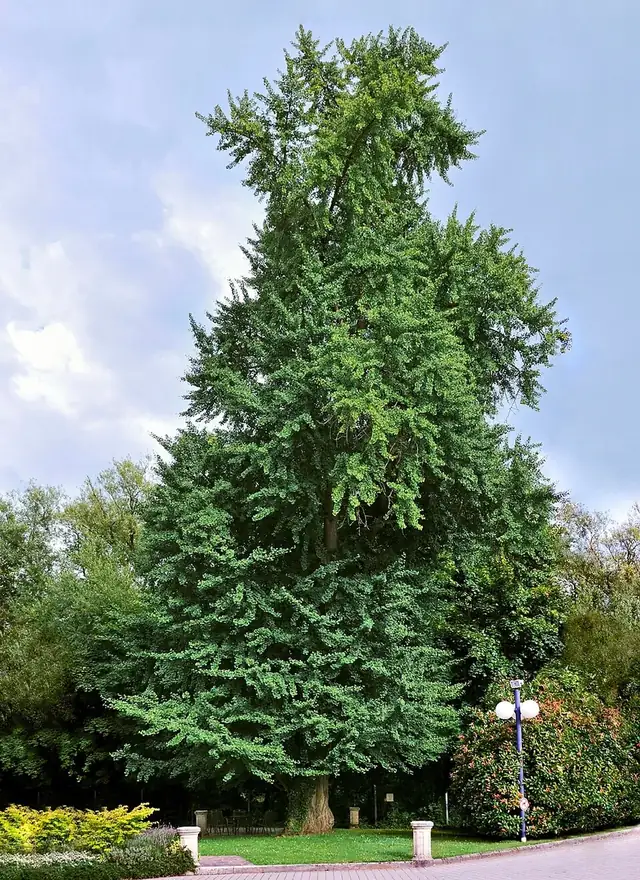
Also known as: Maidenhair tree, Maidenhair tree
Check the scientific name and the part used; a photograph is not sufficient for foraging plants intended for consumption.
An illustration is not enough to identify a plant for consumption. Do not forage for a species based solely on this profile.
01 · UNDERSTAND
Properties & uses.
Age-related cognitive disorders
Certain standardized dry extracts have well-established use in mild dementia under medical supervision; this is not a promise of improved memory for everyone.
Read the sourceHeavy legs
Traditional use of the powder for minor circulatory complaints, after medical exclusion of a serious cause.
Read the sourceThe traditional uses described are not clinical proof of effectiveness. Evidence for one preparation cannot automatically be applied to another.
02 · UNDERSTAND THE ACTION
How does the plant act?
For ginkgo, the preparation determines the level of evidence. Standardized dry extracts have well-established medicinal use for certain age-related cognitive disorders and quality of life in mild dementia. Leaf powder falls within a different, traditional framework for minor circulatory complaints. Experiments on the nervous system help formulate hypotheses, but do not justify promising Alzheimer's prevention or better memory for everyone.
Constituents to know.
Their presence and quantity depend on the plant part and preparation.
- Flavonoids and terpene lactones
- The standardized extracts studied have a controlled profile of flavonoids, ginkgolides and bilobalide; a raw leaf does not reproduce this profile.Read the reference
Cognitive functions
The benefit assessed concerns specific extracts and populations with cognitive disorders, in a medical setting; it does not transfer to a herbal tea.
Read the referenceResearch directions involving neurons and microcirculation
The report describes experimental effects on neuronal survival, free radicals and circulation. No single mechanism accounts with certainty for the benefit in humans.
Read the referenceWhat this means for preparation.
Compare the extract specification, rather than just the number of milligrams of “ginkgo”. Bleeding risk and interactions must be examined before any use, particularly around surgery.
03 · EXAMINE THE EVIDENCE
What the research shows.
A laboratory or animal result alone does not demonstrate a benefit in humans. Each result must be read alongside the preparation studied and its limitations.
Results that depend on the participants
- Type of research
- EMA assessment of trials and clinical reviews.
- Preparation concerned
- Standardized dry extracts, particularly preparations studied under the name EGb 761.
- Observed results
- The assessment supports a defined use in age-related cognitive disorders; it does not find the same effect in young subjects.
- Limitations to consider
- Heterogeneity of extracts and outcome measures; preclinical observations on amyloid do not prove prevention of dementia.
What can we take from this?
It is not possible to conclude that leaf, powder, herbal tea and extract are equivalent, or that ginkgo restores normal memory or changes the course of all dementias.
Documentary review dated 09/10/2026. The references remain available to check the context.
04 · CHOOSE A PREPARATION
One plant, several preparations.
Only forms documented in this profile’s sources are presented.
Standardized dry extractLeaves · Route: oral
Specific preparation assessed by the EMA.
Please note: Not equivalent to a homemade herbal tea.
Read the sourcePowderLeaves · Route: oral
Dried powdered leaf for traditional use.
Please note: Follow the product's package leaflet; preparations are not interchangeable.
Read the source05 · BEFORE ANY USE
Precautions & contraindications.
This guidance does not cover every individual situation. Missing information is not a guarantee of safety.
Contraindications
- Allergy to ginkgo.
- Bleeding risk, epilepsy or planned surgery: medical advice is essential.
Medicine interactions
- Anticoagulants, antiplatelet agents, dabigatran, nifedipine and efavirenz: documented interactions or precautions.
Adverse effects
- Headache, dizziness, digestive disturbances, allergies; bleeding reported.
Pregnancy & breastfeeding
Extracts are contraindicated during pregnancy; use during breastfeeding is not recommended due to lack of data. Powder: not recommended during pregnancy/breastfeeding.
Children & adolescents
For adults only in this leaflet; insufficient pediatric data.
If symptoms persist, worsen or are unusual, consult a healthcare professional. In an emergency, contact the emergency services.
06 · PUTTING KNOWLEDGE INTO PRACTICE
Preparations & recipes.
No home recipe is provided in this profile. For an appropriate preparation, refer to the product leaflet and ask your pharmacist for advice.
07 · CHECK THE SOURCES
Sources for this profile.
- EMA — Ginkgo folium: assessment and documentsAccessed on 09/10/2026
- EMA — monograph or final opinion consultedAccessed on 09/10/2026
- ANSES — summary of precautions for food supplements (June 2023)Accessed on 09/10/2026
- EMA — assessment report on Ginkgo biloba, leafAccessed on 09/10/2026
Illustration: EecherplazGinkgo06.jpg : Cayambe derivative work: Ginkgotree ( talk ) · CC BY-SA 3.0. View the original image and its licence. Image resized and converted to WebP.
A TOUCH OF SOLÉA
Myriam’s tip
Myriam is reviewing the tip for this profile.
Myriam