BOTANICAL IDENTITY
The right name is the first step.
Also known as: No synonyms listed.
Do not confuse horse chestnuts with edible chestnuts; no recipes using raw seeds.
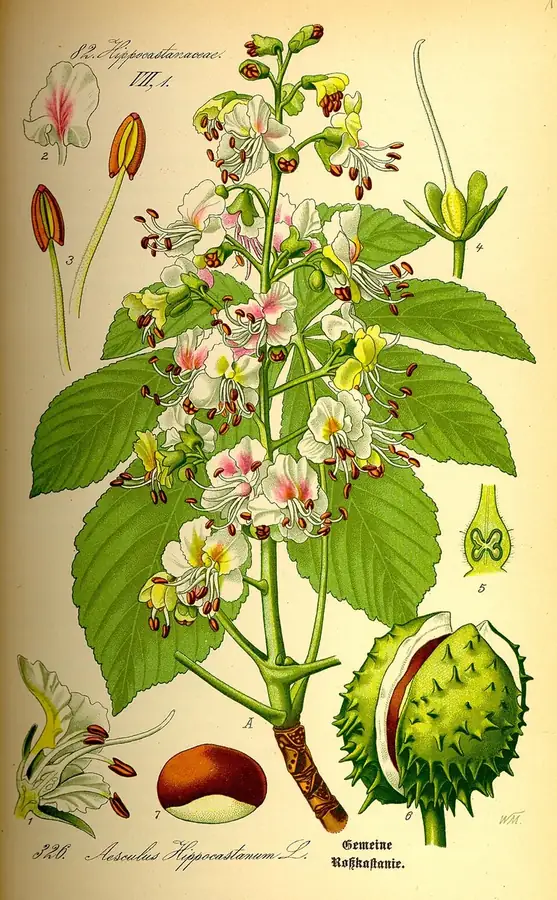
An illustration is not enough to identify a plant for consumption. Do not forage for a species based solely on this profile.
01 · UNDERSTAND
Properties & uses.
Chronic venous insufficiency
Some oral extracts have well-established use for its symptoms; this does not apply to every product.
Read the sourceHeavy legs and bruises
Traditional uses of suitable preparations for minor venous discomfort or bruises.
Read the sourceThe traditional uses described are not clinical proof of effectiveness. Evidence for one preparation cannot automatically be applied to another.
02 · UNDERSTAND THE ACTION
How does the plant act?
Seed extracts have been studied for symptoms of chronic venous insufficiency: swelling, heaviness, pain or itching in the legs. The results concern defined medicines. They validate neither the raw seed nor a bark preparation. The clinical effect is better documented than its complete molecular explanation; this plant should not be reduced to a single substance.
Constituents to know.
Their presence and quantity depend on the plant part and preparation.
- Triterpene glycosides, including aescin
- They help characterize the extracts studied. The report considers the evidence that aescin alone explains the therapeutic effect to be weak.Read the reference
Leg volume and venous symptoms
The trials reviewed report improvements in certain symptoms and leg volume with specific oral extracts.
Read the referenceCapillary filtration and venous tone
These functions are possible explanatory leads. Experiments with aescin injected into animals do not reproduce oral administration of a seed extract.
Read the referenceWhat this means for preparation.
Comparing the part used and the extract's definition matters more than a general promise of “circulation”. A suddenly painful or swollen leg requires assessment.
03 · EXAMINE THE EVIDENCE
What the research shows.
A laboratory or animal result alone does not demonstrate a benefit in humans. Each result must be read alongside the preparation studied and its limitations.
Oral extracts in venous insufficiency
- Type of research
- EMA report analysing, among other things, a review of 17 randomised trials.
- Preparation concerned
- Seed extracts administered mainly in capsules, characterized by their triterpenes.
- Observed results
- The dossier supports well-established use for this indication.
- Limitations to consider
- The data do not prove that a gel produces the same effects or that every supplement is equivalent to the medicines studied.
What can we take from this?
The results do not demonstrate prevention of thrombosis. Local uses for bruises or venous discomfort remain traditional; no recipe using horse chestnuts is proposed.
Documentary review dated 09/10/2026. The references remain available to check the context.
04 · CHOOSE A PREPARATION
One plant, several preparations.
Only forms documented in this profile’s sources are presented.
Dry extractPrepared seeds · Route: oral
Medicine containing a defined seed extract.
Please note: Check the preparation and its leaflet; concentrations are not interchangeable.
Read the sourceGel or preparation for external usePrepared seeds · Route: topical
05 · BEFORE ANY USE
Precautions & contraindications.
This guidance does not cover every individual situation. Missing information is not a guarantee of safety.
Contraindications
- Do not use in cases of known allergy to this plant.
Medicine interactions
- Interactions are not detailed here: have a pharmacist check treatments and the preparation.
Adverse effects
- Digestive disorders, headaches, dizziness and allergic reactions reported.
Pregnancy & breastfeeding
Pregnancy and breastfeeding: have the preparation checked; no self-medication is proposed here.
Children & adolescents
Oral use is restricted to adults; some topical forms for bruises also concern adolescents.
If symptoms persist, worsen or are unusual, consult a healthcare professional. In an emergency, contact the emergency services.
06 · PUTTING KNOWLEDGE INTO PRACTICE
Preparations & recipes.
No home recipe is provided in this profile. For an appropriate preparation, refer to the product leaflet and ask your pharmacist for advice.
07 · CHECK THE SOURCES
Sources for this profile.
- EMA — Hippocastani semen: official dossierAccessed on 09/10/2026
- EMA — assessment report on Aesculus hippocastanum L. (prepared seeds)Accessed on 09/10/2026
Illustration: Flora von Deutschland, Österreich und der Schweiz — Otto Wilhelm Thomé (1885), via Wikimedia Commons · Public domain. View the original image and its licence. Image resized and converted to WebP.
A TOUCH OF SOLÉA
Myriam’s tip
Myriam is reviewing the tip for this profile.
Myriam