BOTANICAL IDENTITY
The right name is the first step.
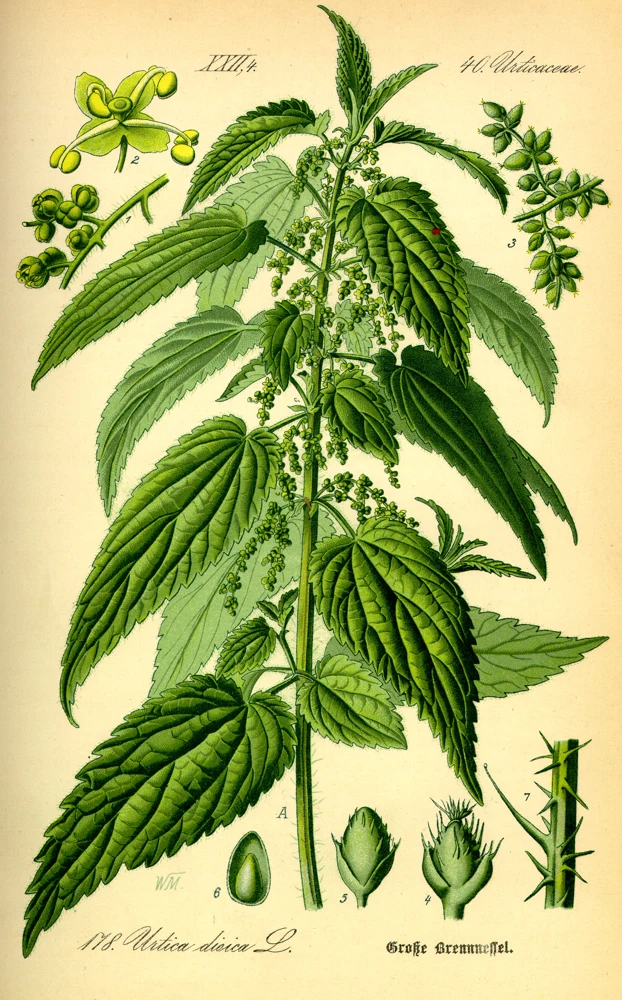
Also known as: stinging nettle, stinging nettle, nettle
Do not substitute the root for the aerial parts. The term “white dead-nettle” does not refer to the species presented here.
An illustration is not enough to identify a plant for consumption. Do not forage for a species based solely on this profile.
01 · UNDERSTAND
Properties & uses.
Joint comfort
Traditional use of the relevant preparations for minor joint pain.
Read the sourceSkin prone to seborrhea
Traditional oral use of the powder for seborrheic conditions; this is not evidence of the efficacy of a topical skincare preparation.
Read the sourceThe traditional uses described are not clinical proof of effectiveness. Evidence for one preparation cannot automatically be applied to another.
02 · UNDERSTAND THE ACTION
How does the plant act?
This profile covers the aerial parts of stinging nettle, not its root. The European monograph also covers Urtica urens and certain mixtures: its evaluation therefore does not systematically establish an isolated effect for each species. Urinary and joint uses are based mainly on tradition. A few human studies provide indications, often with combinations or without placebo. Nettle's rich chemical and mineral composition does not by itself demonstrate treatment of deficiencies or joint diseases.
Constituents to know.
Their presence and quantity depend on the plant part and preparation.
- Flavonoids and mineral constituents
- Flavonoids derived from quercetin, kaempferol and isorhamnetin accompany the minerals in the aerial parts. Their presence in the plant does not directly indicate exposure after an infusion.Read the reference
- Amines in the stinging hairs
- Histamine, acetylcholine and serotonin are described in the hairs. Irritation on contact with the fresh plant does not demonstrate a therapeutic benefit.Read the reference
Traditional increase in urine output
The use aims to increase urine output as an adjunct for minor urinary complaints. It requires sufficient fluid intake and is unsuitable when fluid restriction is recommended. It is not a proven treatment for a urinary tract infection.
Read the referenceMinor joint pain
Certain preparations of the aerial parts are traditionally used for minor joint pain in adults. This demonstrates neither cartilage repair nor an effect on the progression of rheumatoid arthritis.
Read the referenceSeborrheic skin: a specific form
The monograph also mentions traditional oral use of the powder for seborrheic skin conditions. This mention does not validate every lotion recipe or establish a treatment for seborrheic dermatitis.
Read the referenceExperimental diuresis: results depend on the route
Animal studies sometimes show increased urine output, whereas some oral experiments do not find this effect. Effects after injection or infusion cannot predict those of a herbal tea.
Read the referenceWhat this means for preparation.
The word “nettle” is insufficient: check the species, part and form. Root data do not transfer to the leaves. Fluid restriction, blood in the urine or a red, swollen joint change the situation and call for professional advice.
03 · EXAMINE THE EVIDENCE
What the research shows.
A laboratory or animal result alone does not demonstrate a benefit in humans. Each result must be read alongside the preparation studied and its limitations.
Acute arthritis: small trial with diclofenac
- Type of research
- An open-label randomised pilot trial published in 1997, involving 40 participants, of whom 37 completed the study.
- Preparation concerned
- Cooked Urtica dioica herb combined with a lower amount of diclofenac; comparison with a higher amount of diclofenac alone.
- Observed results
- Both groups showed improvements in their symptom scores. The authors proposed further study of a possible complementary effect.
- Limitations to consider
- The lack of blinding, small sample size and different treatments prevent isolation of nettle's effect. This trial does not justify independently reducing an anti-inflammatory drug or replacing it with a plant.
Combination studied in knee osteoarthritis
- Type of research
- Randomized, double-blind, placebo-controlled trial over 12 weeks.
- Preparation concerned
- A formula combining rosehip, Urtica dioica leaf extract, devil's claw and vitamin D.
- Observed results
- The formula improved symptom scores compared with placebo.
- Limitations to consider
- Several components were administered together: the result cannot be attributed to nettle alone, or to juice or an infusion of its aerial parts. Conflicts of interest are declared in the publication.
Nettle juice: observational data
- Type of research
- Open-label study of 114 people over 12 weeks, assessed by EMA.
- Preparation concerned
- Juice from fresh aerial parts of Urtica dioica and/or Urtica urens.
- Observed results
- Urinary or joint improvements were reported.
- Limitations to consider
- Without a control group or validated scales, these observations do not constitute sufficient evidence.
What can we take from this?
The studies do not demonstrate an ability to “detoxify” the body, rebuild cartilage or correct anemia. Results from combinations and uncontrolled observations do not quantify a benefit specific to the aerial parts of stinging nettle.
Documentary review dated 09/10/2026. The references remain available to check the context.
04 · CHOOSE A PREPARATION
One plant, several preparations.
Only forms documented in this profile’s sources are presented.
InfusionAerial parts · Route: oral
A form documented for minor joint pain in adults.
Please note: Not equivalent to the root.
Read the sourcePowderAerial parts · Route: oral
Form covered by traditional use for seborrheic skin.
Please note: Follow the preparation and dose specified in the package leaflet.
Read the sourceExtracts and juiceAerial parts · Route: oral
Some oral preparations are documented for joint comfort.
Please note: Variable concentrations; forms containing alcohol are possible.
Read the source05 · BEFORE ANY USE
Precautions & contraindications.
This guidance does not cover every individual situation. Missing information is not a guarantee of safety.
Contraindications
- Allergy to nettle.
- For urinary use: not recommended if fluid restriction has been prescribed.
Medicine interactions
- No interactions reported in the monograph; this does not guarantee compatibility with all treatments.
Adverse effects
- Nausea, vomiting, diarrhea; itching, rash or hives. Frequencies unknown.
Pregnancy & breastfeeding
Pregnancy and breastfeeding: medicinal use is not recommended because of insufficient data. Safety has not been established.
Children & adolescents
Joint use: not recommended under 18 years of age. Seborrheic use: not recommended under 12 years of age.
If symptoms persist, worsen or are unusual, consult a healthcare professional. In an emergency, contact the emergency services.
06 · PUTTING KNOWLEDGE INTO PRACTICE
Preparations & recipes.
No home recipe is provided in this profile. For an appropriate preparation, refer to the product leaflet and ask your pharmacist for advice.
07 · CHECK THE SOURCES
Sources for this profile.
- EMA — Urtica dioica L. / Urtica urens L.: summary and documentsAccessed on 08/10/2026
- EMA — monograph on Urtica dioica L. / Urtica urens L.Accessed on 08/10/2026
- Royal Botanic Gardens, Kew — botanical identityAccessed on 08/10/2026
- EMA — Assessment report on Urtica dioica L.; Urtica urens L., herba, Revision 1Accessed on 09/10/2026
- Chrubasik et al. (1997) — Evidence for antirheumatic effectiveness of Herba Urticae dioicae in acute arthritis: A pilot studyAccessed on 09/10/2026
- Moré et al. (2017) — A Rosa canina - Urtica dioica - Harpagophytum procumbens/zeyheri Combination Significantly Reduces Gonarthritis Symptoms in a Randomized, Placebo-Controlled Double-Blind StudyAccessed on 09/10/2026
Illustration: Otto Wilhelm Thomé, Flora von Deutschland, Österreich und der Schweiz (1885) · Public domain (Public Domain Mark 1.0). View the original image and its licence. Image resized and converted to WebP.
A TOUCH OF SOLÉA
Myriam’s tip
Myriam is reviewing the tip for this profile.
Myriam