BOTANICAL IDENTITY
The right name is the first step.
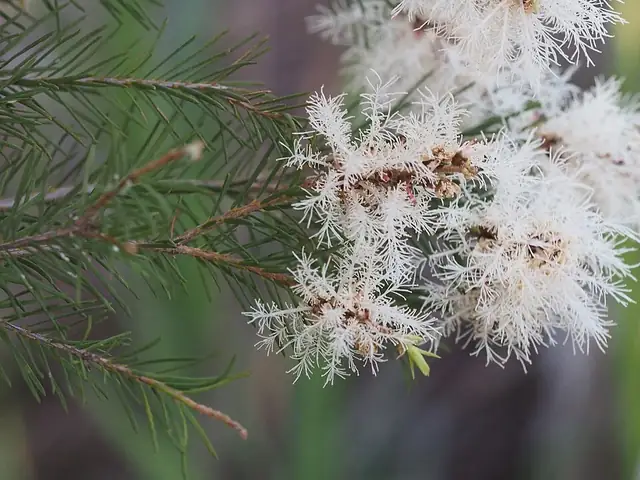
Also known as: Tea tree, Tea tree
Tea tree is not the tea plant Camellia sinensis. Do not drink its essential oil.
An illustration is not enough to identify a plant for consumption. Do not forage for a species based solely on this profile.
01 · UNDERSTAND
Properties & uses.
Minor skin lesions
Traditional use of suitable preparations for minor superficial wounds, insect bites and mild acne.
Read the sourceLocal irritations
Traditional use for certain symptoms of athlete's foot and minor oral inflammation; not a guarantee of a cure.
Read the sourceThe traditional uses described are not clinical proof of effectiveness. Evidence for one preparation cannot automatically be applied to another.
02 · UNDERSTAND THE ACTION
How does the plant act?
Tea tree is documented mainly through an essential oil of controlled composition, used locally. Antimicrobial activities exist in the laboratory, but they do not support the conclusion that a bottle treats every infection. Human studies are limited and their results depend on the skin condition and formulation. The dossier therefore distinguishes acne, symptoms of athlete’s foot and oral uses, for which the levels of knowledge differ.
Constituents to know.
Their presence and quantity depend on the plant part and preparation.
- Terpinen-4-ol and other monoterpenes
- Terpinen-4-ol is a major constituent of the type of oil studied. Its proportion and that of other constituents vary, hence the importance of a defined quality profile.Read the reference
Experimental antimicrobial activity
The oil and some constituents, particularly terpinen-4-ol, act on microorganisms in laboratory tests. These experimental concentrations are not application instructions.
Read the referenceAcne and athlete's foot
A few human studies suggest potential value for local formulations, with a limited evidence base and sometimes lower effectiveness than usual treatments.
Read the referenceTraditional local care
The EMA dossier recognizes specific local uses for minor skin conditions and certain minor inflammations of the mouth.
Read the referenceWhat this means for preparation.
Choose a formulation intended for the area concerned. Storage away from air, light and heat limits oxidation: oxidation products can increase sensitizing potential.
03 · EXAMINE THE EVIDENCE
What the research shows.
A laboratory or animal result alone does not demonstrate a benefit in humans. Each result must be read alongside the preparation studied and its limitations.
Uneven results depending on the indication
- Type of research
- NCCIH institutional summary of human research.
- Preparation concerned
- Topical or oral cavity products containing tea tree essential oil.
- Observed results
- Results for acne and athlete's foot are encouraging but limited; evidence for fungal nail infections and several oral uses remains insufficient.
- Limitations to consider
- Results cannot be generalized to every infection, an unformulated oil or ingestion.
What can we take from this?
Do not swallow the oil. An effect observed on bacteria in culture does not replace assessment of an infected lesion; natural origin does not rule out irritation and allergy.
Documentary review dated 09/10/2026. The references remain available to check the context.
04 · CHOOSE A PREPARATION
One plant, several preparations.
Only forms documented in this profile’s sources are presented.
Formulated topical preparationEssential oil from leaves and terminal branches · Route: topical
Suitable solution or semisolid form.
Please note: Do not swallow; avoid the eyes and ears.
Read the sourceFormulated oromucosal preparationEssential oil from leaves and terminal branches · Route: mouth
Product explicitly intended for the oral mucosa.
Please note: Spit out; no home recipe for ingestion.
Read the source05 · BEFORE ANY USE
Precautions & contraindications.
This guidance does not cover every individual situation. Missing information is not a guarantee of safety.
Contraindications
- Allergy to tea tree; history of allergy to rosin: seek professional advice.
Medicine interactions
- No established interaction is included in this entry; this does not guarantee compatibility with a treatment.
Adverse effects
- Irritation, burning and contact allergy possible.
Pregnancy & breastfeeding
Pregnancy and breastfeeding: medicinal use is not recommended because of insufficient data.
Children & adolescents
Not recommended under 12 years in the monograph.
If symptoms persist, worsen or are unusual, consult a healthcare professional. In an emergency, contact the emergency services.
06 · PUTTING KNOWLEDGE INTO PRACTICE
Preparations & recipes.
No home recipe is provided in this profile. For an appropriate preparation, refer to the product leaflet and ask your pharmacist for advice.
07 · CHECK THE SOURCES
Sources for this profile.
- EMA — Melaleucae aetheroleum: assessment and documentsAccessed on 09/10/2026
- ANSES — summary of precautions for food supplements (June 2023)Accessed on 09/10/2026
- EMA — assessment report on Melaleuca essential oil, first versionAccessed on 09/10/2026
- NCCIH — Tea Tree Oil: research and safetyAccessed on 09/10/2026
Illustration: Geoff Derrin · CC BY-SA 4.0. View the original image and its licence. Image resized and converted to WebP.
A TOUCH OF SOLÉA
Myriam’s tip
Myriam is reviewing the tip for this profile.
Myriam