BOTANICAL IDENTITY
The right name is the first step.
Also known as: No synonyms listed.
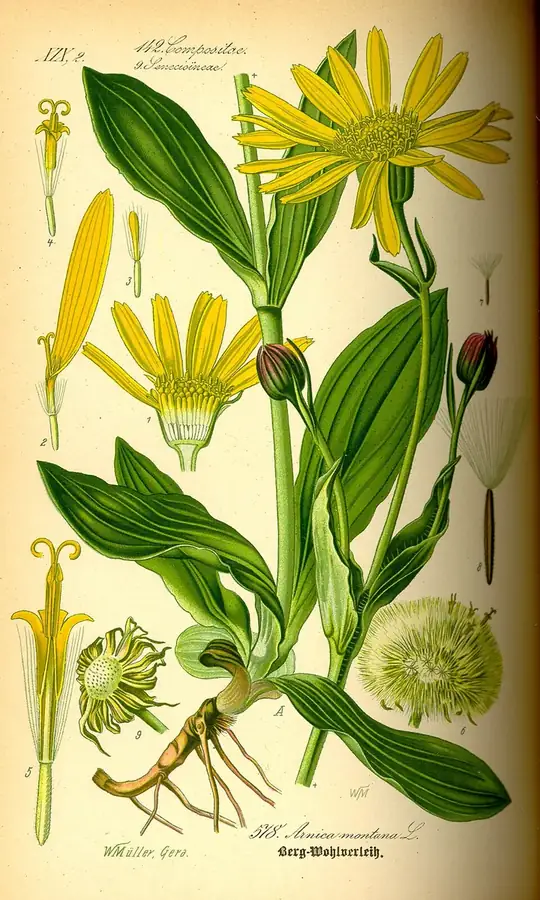
The botanical name, part and preparation must match. A photograph is not enough for identification intended for consumption.
An illustration is not enough to identify a plant for consumption. Do not forage for a species based solely on this profile.
01 · UNDERSTAND
Properties & uses.
Bruises and local muscle pain
Traditional use for bruises, sprains and localized pain; trials do not demonstrate universal efficacy.
Read the sourceThe traditional uses described are not clinical proof of effectiveness. Evidence for one preparation cannot automatically be applied to another.
02 · UNDERSTAND THE ACTION
How does the plant act?
Arnica flowers are mainly studied in local preparations for bruises, sprains and muscle pain. Their activity on inflammatory pathways is biologically plausible, but the European dossier retains a traditional level of evidence. The results concern defined tinctures, gels or extracts applied to the skin; they justify neither ingestion at home nor treating all preparations sold under the name arnica as equivalent.
Constituents to know.
Their presence and quantity depend on the plant part and preparation.
- Sesquiterpene lactones
- Helenalin and dihydrohelenalin derivatives are among the characteristic constituents. Composition varies; no constituent is recognized as explaining the therapeutic effect alone.Read the reference
Cellular inflammatory signals
Preparations have limited the activation of factors such as NF-κB in cells. This factor regulates inflammatory genes; its experimental inhibition is not a measure of relief in a patient.
Read the referenceBruises and local pain
Use of gels or creams for these situations remains traditional. The formulation and skin contact matter as much as the plant's name.
Read the referenceWhat this means for preparation.
Check that a preparation is intended for the skin and keep to the specified areas. A tincture cannot automatically be used in the same way as a formulated cream.
03 · EXAMINE THE EVIDENCE
What the research shows.
A laboratory or animal result alone does not demonstrate a benefit in humans. Each result must be read alongside the preparation studied and its limitations.
Why the evidence level remains traditional
- Type of research
- EMA report examining topical clinical trials.
- Preparation concerned
- Preparations of Arnica montana flowers.
- Observed results
- The trials provide evidence, but their limitations prevent justification of well-established use.
- Limitations to consider
- Cell models and studies of different formulations do not demonstrate the efficacy of every cream on the market.
What can we take from this?
Plausible anti-inflammatory activity does not remove the risk of skin sensitization, particularly in people allergic to Asteraceae. Stop use if redness or eczema develops after application.
Documentary review dated 09/10/2026. The references remain available to check the context.
04 · CHOOSE A PREPARATION
One plant, several preparations.
Only forms documented in this profile’s sources are presented.
Cream or gelFlower heads · Route: topical
Solution for external useFlower heads · Route: topical
Liquid extract intended for local care.
Please note: Follow its package leaflet; not a preparation for drinking.
Read the source05 · BEFORE ANY USE
Precautions & contraindications.
This guidance does not cover every individual situation. Missing information is not a guarantee of safety.
Contraindications
- Allergy to the plant; do not apply a preparation to damaged skin unless it is intended for that use.
Medicine interactions
- Interactions are not detailed here: have a pharmacist check treatments and the preparation.
Adverse effects
- Itching, redness and allergic eczema reported.
Pregnancy & breastfeeding
Pregnancy and breastfeeding: have the preparation checked; no self-medication is proposed here.
Children & adolescents
Not recommended under 12 years.
If symptoms persist, worsen or are unusual, consult a healthcare professional. In an emergency, contact the emergency services.
06 · PUTTING KNOWLEDGE INTO PRACTICE
Preparations & recipes.
No home recipe is provided in this profile. For an appropriate preparation, refer to the product leaflet and ask your pharmacist for advice.
07 · CHECK THE SOURCES
Sources for this profile.
- EMA — Arnicae flos: official dossierAccessed on 09/10/2026
- EMA — assessment report on Arnica montana L. (Flower heads)Accessed on 09/10/2026
Illustration: Flora von Deutschland, Österreich und der Schweiz — Otto Wilhelm Thomé (1885), via Wikimedia Commons · Public domain. View the original image and its licence. Image resized and converted to WebP.
A TOUCH OF SOLÉA
Myriam’s tip
Myriam is reviewing the tip for this profile.
Myriam