Identity & origin
BOTANICAL IDENTITY
The right name is the first step.
This profile concerns the root. The uses described depend on the preparation.
Also known as: Restharrow
Check the scientific name and the part used; a photograph is not sufficient for foraging plants intended for consumption.
An illustration is not enough to identify a plant for consumption. Do not forage for a species based solely on this profile.
Uses & evidence
UNDERSTANDING THE USES
Properties & uses.
Urinary elimination
Traditional use to increase urine output in minor urinary complaints.
Use considered plausible in a traditional-use monograph. That status alone does not demonstrate clinical efficacy.
Read the sourceThe traditional uses described are not clinical proof of effectiveness. Evidence for one preparation cannot automatically be applied to another.
Precautions before use
BEFORE ANY USE
Precautions & contraindications.
This guidance does not cover every individual situation. Missing information is not a guarantee of safety.
Contraindications & precautions
- Source-listed contraindicationAllergy to the plant or preparation: contraindication.Source
- Source-listed contraindicationDo not use where fluid intake must be restricted, including severe heart or kidney disease.Source
- PrecautionFever, painful urination, spasms or blood in urine require medical assessment; do not delay infection diagnosis.Source
Medicine interactions
- No interaction reported in the sourceNo interactions are reported in the source for the assessed preparations. Evidence is limited; compatibility with medicines is not guaranteed.Source
“Reported” does not prove causality; “possible” may reflect indirect evidence. “None reported” means none in the cited source, not that all combinations have been studied. Do not stop a prescribed treatment based on this profile.
Adverse effects
- Adverse effects insufficiently documented in the sources used here.
Pregnancy & breastfeeding
Medicinal use is not recommended during pregnancy or breastfeeding because evidence is insufficient; missing evidence establishes neither harm nor safety.
SourceChildren & adolescents
Medicinal use is not recommended below age 12 because evidence is insufficient; do not scale down an adult dose.
SourceIf symptoms persist, worsen or are unusual, consult a healthcare professional. In an emergency, contact the emergency services.
Forms & how they are used
DOCUMENTED FORMS
One plant, several preparations.
Only forms documented in this profile’s sources are presented.
InfusionRoot · Route: oral
Dried, cut root.
Please note: Follow the product's package leaflet; preparations are not interchangeable.
Read the sourcePreparations: ingredients & steps
DOCUMENTED PREPARATIONS
Preparations & recipes.
A DOCUMENTED PREPARATION
Restharrow root infusion
Traditional support for minor urinary discomfort. Traditional-use guidance; sufficient clinical evidence for a benefit from this tea is lacking.
Plant part: Root
Ingredients & quantities
- 2–3 g — dried, comminuted root (Ononis spinosa L.)
- 150 ml water
Preparation steps
- Weigh 2–3 g of the specified dried, comminuted part from a supplier who verifies the species.
- Pour 150 ml of boiling water over the herb.
- Steep for 20–30 minutes, then strain.
- Allow to cool before drinking. Do not substitute an extract or essential oil.
Use: One cup up to 3–4 times daily, without exceeding 12 g root daily. Seek advice if discomfort persists over one week or worsens.
Storage: Prepare a cup just before use and drink once cooled. No storage period for the prepared infusion is established here; do not keep it for the following day.
Before you start. Adults aged 18 and over. Do not use if allergic to the plant. Not recommended during pregnancy or breastfeeding because sufficient safety data are lacking. Do not use when fluid restriction has been prescribed, particularly with severe heart or kidney disease. Maintain an appropriate fluid intake; do not force fluids. This tea does not treat a urinary infection. Fever, flank pain, painful urination, blood in the urine or worsening symptoms require prompt medical assessment. No known adverse effect in the monograph does not guarantee safety. No reported interaction in the monograph does not mean no risk; ask a pharmacist to check your medicines.
This plant in documented blends
These recipes have their own formula and precautions. The dose of a single plant cannot be transferred to a blend.
Understanding the plant’s actions
EXPLORE THE EVIDENCE
How does the plant act?
Spiny restharrow is documented through its root. Its traditional use aims to increase urine output as an adjunct in minor urinary problems. Older animal experiments make diuretic activity plausible, but their heterogeneous protocols and small samples do not allow prediction of an infusion's effect in a person. “Traditionally promotes urine output” must therefore be separated from “treats an infection” or “dissolves a stone”.
Support for urinary elimination
The root in an aqueous preparation falls within the traditional scope of increasing urine output, with appropriate fluid intake. This use requires that there be no medical fluid restriction.
Use considered plausible in a traditional-use monograph. That status alone does not demonstrate clinical efficacy.
Read the referenceDiuresis in animal models
Some older experiments on aqueous root extracts observed increased urine output. They do not characterize a predictable human response.
Laboratory or animal observation. A human benefit cannot be inferred from this finding alone.
Read the referenceWhat this means for preparation.
Look for the word root and do not substitute an aerial part or a mixture with unknown components. A urinary herbal tea must not delay consultation for fever, significant pain or blood in the urine.
Studies, findings & limitations
THE RESEARCH
What the research shows.
A laboratory or animal result alone does not demonstrate a benefit in humans. Each result must be read alongside the preparation studied and its limitations.
Old and weak pharmacological evidence
Laboratory or animal observation. A human benefit cannot be inferred from this finding alone.
- Type of research
- Rat or rabbit studies examined in the EMA report.
- Preparation concerned
- Aqueous Ononis spinosa root extracts administered orally.
- Observed results
- Effects on diuresis have been reported in some protocols.
- Limitations to consider
- Sample sizes were sometimes very small, methods varied and comparisons were difficult. These studies do not measure clinical benefit in a urinary tract infection.
What can we take from this?
The constituent responsible for a possible therapeutic effect is not established here. The dossier does not support claims of antibiotic action, proven prevention of recurrence or dissolution of stones.
Documentary review dated 09/10/2026. The references remain available to check the context.
Sources & last review
CHECKING REFERENCES
Sources for this profile.
- EMA — Ononidis radix: assessment and documentsAccessed on 09/10/2026
- ANSES — summary of precautions for food supplements (June 2023)Accessed on 09/10/2026
- EMA — Ononis spinosa L.: assessment report, traditional preparationAccessed on 09/10/2026
- EMA — Ononis spinosa L.: official monograph, preparation and precautionsAccessed on 09/10/2026
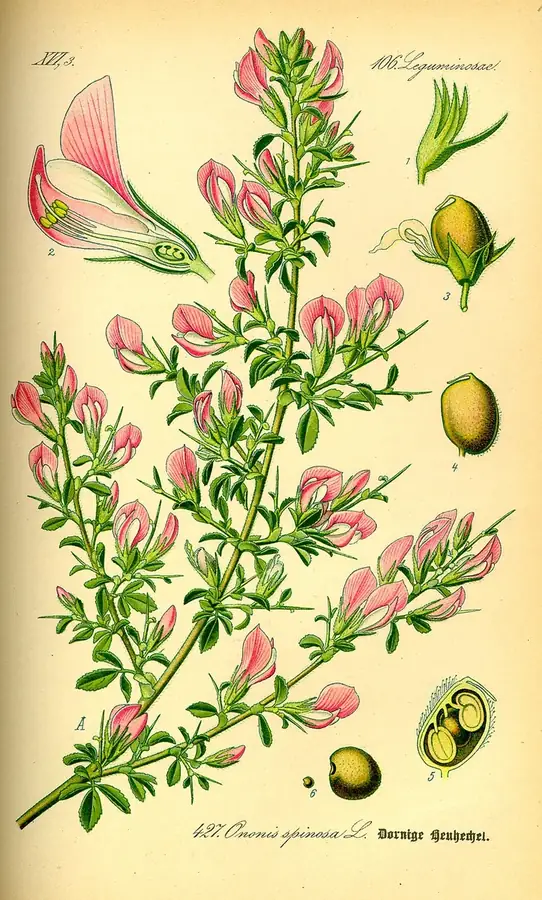
Image: Flora von Deutschland, Österreich und der Schweiz — Otto Wilhelm Thomé (1885), via Wikimedia Commons · Public domain. View the original image and its licence. Image resized and converted to WebP.