BOTANICAL IDENTITY
The right name is the first step.
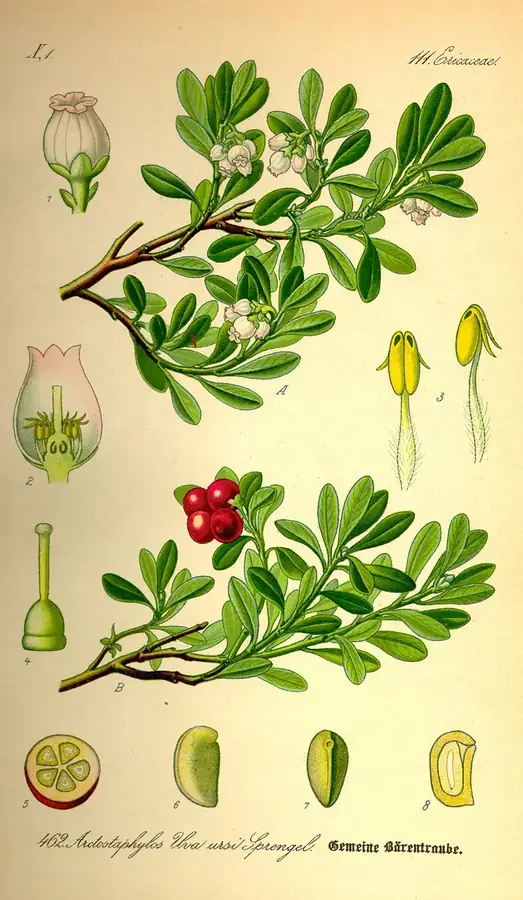
Also known as: bearberry
The botanical name, part and preparation must match. A photograph is not enough for identification intended for consumption.
An illustration is not enough to identify a plant for consumption. Do not forage for a species based solely on this profile.
01 · UNDERSTAND
Properties & uses.
Mild recurrent urinary symptoms
Traditional use for burning during urination and urinary frequency; does not replace a diagnosis or an indicated antibiotic.
Read the sourceThe traditional uses described are not clinical proof of effectiveness. Evidence for one preparation cannot automatically be applied to another.
02 · UNDERSTAND THE ACTION
How does the plant act?
Bearberry leaf is traditionally used for certain mild, recurrent urinary symptoms in adult women, after a serious cause has been excluded. An antimicrobial hypothesis exists, but it is not sufficient to regard it as a plant-based antibiotic. The EMA’s 2025 update examines more recent trials that require particular caution about promises of replacing antibiotics.
Constituents to know.
Their presence and quantity depend on the plant part and preparation.
- Arbutin and tannins
- Arbutin is a hydroquinone derivative. Its quantity varies; the leaves also contain tannins. The transformation of constituents matters as much as their presence.Read the reference
Hypothesis of urinary antibacterial activity
Hydroquinone released from arbutin is a proposed explanation based on experiments. This does not establish clinical eradication of infection.
Read the referenceTargeted traditional relief
The monograph does not extend this use to men, children or every urinary tract infection. Severe symptoms require different care.
Read the referenceWhat this means for preparation.
Arbutin content does not guarantee a clinical benefit. Prior assessment of symptoms, the exact form and the limited duration of a product are decisive.
03 · EXAMINE THE EVIDENCE
What the research shows.
A laboratory or animal result alone does not demonstrate a benefit in humans. Each result must be read alongside the preparation studied and its limitations.
ATAFUTI and REGATTA trials
- Type of research
- EMA 2025 addendum: randomized controlled trials in women.
- Preparation concerned
- Leaf extracts, distinct from an uncharacterized herbal tea.
- Observed results
- ATAFUTI, 382 participants: no demonstrated difference in symptom severity versus placebo. REGATTA did not demonstrate non-inferiority to fosfomycin.
- Limitations to consider
- These results do not justify replacing an indicated antibiotic with bearberry.
What can we take from this?
Laboratory activity does not justify a prolonged preventive course. Metabolism into hydroquinone and toxicological uncertainties contribute to the restrictions on use.
Documentary review dated 09/10/2026. The references remain available to check the context.
04 · CHOOSE A PREPARATION
One plant, several preparations.
Only forms documented in this profile’s sources are presented.
Herbal teaLeaves · Route: oral
Dry extractLeaves · Route: oral
Solid form with a defined extract.
Please note: No more than one week according to the EMA; reassess if symptoms persist or worsen.
Read the source05 · BEFORE ANY USE
Precautions & contraindications.
This guidance does not cover every individual situation. Missing information is not a guarantee of safety.
Contraindications
- Kidney disorder: do not use.
- Do not use without medical exclusion of a serious condition.
Medicine interactions
- Interactions are not detailed here: have a pharmacist check treatments and the preparation.
Adverse effects
- Nausea, vomiting and stomach pain have been reported.
Pregnancy & breastfeeding
Pregnancy and breastfeeding: have the preparation checked; no self-medication is proposed here.
Children & adolescents
For adult women only; no paediatric use.
If symptoms persist, worsen or are unusual, consult a healthcare professional. In an emergency, contact the emergency services.
06 · PUTTING KNOWLEDGE INTO PRACTICE
Preparations & recipes.
No home recipe is provided in this profile. For an appropriate preparation, refer to the product leaflet and ask your pharmacist for advice.
07 · CHECK THE SOURCES
Sources for this profile.
- EMA — Uvae ursi folium: official dossierAccessed on 09/10/2026
- EMA — assessment report on Arctostaphylos uva-ursi (L.) Spreng. (Leaves)Accessed on 09/10/2026
- EMA — addendum to the assessment report on Arctostaphylos uva-ursi (L.) Spreng. (Leaves)Accessed on 09/10/2026
Illustration: Flora von Deutschland, Österreich und der Schweiz — Otto Wilhelm Thomé (1885), via Wikimedia Commons · Public domain. View the original image and its licence. Image resized and converted to WebP.
A TOUCH OF SOLÉA
Myriam’s tip
Myriam is reviewing the tip for this profile.
Myriam