BOTANICAL IDENTITY
The right name is the first step.
Also known as: Cnicus benedictus, Centaurea benedicta
The botanical name, part and preparation must match. A photograph is not enough for identification intended for consumption.
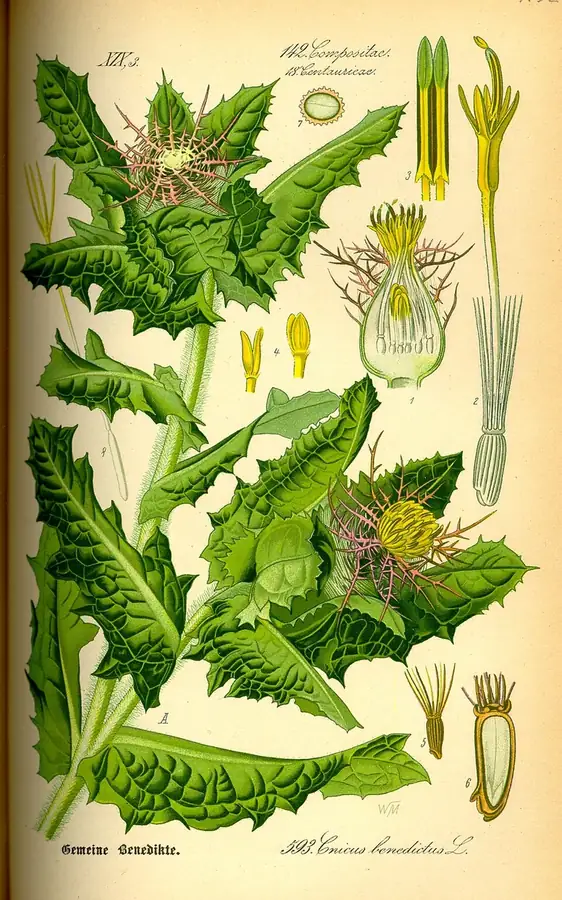
An illustration is not enough to identify a plant for consumption. Do not forage for a species based solely on this profile.
01 · UNDERSTAND
Properties & uses.
Appetite and digestion
Traditional uses for temporary loss of appetite, dyspepsia and mild digestive spasms.
Read the sourceThe traditional uses described are not clinical proof of effectiveness. Evidence for one preparation cannot automatically be applied to another.
02 · UNDERSTAND THE ACTION
How does the plant act?
Blessed thistle is a bitter plant traditionally used for temporary loss of appetite and certain digestive discomforts. The aerial parts are harvested during flowering. Its chemical profile explains the strong taste, but a bitter taste is not a measure of effectiveness. This species must also be distinguished from milk thistle, whose seeds and scientific dossier are different.
Constituents to know.
Their presence and quantity depend on the plant part and preparation.
- Cnicin and sesquiterpene lactones
- Cnicin is among the characteristic bitter compounds. Other lactones, tannins and lignans complete the composition described.Read the reference
Appetite
Use as a bitter rests on tradition; it does not justify claiming that it corrects a cause of appetite loss.
Read the referenceDigestive comfort
The aerial parts preparation is documented for mild complaints. Isolated fractions are not equivalent to an infusion.
Read the referenceWhat this means for preparation.
Looking for Cnicus benedictus on the label avoids confusion with other thistles. The part used and extraction solvent provide more precise information than a “tonic” promise.
03 · EXAMINE THE EVIDENCE
What the research shows.
A laboratory or animal result alone does not demonstrate a benefit in humans. Each result must be read alongside the preparation studied and its limitations.
A preparation must be identifiable
- Type of research
- Final EMA characterization and assessment report.
- Preparation concerned
- Fragmented or powdered plant, defined liquid extract and tincture.
- Observed results
- These forms have distinct descriptions, with compositions related to the process.
- Limitations to consider
- The presence of cnicin does not, by itself, constitute a clinical demonstration of each product's efficacy.
What can we take from this?
The chemical content reviewed does not justify claims of a galactagogue, anticancer or liver-repairing effect. This profile remains within the scope of traditional digestive uses.
Documentary review dated 09/10/2026. The references remain available to check the context.
04 · CHOOSE A PREPARATION
One plant, several preparations.
Only forms documented in this profile’s sources are presented.
InfusionAerial parts · Route: oral
Cut aerial parts.
Please note: Check the preparation and its leaflet; concentrations are not interchangeable.
Read the sourceTinctureAerial parts · Route: oral
Defined hydroalcoholic preparation.
Please note: Take the alcohol content into account.
Read the source05 · BEFORE ANY USE
Precautions & contraindications.
This guidance does not cover every individual situation. Missing information is not a guarantee of safety.
Contraindications
- Allergy to Asteraceae.
Medicine interactions
- No interactions reported in the monograph; check the treatment.
Adverse effects
- Large amounts may cause stomach complaints and vomiting.
Pregnancy & breastfeeding
Pregnancy and breastfeeding: have the preparation checked; no self-medication is proposed here.
Children & adolescents
Not recommended under 18 years.
If symptoms persist, worsen or are unusual, consult a healthcare professional. In an emergency, contact the emergency services.
06 · PUTTING KNOWLEDGE INTO PRACTICE
Preparations & recipes.
No home recipe is provided in this profile. For an appropriate preparation, refer to the product leaflet and ask your pharmacist for advice.
07 · CHECK THE SOURCES
Sources for this profile.
- EMA — Cnici benedicti herba: official dossierAccessed on 09/10/2026
- EMA — monograph or public statement on Cnicus benedictusAccessed on 09/10/2026
- EMA — assessment report on Cnicus benedictus L. (aerial parts)Accessed on 09/10/2026
Illustration: Flora von Deutschland, Österreich und der Schweiz — Otto Wilhelm Thomé (1885), via Wikimedia Commons · Public domain. View the original image and its licence. Image resized and converted to WebP.
A TOUCH OF SOLÉA
Myriam’s tip
Myriam is reviewing the tip for this profile.
Myriam