BOTANICAL IDENTITY
The right name is the first step.
Also known as: No synonyms listed.
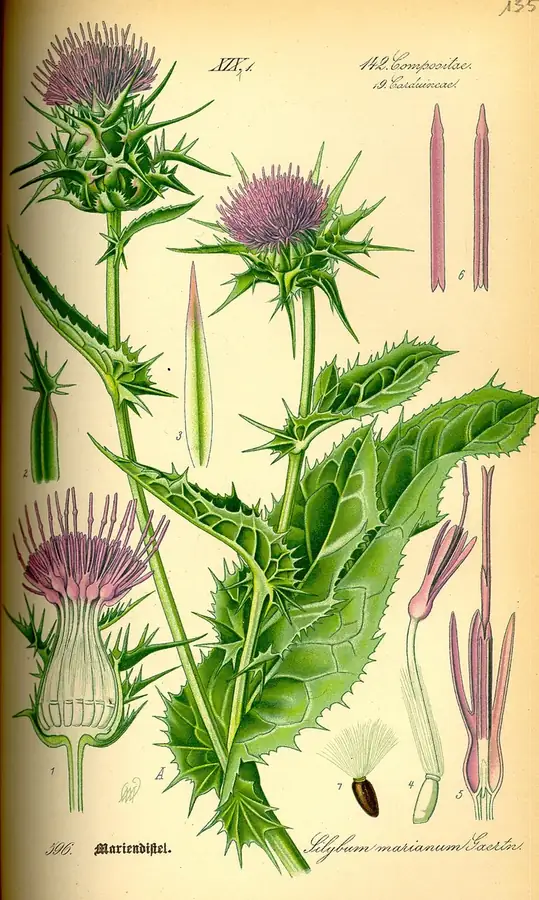
The botanical name and part used must match the profile; a photograph alone is not sufficient grounds for consuming a plant.
An illustration is not enough to identify a plant for consumption. Do not forage for a species based solely on this profile.
01 · UNDERSTAND
Properties & uses.
Digestive comfort
Traditional use for feelings of fullness and indigestion.
Read the sourceLiver function
Traditional use after a doctor has excluded serious disease; trials are insufficient to demonstrate general efficacy.
Read the sourceThe traditional uses described are not clinical proof of effectiveness. Evidence for one preparation cannot automatically be applied to another.
02 · UNDERSTAND THE ACTION
How does the plant act?
Milk thistle is best known for silymarin, a mixture of compounds extracted from the fruit. Cellular actions explain the interest in liver research, but changing a liver marker does not prove improvement in disease or survival. EMA recognizes traditional digestive uses and support of liver function after serious diseases have been excluded; NCCIH emphasizes conflicting clinical results.
Constituents to know.
Their presence and quantity depend on the plant part and preparation.
- Silymarin
- A mixture including silibinin; concentrated, standardized extracts are not equivalent to a fruit infusion.Read the reference
Digestive comfort
The fruit and certain preparations fall under traditional use for minor digestive discomfort, within the framework defined by the monograph.
Read the referenceHepatoprotective hypotheses
Experimental models investigate oxidative stress and cellular responses; they do not justify a promise to regenerate a diseased liver.
Read the referenceWhat this means for preparation.
Check the extract type and quality rather than a single “liver” promise. According to the NCCIH, marketed products have shown variable contents and contamination problems.
03 · EXAMINE THE EVIDENCE
What the research shows.
A laboratory or animal result alone does not demonstrate a benefit in humans. Each result must be read alongside the preparation studied and its limitations.
Trials without demonstrated benefit
- Type of research
- NCCIH summary of human research, including two trials funded by the centre.
- Preparation concerned
- Oral supplementation with milk thistle extract/silymarin, studied particularly in hepatitis C and steatohepatitis.
- Observed results
- These two trials showed no benefit; results in other liver diseases are limited or contradictory.
- Limitations to consider
- Populations and preparations differ; no medical liver treatment can be replaced on this basis.
What can we take from this?
The hospital role of a derived substance cannot be transferred to a capsule. Silymarin does not compensate for alcohol consumption or poisoning.
Documentary review dated 09/10/2026. The references remain available to check the context.
04 · CHOOSE A PREPARATION
One plant, several preparations.
Only forms documented in this profile’s sources are presented.
Herbal tea or powderFruit · Route: oral
ExtractFruit · Route: oral
Specific soft or dry extracts.
Please note: Composition varies according to the process.
Read the source05 · BEFORE ANY USE
Precautions & contraindications.
This guidance does not cover every individual situation. Missing information is not a guarantee of safety.
Contraindications
- Allergy to milk thistle or Asteraceae.
Medicine interactions
- Check medicines with a pharmacist; this profile does not guarantee their compatibility.
Adverse effects
- Digestive disorders, headaches and sometimes severe allergies reported.
Pregnancy & breastfeeding
Pregnancy and breastfeeding: medicinal use is not recommended due to insufficient data.
Children & adolescents
For adults only.
If symptoms persist, worsen or are unusual, consult a healthcare professional. In an emergency, contact the emergency services.
06 · PUTTING KNOWLEDGE INTO PRACTICE
Preparations & recipes.
No home recipe is provided in this profile. For an appropriate preparation, refer to the product leaflet and ask your pharmacist for advice.
07 · CHECK THE SOURCES
Sources for this profile.
- EMA — Silybi mariani fructus: dossier and documentsAccessed on 09/10/2026
- ANSES — precautions for herbal supplements, June 2023 tableAccessed on 09/10/2026
- EMA — scientific assessment report: Silybum marianumAccessed on 09/10/2026
- NCCIH — Milk Thistle: Usefulness and SafetyAccessed on 09/10/2026
Illustration: Flora von Deutschland, Österreich und der Schweiz — Otto Wilhelm Thomé (1885), via Wikimedia Commons · Public domain. View the original image and its licence. Image resized and converted to WebP.
A TOUCH OF SOLÉA
Myriam’s tip
Myriam is reviewing the tip for this profile.
Myriam