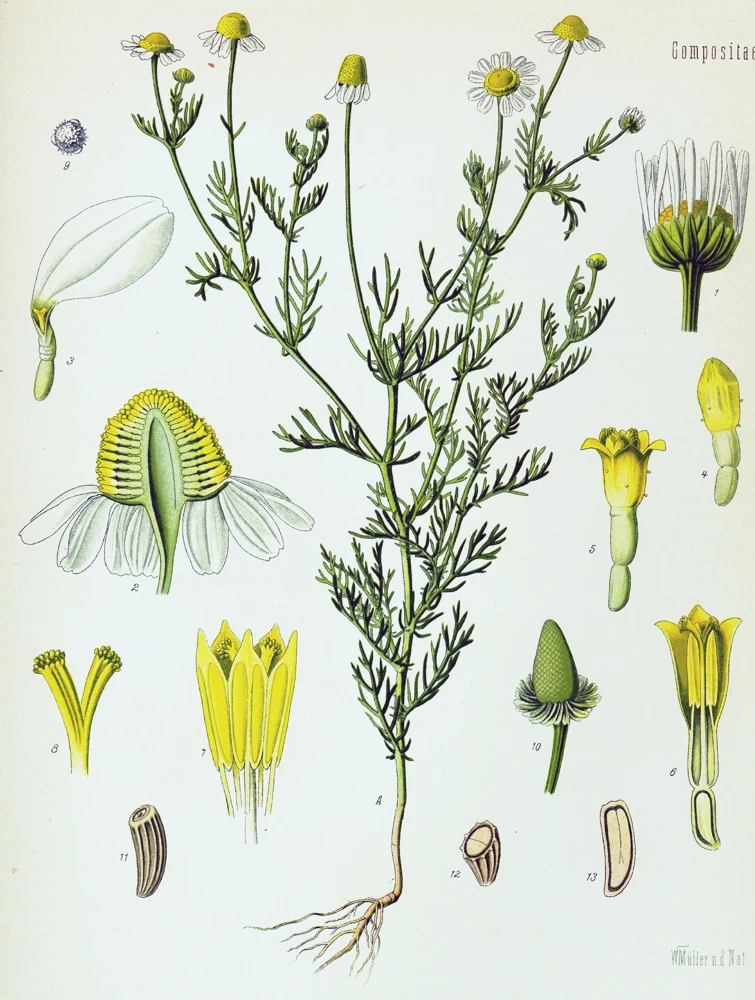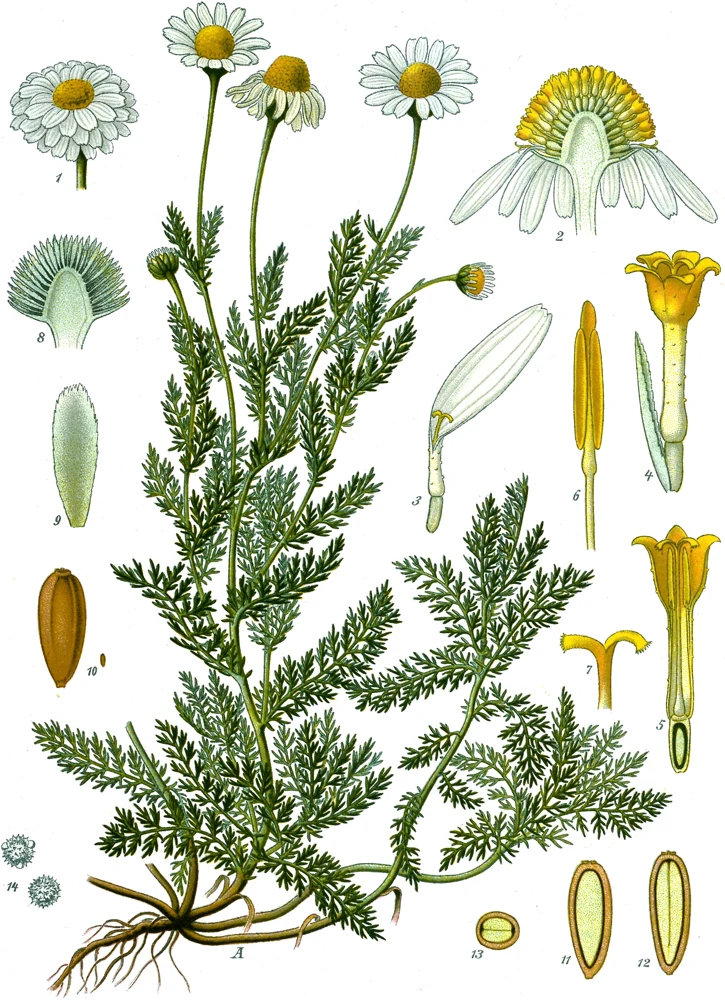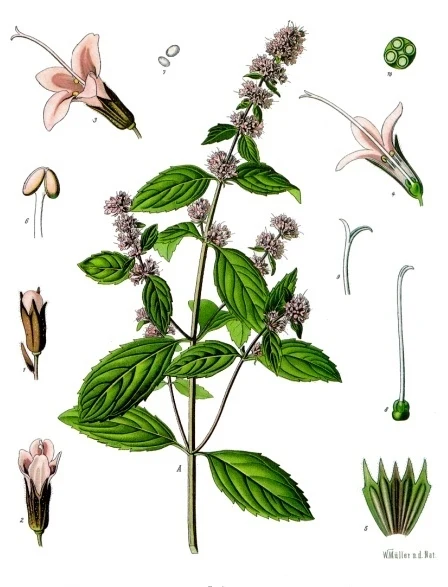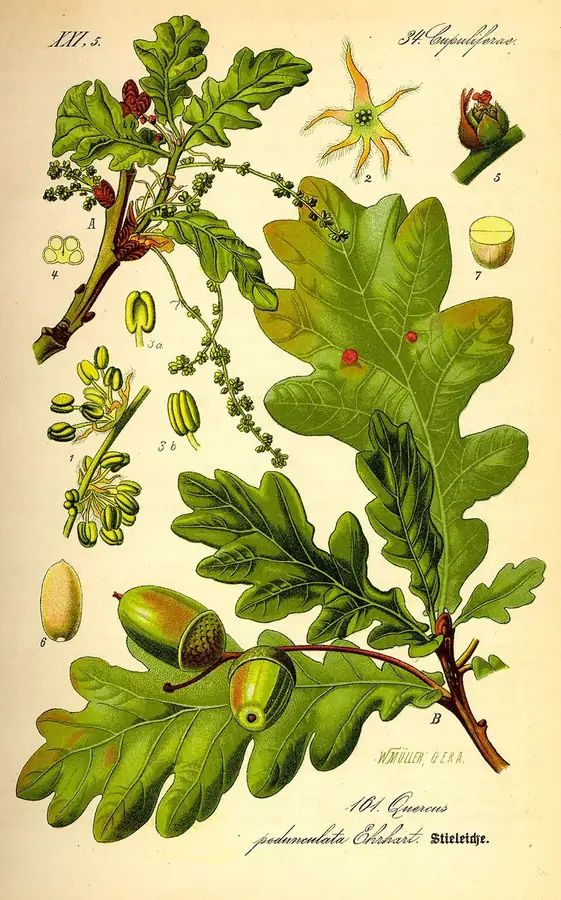
BOTANICAL IDENTITY
The right name is the first step.
Also known as: No synonyms listed.
Quercus petraea and Q. pubescens are also included in the monograph.
An illustration is not enough to identify a plant for consumption. Do not forage for a species based solely on this profile.
01 · UNDERSTAND
Properties & uses.
Diarrhoea, mouth and skin
These uses reflect a history of bark preparations; they do not prove action on the infectious cause of diarrhea.
Read the sourceOak bark mouth rinse
Traditional use of bark for minor mouth inflammation. This reference rests on long-standing use; it does not establish clinical efficacy or treat a dental infection.
Read the sourceOak bark tea — mild diarrhoea
Traditional astringent use for mild diarrhoea. Keep use short term; this preparation does not replace rehydration.
Read the sourceThe traditional uses described are not clinical proof of effectiveness. Evidence for one preparation cannot automatically be applied to another.
02 · UNDERSTAND THE ACTION
How does the plant act?
Oak bark is an astringent herbal material: its tannins interact with proteins on surfaces in contact with the preparation. Traditional uses concern mild diarrhea, minor inflammation of the skin or mouth and certain hemorrhoidal symptoms already medically assessed. The monograph is shared by Quercus robur, Q. petraea and Q. pubescens; it is not a separate demonstration for each species.
Constituents to know.
Their presence and quantity depend on the plant part and preparation.
- Tannins
- Hydrolyzable and condensed tannins; their content depends in particular on branch age, harvesting and the analytical method.Read the reference
Surface astringency
Precipitation of surface proteins may form a protective layer and reduce secretions; this mechanism makes the use plausible without quantifying its benefit.
Read the referenceDiarrhoea, mouth and skin
These uses reflect a history of bark preparations; they do not prove action on the infectious cause of diarrhea.
Read the referenceWhat this means for preparation.
“Bark” must appear on the preparation; acorn or leaf are not substitutes. Rectal bleeding must never be self-attributed to hemorrhoids.
03 · EXAMINE THE EVIDENCE
What the research shows.
A laboratory or animal result alone does not demonstrate a benefit in humans. Each result must be read alongside the preparation studied and its limitations.
Scope of the assessment
- Type of research
- EMA report on pharmacology and traditional use.
- Preparation concerned
- Bark from the three accepted species, aqueous preparations or other defined forms.
- Observed results
- Plausibility is based in particular on astringency and the long history of use.
- Limitations to consider
- Experimental data from other oaks, for example Quercus ilex, are not evidence specific to Q. robur; robust clinical trials are lacking.
What can we take from this?
This profile justifies neither prolonged consumption nor treatment of a chronic digestive disease. No superiority of Q. robur over the other accepted species has been established.
Documentary review dated 09/10/2026. The references remain available to check the context.
04 · CHOOSE A PREPARATION
One plant, several preparations.
Only forms documented in this profile’s sources are presented.
Oak bark mouth rinseDried, fragmented Quercus robur bark · Route: oromucosal, spit out
Traditional use of bark for minor mouth inflammation. This reference rests on long-standing use; it does not establish clinical efficacy or treat a dental infection.
Please note: Do not swallow or use in the eyes. Contraindicated with bark allergy; allergic reactions are reported. Medicinal use is not recommended during pregnancy or breastfeeding because data are insufficient. Use identified, quality-controlled bark, not bark collected from a garden tree. Toothache or swelling requires professional advice.
Read the sourceOak bark tea — mild diarrhoeaDried, fragmented Quercus robur bark · Route: oral
Traditional astringent use for mild diarrhoea. Keep use short term; this preparation does not replace rehydration.
Please note: May delay absorption of other medicines: separate by at least 1 hour before or after their use, and ask a pharmacist to check treatment. Contraindicated with bark allergy; allergic reactions are possible. Medicinal use is not recommended during pregnancy or breastfeeding because data are insufficient.
Read the source05 · BEFORE ANY USE
Precautions & contraindications.
This guidance does not cover every individual situation. Missing information is not a guarantee of safety.
Contraindications
- Allergy.
- Baths are contraindicated in extensive lesions, high fever, serious infection, severe circulatory disorders or heart failure.
Medicine interactions
- Medicine absorption may be delayed: separate oral doses.
Adverse effects
- Allergic reactions are possible.
Pregnancy & breastfeeding
Pregnancy and breastfeeding: medicinal use is not recommended due to insufficient data.
Children & adolescents
Medicinal use for adults only.
If symptoms persist, worsen or are unusual, consult a healthcare professional. In an emergency, contact the emergency services.
06 · PUTTING KNOWLEDGE INTO PRACTICE
Preparations & recipes.
A DOCUMENTED PREPARATION
Oak bark mouth rinse
Traditional use of bark for minor mouth inflammation. This reference rests on long-standing use; it does not establish clinical efficacy or treat a dental infection.
Plant part: Dried, fragmented Quercus robur bark
Ingredients & quantities
- 20 g dried Quercus robur L. bark supplied for medicinal use
- 1 litre cold drinking water
Preparation steps
- Place the weighed bark in the litre of cold water.
- Bring to the boil, then simmer for 15–30 minutes: the EMA glossary’s general method, as the monograph gives no preparation-specific time. Follow the leaflet first.
- Strain carefully and allow to cool to a comfortable temperature before use.
- Rinse the mouth with the cooled preparation, then spit out.
Use: Adults aged 18+ only. The monograph allows several rinses daily without a precise number. Do not exceed one week; seek advice sooner if symptoms persist or worsen.
Storage: Prepare immediately before use. The monograph establishes no storage period for this water-based preparation; do not make a stock batch.
Before you start. Do not swallow or use in the eyes. Contraindicated with bark allergy; allergic reactions are reported. Medicinal use is not recommended during pregnancy or breastfeeding because data are insufficient. Use identified, quality-controlled bark, not bark collected from a garden tree. Toothache or swelling requires professional advice.
A DOCUMENTED PREPARATION
Oak bark tea — mild diarrhoea
Traditional astringent use for mild diarrhoea. Keep use short term; this preparation does not replace rehydration.
Plant part: Dried, fragmented Quercus robur bark
Ingredients & quantities
- 3 g quality-controlled, dried, fragmented Quercus robur L. bark
- 250 ml cold drinking water
Preparation steps
- Place the 3 g bark in the 250 ml cold water.
- Bring briefly to the boil, following the method described in the EMA assessment report. The report gives no numerical duration; follow the product leaflet.
- Strain carefully and allow to cool to a comfortable temperature before use.
Use: Adults aged 18+ only. EMA reference: 1 preparation, 3 times daily. Do not use for more than 3 days. Seek advice for persistent, recurrent or bloody diarrhoea; without delay for dehydration, fever or significant pain.
Storage: Prepare immediately before use. The monograph establishes no storage period for this water-based preparation; do not make a stock batch.
Before you start. May delay absorption of other medicines: separate by at least 1 hour before or after their use, and ask a pharmacist to check treatment. Contraindicated with bark allergy; allergic reactions are possible. Medicinal use is not recommended during pregnancy or breastfeeding because data are insufficient.
07 · CHECK THE SOURCES
Sources for this profile.
- EMA — Quercus cortex: dossier and documentsAccessed on 09/10/2026
- EMA — Quercus cortex, rapport d’évaluation / assessment report (§2.1, p. 7)Accessed on 09/10/2026
- EMA — Monograph on Quercus robur L., cortexAccessed on 09/10/2026
- EMA — Glossary on herbal teas, general method (§4)Accessed on 09/10/2026
Illustration: Prof. Dr. Otto Wilhelm Thomé Flora von Deutschland, Österreich und der Schweiz 1885, Gera, Germany · Public domain. View the original image and its licence. Image resized and converted to WebP.
A TOUCH OF SOLÉA
Myriam’s tip
Myriam is reviewing the tip for this profile.
Myriam