BOTANICAL IDENTITY
The right name is the first step.
Also known as: No synonyms listed.
The botanical name, part and preparation must match. A photograph is not enough for identification intended for consumption.
An illustration is not enough to identify a plant for consumption. Do not forage for a species based solely on this profile.
01 · UNDERSTAND
Properties & uses.
Common cold: short-term use
Well-established use of certain expressed juices for the prevention and short-term treatment of the common cold.
Read the sourceThe traditional uses described are not clinical proof of effectiveness. Evidence for one preparation cannot automatically be applied to another.
02 · UNDERSTAND THE ACTION
How does the plant act?
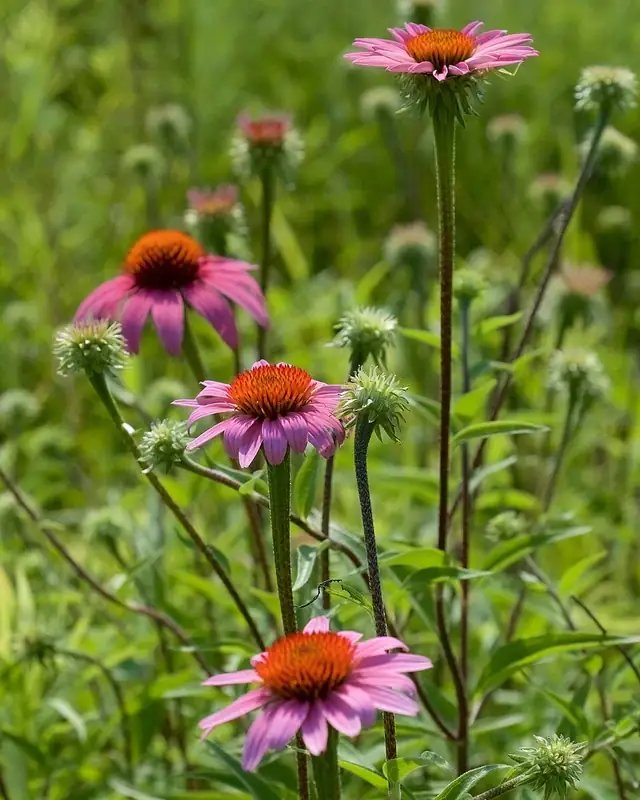
The fresh flowering aerial parts of Echinacea purpurea yield a pressed juice; certain medicines made from it have well-established medicinal use for short-term use in the common cold. The root has a separate dossier. This difference in plant part and manufacturing is crucial: a publication on another echinacea or on a root–herb mixture does not prove the efficacy of the juice alone.
Common cold: defined preparation
Well-established medicinal use concerns certain expressed juices, which may be dried. It does not mean a benefit for every infection or unlimited immune stimulation.
Read the referenceMinor wounds
Topical use has a separate traditional purpose. It cannot be justified solely by oral studies of the common cold.
Read the referenceDrug metabolism: indirect evidence
The report examines research on metabolic enzymes, while specifying that it does not directly concern the herb juice alone. Its relevance to this product remains uncertain.
Read the referenceWhat this means for preparation.
Looking for “fresh aerial parts” and “expressed juice” distinguishes this evidence from that for root extracts. Also check the accompanying ingredients.
03 · EXAMINE THE EVIDENCE
What the research shows.
A laboratory or animal result alone does not demonstrate a benefit in humans. Each result must be read alongside the preparation studied and its limitations.
Why check the composition used in trials
- Type of research
- EMA review of research on echinaceas.
- Preparation concerned
- Herb juice, but also research on other parts, species or combinations analyzed separately.
- Observed results
- The committee identifies limitations in attribution and requests more data to reach conclusions on certain interactions.
- Limitations to consider
- Absence of interaction in a given drug combination does not guarantee absence of interaction in all others.
What can we take from this?
Specific immune conditions, immunosuppressants and significant allergies require advice. The data do not support a general promise of “boosted immunity.”
Documentary review dated 09/10/2026. The references remain available to check the context.
04 · CHOOSE A PREPARATION
One plant, several preparations.
Only forms documented in this profile’s sources are presented.
Formulated pressed juiceFresh flowering aerial parts · Route: oral
Fresh juice, possibly dried, in a defined medicinal product.
Please note: Check the preparation and its leaflet; concentrations are not interchangeable.
Read the sourceTopical preparationFresh flowering aerial parts · Route: topical
Form suitable for minor wounds.
Please note: Seek medical advice for a skin infection; do not apply to the breast during breastfeeding.
Read the source05 · BEFORE ANY USE
Precautions & contraindications.
This guidance does not cover every individual situation. Missing information is not a guarantee of safety.
Contraindications
- Allergy to Asteraceae.
- Immune disease or treatment affecting immunity: medical approval is essential.
Medicine interactions
- No interaction reported in the monograph; any immunosuppression requires medical advice before use.
Adverse effects
- Allergies, sometimes severe, particularly in people with atopy.
Pregnancy & breastfeeding
Oral use: not recommended during pregnancy and breastfeeding without medical advice, due to insufficient evidence. Topical use: do not apply to the breast while breastfeeding.
Children & adolescents
Not recommended under 12 years.
If symptoms persist, worsen or are unusual, consult a healthcare professional. In an emergency, contact the emergency services.
06 · PUTTING KNOWLEDGE INTO PRACTICE
Preparations & recipes.
No home recipe is provided in this profile. For an appropriate preparation, refer to the product leaflet and ask your pharmacist for advice.
07 · CHECK THE SOURCES
Sources for this profile.
- EMA — Echinaceae purpureae herba: official dossierAccessed on 09/10/2026
- EMA — monograph on fresh aerial parts, sections 4.4 to 4.6Accessed on 09/10/2026
- EMA — assessment report on Echinacea purpurea (L.) Moench (Fresh flowering aerial parts)Accessed on 09/10/2026
Illustration: Eric Hunt · CC BY-SA 4.0. View the original image and its licence. Image resized and converted to WebP.
A TOUCH OF SOLÉA
Myriam’s tip
Myriam is reviewing the tip for this profile.
Myriam