BOTANICAL IDENTITY
The right name is the first step.
Also known as: thyme, common thyme
The name “thyme” may refer to several species. Leaves and flowers are not interchangeable with an essential oil.
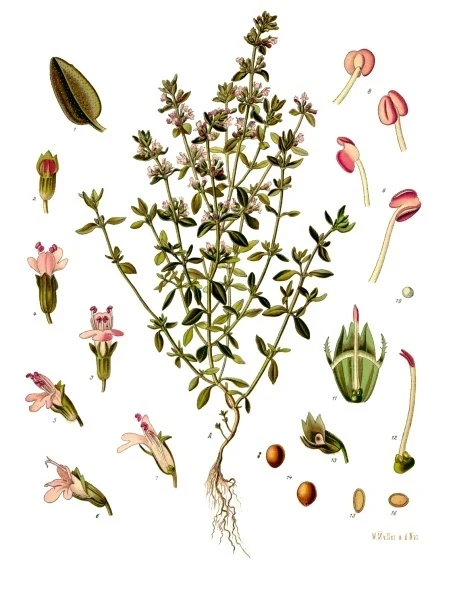
An illustration is not enough to identify a plant for consumption. Do not forage for a species based solely on this profile.
01 · UNDERSTAND
Properties & uses.
Productive cough associated with a cold
Traditional use to support a productive cough associated with a cold. The trials evaluated do not allow a firm conclusion on clinical efficacy.
Read the sourceThe traditional uses described are not clinical proof of effectiveness. Evidence for one preparation cannot automatically be applied to another.
02 · UNDERSTAND THE ACTION
How does the plant act?
The European thyme dossier concerns the leaves and flowers of Thymus vulgaris or Thymus zygis, sometimes mixed. It recognizes traditional use for productive cough associated with a cold. Actions on airway muscles and microorganisms are mainly experimental. Favorable human trials exist for combinations with ivy or primrose, but they do not measure the effect of common thyme alone and do not establish an equivalent herbal tea.
Constituents to know.
Their presence and quantity depend on the plant part and preparation.
- Thymol, carvacrol and aromatic variability
- The aromatic composition varies with the chemotype. Medicinal material favors a thymol profile; not all oils labeled “thyme” therefore have the same composition.Read the reference
- Flavonoids and phenolic acids
- The plant contains derivatives of apigenin, luteolin and rosmarinic acid, among others. The solvent and extraction process alter the proportions found in the final product.Read the reference
Traditional support for productive cough
The recognized use concerns a cough with expectoration during a cold. It is based on long-standing use and does not demonstrate treatment of bacterial bronchitis, asthma or pneumonia.
Read the referenceAirway muscle and mucus transport
Relaxant effects and effects on ciliary transport are observed in isolated tissues and animals. The EMA considers some concentrations too high to directly explain an effect in humans.
Read the referenceAntimicrobial activity in the laboratory
The inhibition of microorganisms in the laboratory does not demonstrate anti-infective efficacy after ingestion or an ability to disinfect the bronchi. Essential oil does not replace treatment for an infection.
Read the referenceWhat this means for preparation.
Check the species, plant part and full composition of a syrup: a mixture may contain several active plants. Breathing difficulties, fever or purulent sputum require medical advice; the traditional-use dossier does not cover these situations.
03 · EXAMINE THE EVIDENCE
What the research shows.
A laboratory or animal result alone does not demonstrate a benefit in humans. Each result must be read alongside the preparation studied and its limitations.
Thyme–ivy combination: 2006 trial
- Type of research
- Double-blind randomized trial in 361 adults with acute bronchitis and productive cough, over 11 days.
- Preparation concerned
- Syrup combining a fluid extract of thyme herb with an ivy leaf extract; compared with placebo.
- Observed results
- Coughing fits decreased by 68.7% with the combination, compared with 47.6% with placebo, between the start of the study and days 7 to 9. The threshold of a one-half reduction was reached earlier in the treated group.
- Limitations to consider
- The result applies to a specific combination and formulation. It does not allow thyme's contribution to be separated from ivy's, or extrapolation to an infusion or essential oil.
Thyme alone: why the evidence remains traditional
- Type of research
- Public EMA assessment of a study in 60 adults with a productive cough.
- Preparation concerned
- Thyme preparation compared with bromhexine; product characterization was considered insufficiently precise.
- Observed results
- No significant difference was found between the groups. EMA considers this result insufficient to establish thyme's efficacy.
- Limitations to consider
- A small sample and an active comparator, without robust evidence against placebo, do not demonstrate therapeutic equivalence. The precise identity of the preparation also determines interpretation.
What can we take from this?
The shared monograph does not demonstrate an isolated effect of Thymus vulgaris compared with Thymus zygis. Results for a combination do not justify adding essential oils at home or replacing care for a respiratory disease.
Documentary review dated 09/10/2026. The references remain available to check the context.
04 · CHOOSE A PREPARATION
One plant, several preparations.
Only forms documented in this profile’s sources are presented.
InfusionLeaves and flowers · Route: oral
Liquid and dry extractsLeaves and flowers · Route: oral
Specific preparations defined by the extraction process.
Please note: Concentrations and age restrictions differ; follow the leaflet.
Read the sourceTinctureLeaves and flowers · Route: oral
Documented hydroalcoholic form.
Please note: Contains alcohol; do not prepare it using a different extract.
Read the source05 · BEFORE ANY USE
Precautions & contraindications.
This guidance does not cover every individual situation. Missing information is not a guarantee of safety.
Contraindications
- Allergy to thyme or other Lamiaceae.
Medicine interactions
- No interactions reported in the monograph; this does not guarantee compatibility with all treatments.
Adverse effects
- Stomach upset is possible; frequency unknown.
Pregnancy & breastfeeding
Pregnancy and breastfeeding: medicinal use is not recommended because of insufficient data. Safety has not been established.
Children & adolescents
Most forms, including herbal tea, are not recommended under 12 years of age. Some specific preparations are available from age 4: check the package leaflet with a professional.
If symptoms persist, worsen or are unusual, consult a healthcare professional. In an emergency, contact the emergency services.
06 · PUTTING KNOWLEDGE INTO PRACTICE
Preparations & recipes.
A DOCUMENTED PREPARATION
Thyme infusion — cold-related chesty cough
Traditional expectorant use for a chesty cough associated with a cold. Results from combination extracts do not prove the efficacy of this tea alone.
Plant part: Dried leaves and flowers of Thymus vulgaris L.
Ingredients & quantities
- 1–2 g dried Thymus vulgaris L. leaves and flowers supplied for herbal tea
- 150 ml boiling drinking water
Preparation steps
- Weigh the leaves and flowers; do not use essential oil.
- Pour the 150 ml boiling water over the herb.
- Steep for 5–15 minutes: the EMA glossary’s general method, as the monograph gives no plant-specific time. Follow the tea’s leaflet first.
- Strain, then allow to cool to a comfortable temperature before use.
Use: Adults aged 18+. EMA reference: one preparation per dose, 3–4 times daily. Seek advice if the cough lasts over one week or worsens.
Storage: Prepare immediately before use (EMA glossary). The monograph establishes no storage period; do not prepare a stock batch.
Before you start. Contraindicated with thyme or Lamiaceae allergy. Stomach upset is possible. Medicinal use is not recommended during pregnancy or breastfeeding because data are insufficient. Seek prompt medical advice for breathing difficulty, fever or purulent sputum.
07 · CHECK THE SOURCES
Sources for this profile.
- EMA — Thymus vulgaris L.: summary and documentsAccessed on 08/10/2026
- EMA — Thymus vulgaris L. et Thymus zygis L., herba monograph: preparation and precautionsAccessed on 09/10/2026
- Royal Botanic Gardens, Kew — botanical identityAccessed on 08/10/2026
- EMA — Assessment report on Thymus vulgaris L., Thymus zygis L., herbaAccessed on 09/10/2026
- Kemmerich et al. (2006) — Efficacy and tolerability of a fluid extract combination of thyme herb and ivy leaves and matched placebo in adults suffering from acute bronchitis with productive cough. A prospective, double-blind, placebo-controlled clinical trialAccessed on 09/10/2026
- EMA — Glossary on herbal teas: general preparation method, §4Accessed on 09/10/2026
Illustration: Walther Otto Müller, Köhler’s Medizinal-Pflanzen · Public domain (Public Domain Mark 1.0). View the original image and its licence. Image resized and converted to WebP.
A TOUCH OF SOLÉA
Myriam’s tip
Myriam is reviewing the tip for this profile.
Myriam