Identity & origin
BOTANICAL IDENTITY
The right name is the first step.
The root is used in aqueous preparations or extracts with differing uses.
Also known as: No synonyms listed.
The botanical name, part and preparation must match. A photograph is not enough for identification intended for consumption.
An illustration is not enough to identify a plant for consumption. Do not forage for a species based solely on this profile.
Uses & evidence
UNDERSTANDING THE USES
Properties & uses.
Throat and dry cough
Traditional use for irritation of the mouth/throat and the associated dry cough.
Use considered plausible in a traditional-use monograph. That status alone does not demonstrate clinical efficacy.
Read the sourceMild digestive discomfort
Traditional use; insufficient clinical evidence for general efficacy.
Use considered plausible in a traditional-use monograph. That status alone does not demonstrate clinical efficacy.
Read the sourceThe traditional uses described are not clinical proof of effectiveness. Evidence for one preparation cannot automatically be applied to another.
Precautions before use
BEFORE ANY USE
Precautions & contraindications.
This guidance does not cover every individual situation. Missing information is not a guarantee of safety.
Contraindications & precautions
- Source-listed contraindicationKnown allergy to the preparation.Source
Medicine interactions
- Possible interactionMay delay medicine absorption. For supplements, ANSES recommends at least a one-hour interval; have the medication regimen checked.Source
“Reported” does not prove causality; “possible” may reflect indirect evidence. “None reported” means none in the cited source, not that all combinations have been studied. Do not stop a prescribed treatment based on this profile.
Adverse effects
- No adverse effects reported in the EMA summary at the time of its assessment.
Pregnancy & breastfeeding
Not recommended during pregnancy or breastfeeding: insufficient safety data.
SourceChildren & adolescents
Cough: certain aqueous forms from 3; no solid forms below 6. Digestion: macerate from 12. Alcoholic extract: adults.
SourceIf symptoms persist, worsen or are unusual, consult a healthcare professional. In an emergency, contact the emergency services.
Forms & how they are used
DOCUMENTED FORMS
One plant, several preparations.
Only forms documented in this profile’s sources are presented.
Water macerationRoot · Route: oral / mouth
Fragmented root prepared according to an appropriate package leaflet.
Please note: Check the preparation and its leaflet; concentrations are not interchangeable.
Read the sourceSyrup or extractRoot · Route: oral
Preparation formulated from the root.
Please note: Alcoholic extracts are not suitable for the same age groups.
Read the sourcePreparations: ingredients & steps
DOCUMENTED PREPARATIONS
Preparations & recipes.
A DOCUMENTED PREPARATION
Marshmallow macerate — throat and dry cough
Demulcent reference for mouth or throat irritation with dry cough. Traditional use; robust clinical trials have not established this preparation’s efficacy.
Plant part: Dried, cut root
Ingredients & quantities
- 0.5–3 g dried, cut Althaea officinalis L. root
- 150 ml room-temperature drinking water
Preparation steps
- Weigh the identified, dried, cut plant part supplied for this use; use clean utensils.
- Add 150 ml drinking water at room temperature.
- Macerate for 30 minutes: the EMA glossary’s general reference, as the monograph gives no specific duration. Follow the product leaflet first.
- Strain and use immediately; do not leave to soak overnight.
Use: For adults aged 18+ in this collection. The monograph describes one preparation per dose, several times daily, with a maximum total of 15 g root daily. This ceiling is not a target; follow the leaflet and pharmacist’s advice. Seek advice if symptoms last over one week, worsen, or if fever, breathing difficulty or purulent sputum develops.
Storage: Use immediately after preparation, as required by the monograph. Do not store or make ahead.
Before you start. Contraindicated with marshmallow allergy. Mucilage may delay medicine absorption: as a precaution EMA advises separating it from other medicines by 30 minutes to one hour before or after; ask a pharmacist about the interval for your treatment. Use is not recommended during pregnancy or breastfeeding because data are insufficient.
A DOCUMENTED PREPARATION
Marshmallow macerate — mild digestive discomfort
Demulcent reference for mild gastrointestinal discomfort; this quantity differs from the throat preparation. Traditional use; robust clinical trials have not established this preparation’s efficacy.
Plant part: Dried, cut root
Ingredients & quantities
- 2–5 g dried, cut Althaea officinalis L. root
- 150 ml room-temperature drinking water
Preparation steps
- Weigh the identified, dried, cut plant part supplied for this use; use clean utensils.
- Add 150 ml drinking water at room temperature.
- Macerate for 30 minutes: the EMA glossary’s general reference, as the monograph gives no specific duration. Follow the product leaflet first.
- Strain and use immediately; do not leave to soak overnight.
Use: For adults aged 18+ in this collection. One preparation per dose, 3 times daily; maximum 15 g root daily. Do not add this preparation to the throat macerate. Seek advice if discomfort persists beyond 2 weeks, worsens or becomes painful.
Storage: Use immediately after preparation, as required by the monograph. Do not store or make ahead.
Before you start. Contraindicated with marshmallow allergy. Mucilage may delay medicine absorption: as a precaution EMA advises separating it from other medicines by 30 minutes to one hour before or after; ask a pharmacist about the interval for your treatment. Substantial or unusual abdominal pain needs medical assessment. Use is not recommended during pregnancy or breastfeeding because data are insufficient.
A DOCUMENTED PREPARATION
Marshmallow — throat macerate, ages 6–11
Traditional demulcent use for irritation of the mouth or throat with a dry cough. Mucilage supports the plausibility of this action; this does not establish robust clinical benefit in children.
EMA/HMPC/436679/2015, section 4.2, throat/dry-cough indication: explicit ages 6–11. The protocol changes for adolescents; this card does not apply at age 12.
Read the complete children’s chapterPlant part: Dried cut root
Ingredients & quantities
- 0.5–1.5 g pharmaceutical-quality dried, cut Althaea officinalis L. root
- 150 ml drinking water at room temperature
Preparation steps
- An adult checks the leaflet and weighs the amount agreed with the professional into a clean container. Do not use garden-collected root.
- Pour the 150 ml water over the root. Macerate for about 30 minutes at room temperature unless the leaflet says otherwise: this is the EMA glossary’s general reference; the monograph specifies no plant-specific time.
- Strain with clean equipment. Do not extend maceration overnight.
- Use immediately after preparation. No additional heating is prescribed here: if the product leaflet specifies another method, follow it with the pharmacist.
Use: EMA reference for ages 6–11: one preparation, 3 times daily, totalling 1.5–4.5 g root daily. Consult if cough or irritation lasts over one week; earlier for worsening symptoms, fever or purulent sputum. Difficulty breathing is an emergency.
Storage: Use immediately after preparation, as specified by the monograph. Discard any remainder; neither refrigerated storage nor preparation for the following day is established.
Before you start. Before medicinal use in a child, ask a pharmacist or doctor to confirm the product and dose. Contraindicated with marshmallow allergy. Cold maceration does not reduce microbial load as boiling does: pharmaceutical-quality material, hygiene and immediate use are essential. Other medicines may be absorbed more slowly: EMA specifies a 30–60 minute interval before or after their intake; ask the pharmacist to confirm the schedule. Do not transfer this protocol to digestive discomfort, syrup or extract.
A DOCUMENTED PREPARATION
Elder, lime & marshmallow — a five-herb cold formula
Traditional use for early cold symptoms, including an irritating cough. Fever requires monitoring.
Keep the exact formula, plant parts and preparation stated below. Some blends require a specified ready-made product or professional preparation. Do not create your own substitutions.
Plant part: Elder, lime and meadowsweet flowers; ribwort plantain leaves; marshmallow root.
Ingredients & quantities
- 1 pre-dosed 1.4 g sachet of the cited product. Reference: DR. KOTTAS Grippe-Erkältungstee.
- Per sachet: 0.28 g elder flowers; 0.336 g lime flowers; 0.308 g ribwort plantain leaves; 0.21 g marshmallow root; 0.266 g meadowsweet flowers.
- 125 ml boiling water.
Preparation steps
- Pour 125 ml boiling water over one sachet.
- Cover and infuse for 10–15 minutes.
- Squeeze and remove the sachet; drink lukewarm.
Use: Adult leaflet: 1 cup 3–4 times daily. Seek advice if worsening or no improvement after 7 days; do not wait if warning signs appear.
Storage: The leaflet gives no storage period for the prepared infusion; prepare for immediate use rather than storing a batch. Store sachets according to their packaging and expiry date.
Before you start. This record applies only to the cited pre-dosed product, after a pharmacist checks its current leaflet. Do not recreate or modify the mixture at home. General information, not a replacement for diagnosis or treatment. Contains meadowsweet flowers: contraindicated with salicylate intolerance. Contraindications: Allergy to any ingredient. Salicylate intolerance. Not recommended during pregnancy or breastfeeding because data are insufficient.
Properties, interactions & contraindications
Read before using this blend.
Do not stop or change a prescribed treatment. Show the exact ingredients and quantities to your pharmacist, including any other herbal products you take.
This review combines the exact formula’s source with ingredient-specific references. It does not establish synergy, assess every medicine, or guarantee that the mixture is suitable for you. “None reported” means no reports in the cited source, not proven compatibility.
Additional review needed: Multi-species pharmacopoeial lime flowers · Meadowsweet FLOWERS. The blend’s leaflet and warnings remain essential.
Review of the exact formulaDR. KOTTAS Grippe-Erkältungstee · Cited pre-dosed pharmaceutical product
Preparations covered by this ingredient review: infusion. These forms cannot be substituted for one another.
Documented uses and limits
- Marshmallow and plantain provide mucilage associated with soothing use. Elder and lime flowers have a traditional role in early colds. Meadowsweet does not establish a clinical anti-inflammatory benefit for the combination.↗
- Registration rests on traditional use. The leaflet does not establish clinical efficacy or synergy between ingredients. Findings for concentrated extracts cannot be transferred to this infusion.↗
Contraindications
Medicines and interactions
- Interaction reported in the sourceSmPC §4.5: interaction studies are absent; none known were reported.↗
- Possible interaction · cautionAsk a pharmacist before combining with aspirin, NSAIDs or anticoagulants because meadowsweet is present; precaution, not an interaction demonstrated by this SmPC.↗
Precautions and adverse effects
- Seek immediate medical advice for fever above 39°C, persistent fever despite sweating, breathing difficulty or purulent sputum.↗
- Lime is pharmacopoeial Tiliae flos: retain the product’s identity and do not substitute an unspecified lime tree.↗
- For marshmallow root, EMA notes possible delayed medicine absorption and advises a precautionary interval of ½–1 hour before or after other medicines. This comes from the ingredient monograph, not a trial of this mixture; ask a pharmacist to confirm timing.↗
- Mild gastric discomfort; frequency unknown.↗
Pregnancy, breastfeeding and children
Black elderSambucus nigra · Dried Sambucus nigra flowers
Preparations covered by this ingredient review: infusion. These forms cannot be substituted for one another.
Read the plant’s current safety profileDocumented uses and limits
- Traditional relief of early symptoms of a common cold.↗
- EMA traditional use for this part and preparation. This does not establish the efficacy or safety of a new blend.↗
What is known about its action
- EMA does not have clinical data establishing flower efficacy. Common-cold use is traditional, without antiviral promises or extrapolation from berries.↗
Contraindications
- Allergy to the plant.↗
Medicines and interactions
- No interaction reported in this sourceNo interactions reported in the EMA monograph reviewed.↗
Precautions and adverse effects
- Seek medical advice for worsening symptoms, breathlessness, fever or purulent sputum.↗
- Trials of berries or berry extracts are not evidence for flower infusion.↗
- No adverse effects known in the monograph; this is not a guarantee of no risk.↗
Pregnancy, breastfeeding and children
Ribwort plantainPlantago lanceolata · Plantago lanceolata leaves
Preparations covered by this ingredient review: infusion. These forms cannot be substituted for one another.
Read the plant’s current safety profileDocumented uses and limits
- Traditional demulcent use for mouth/throat irritation and associated dry cough; relief of cough with a cold.↗
- EMA traditional use for this part and preparation. This does not establish the efficacy or safety of a new blend.↗
What is known about its action
- EMA states that the exact mechanism is unknown. Experimental findings are limited and controlled studies do not establish well-established use.↗
Contraindications
- Allergy to ribwort plantain or its pollen.↗
Medicines and interactions
- No interaction reported in this sourceNo interactions reported in the EMA monograph reviewed.↗
Precautions and adverse effects
- Seek medical advice for worsening symptoms, breathlessness, fever or purulent sputum.↗
- The 2025 revision specifies oral infusion from 12; macerates here concern oromucosal/cutaneous routes with separate rules.↗
- No adverse effects known in the monograph; this is not a guarantee of no risk.↗
Pregnancy, breastfeeding and children
MarshmallowAlthaea officinalis L. · Root
Preparations covered by this ingredient review: maceration. These forms cannot be substituted for one another.
Read the plant’s current safety profileDocumented uses and limits
- Traditional demulcent use: mouth/throat irritation with dry cough; mild gastrointestinal discomfort.↗
- EMA traditional use for this part and preparation. This does not establish the efficacy or safety of a new blend.↗
What is known about its action
- Mucilage polysaccharide adhesion to mucosa has been studied experimentally, consistent with a demulcent role. Human evidence does not establish well-established use; the blend remains untested.↗
Contraindications
- Allergy to the plant.↗
Medicines and interactions
- No interaction reported in this sourceNo interactions reported in section 4.5.↗
- Possible interaction · cautionAbsorption of medicines taken together may be delayed. As a precaution, EMA advises separating use by 30–60 minutes before or after other medicines (4.4).↗
Precautions and adverse effects
- Seek medical advice for worsening symptoms, breathlessness, fever or purulent sputum.↗
- Root water macerate is the specified tea preparation; use immediately. Do not automatically replace with an infusion.↗
- No adverse effects known in the monograph; this is not a guarantee of no risk.↗
Pregnancy, breastfeeding and children
Documentary review: 2026-10-09
This plant in documented blends
These recipes have their own formula and precautions. The dose of a single plant cannot be transferred to a blend.
Understanding the plant’s actions
EXPLORE THE EVIDENCE
How does the plant act?
The root is understood primarily as a preparation that soothes mucous membranes on contact, for irritation of the mouth or throat with a dry cough, and mild digestive discomfort. This local action differs from that of an antibiotic or an expectorant. Mucilages suggest an interesting physical mechanism, but depicting a protective film as conclusively demonstrated in humans would be too assertive.
Constituents to know.
Their presence and quantity depend on the plant part and preparation.
- Polysaccharide mucilages
- The root contains hydrophilic polysaccharides. Their composition and proportion vary; aqueous and alcoholic extracts do not necessarily extract them in the same way.Read the reference
Adhesion to mucous membranes
Purified polysaccharides adhered moderately to isolated porcine oral mucosa. This model supports a local hypothesis without exactly reproducing human saliva and mucus.
Laboratory or animal observation. A human benefit cannot be inferred from this finding alone.
Read the referenceIrritation and dry cough
The soothing use is traditional. It targets irritation associated with a dry cough, not every cough or its cause.
Use considered plausible in a traditional-use monograph. That status alone does not demonstrate clinical efficacy.
Read the referenceWhat this means for preparation.
Check that the root is used and identify the type of extract or syrup. The formulation, other ingredients and age specified in the leaflet matter.
Studies, findings & limitations
THE RESEARCH
What the research shows.
A laboratory or animal result alone does not demonstrate a benefit in humans. Each result must be read alongside the preparation studied and its limitations.
Examining the protective film concept
The references do not establish a benefit. Lack of evidence is not assurance of safety.
- Type of research
- EMA review of experimental and clinical data.
- Preparation concerned
- Root, aqueous extracts and isolated polysaccharides.
- Observed results
- Experimental adhesion provides limited mechanistic support; human evidence does not reach the level required for well-established use.
- Limitations to consider
- A result in isolated tissue measures neither the intensity nor the duration of relief in a person.
What can we take from this?
Marshmallow does not treat a respiratory infection. Contact with mucilage may also warrant checking the interval between taking it and other medicines; the exact preparation must be considered.
Documentary review dated 09/10/2026. The references remain available to check the context.
Sources & last review
CHECKING REFERENCES
Sources for this profile.
- EMA — Althaeae radix: official dossierAccessed on 09/10/2026
- ANSES — precautions for plants in food supplements, June 2023 summaryAccessed on 09/10/2026
- EMA — Assessment report on Althaea officinalis L. (root)Accessed on 09/10/2026
- EMA — Althaea officinalis L., radix, monographie finale EMA/HMPC/436679/2015, §4.4–4.5Accessed on 09/10/2026
- EMA — Glossary on herbal teas: general preparation method, §4Accessed on 09/10/2026
- BASG — DR. KOTTAS Grippe-Erkältungstee, HERB-00080, RCP 12/2020, §2, 4.1–4.9, 6.1–6.5Accessed on 09/10/2026
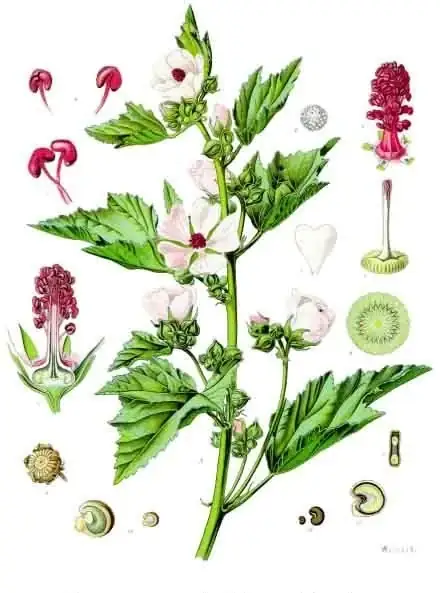
Image: Franz Eugen Köhler, Köhler's Medizinal-Pflanzen · Public domain. View the original image and its licence. Image resized and converted to WebP.