BOTANICAL IDENTITY
The right name is the first step.
Also known as: Sweet fennel, Bitter fennel
Check the scientific name and the part used; a photograph is not sufficient for foraging plants intended for consumption.
An illustration is not enough to identify a plant for consumption. Do not forage for a species based solely on this profile.
01 · UNDERSTAND
Properties & uses.
Digestion
Traditional use of the fruits for bloating and mild digestive spasms.
Read the sourceCough associated with a cold
Traditional expectorant use; does not replace examination if breathing becomes difficult.
Read the sourceMenstrual cramps
Traditional use of the fruits for minor menstrual spasms.
Read the sourceThe traditional uses described are not clinical proof of effectiveness. Evidence for one preparation cannot automatically be applied to another.
02 · UNDERSTAND THE ACTION
How does the plant act?
Fennel is documented mainly for its fruits, often called seeds. Its digestive, respiratory and menstrual uses remain traditional. Smooth muscle experiments make an action on digestive contractions plausible, without demonstrating that every herbal tea relieves a digestive disease. Variety, grinding and preparation influence the extracted content: results on an aromatic fraction do not automatically describe those of an infusion.
Constituents to know.
Their presence and quantity depend on the plant part and preparation.
- Trans-anethole
- Constituent studied separately in digestive models; its pharmacology does not represent that of the whole fruit.Read the reference
- Estragole
- A constituent that warrants exposure restrictions, particularly in children; its presence must be taken into account in product quality.Read the reference
Mild digestive spasms
The use concerns bloating, flatulence and mild painful contractions; it does not mean treatment of an ulcer or obstruction.
Read the referenceSmooth muscle contractions
A hydroalcoholic extract of bitter fennel experimentally reduced contractions of isolated intestine induced by acetylcholine and histamine.
Read the referenceCough and menstruation
The fruits also have recognized traditional use as an expectorant for colds and for minor menstrual cramps.
Read the referenceWhat this means for preparation.
Look for the variety and part on the label, then a preparation with explicit precautions. Essential oil is not an equivalent way of preparing the fruits.
03 · EXAMINE THE EVIDENCE
What the research shows.
A laboratory or animal result alone does not demonstrate a benefit in humans. Each result must be read alongside the preparation studied and its limitations.
What digestive models show
- Type of research
- EMA review of work on isolated organs and animals.
- Preparation concerned
- Extracts, powdered fruits or isolated anethole, depending on the experiment.
- Observed results
- Effects on contractions, emptying or transit were observed.
- Limitations to consider
- The variety is often unspecified; models, solvents and doses differ from a human infusion.
What can we take from this?
These experiments establish neither a beneficial hormonal effect nor the safety of prolonged use. No recipe for infants follows from these results.
Documentary review dated 09/10/2026. The references remain available to check the context.
04 · CHOOSE A PREPARATION
One plant, several preparations.
Only forms documented in this profile’s sources are presented.
InfusionFruits · Route: oral
Dried fruits, identified as sweet or bitter fennel.
Please note: Estragole requires precautions; no preparation is intended for infants.
Read the source05 · BEFORE ANY USE
Precautions & contraindications.
This guidance does not cover every individual situation. Missing information is not a guarantee of safety.
Contraindications
- Allergy to fennel, Apiaceae, anethole or mugwort pollen.
Medicine interactions
- No established interaction is included in this entry; this does not guarantee compatibility with a treatment.
Adverse effects
- Allergic skin or respiratory reactions are possible.
Pregnancy & breastfeeding
Pregnancy and breastfeeding: medicinal use is not recommended because of insufficient data.
Children & adolescents
Not recommended under 4 years. From 4 to 12 years, estragole exposure must be checked by a professional; menstrual use is not established under 12 years.
If symptoms persist, worsen or are unusual, consult a healthcare professional. In an emergency, contact the emergency services.
06 · PUTTING KNOWLEDGE INTO PRACTICE
Preparations & recipes.
A DOCUMENTED PREPARATION
Sweet fennel infusion — occasional bloating
Traditional use for mild digestive spasms, bloating and gas. This recipe applies specifically to identified sweet fennel fruit; neither the edible bulb nor essential oil is a substitute.
Plant part: Dried sweet fennel fruit, var. dulce
Ingredients & quantities
- 1.5 g dried fruit of Foeniculum vulgare Miller subsp. vulgare var. dulce (Mill.) Batt. & Trab.
- 250 ml boiling drinking water
Preparation steps
- Check that a quality-controlled tea specifies the sweet variety and the fruit; follow its leaflet for whole or cut material. Weigh 1.5 g.
- Pour 250 ml boiling drinking water over the herb in a heatproof container.
- Steep for 15 minutes, the time specified in the monograph.
- Strain, then allow to cool to a comfortable temperature before drinking.
Use: EMA reference: one preparation per dose, 3 times daily, totalling 4.5 g fruit. Do not exceed 2 weeks; seek advice if symptoms persist or worsen. With a pharmacist, choose a quality-controlled product intended for medicinal use.
Storage: Prepare immediately before use, following the EMA glossary. The monograph provides no domestic storage period; do not prepare a stock batch.
Before you start. For adults aged 18+ in this collection. Not recommended during pregnancy or breastfeeding because sufficient safety data are lacking. Contraindicated with fennel, anethole or Apiaceae allergy (aniseed, caraway, celery, coriander, dill), or mugwort-pollen allergy. Skin or respiratory allergic reactions are possible. Estragole exposure should be kept as low as possible: avoid prolonged courses, concentrates and combining fennel products. Do not adapt this adult recipe for a child. No interactions are reported in this monograph; this does not establish compatibility with medicines. Ask a pharmacist if you take medication.
07 · CHECK THE SOURCES
Sources for this profile.
- EMA — Foeniculi dulcis fructus: assessment and documentsAccessed on 09/10/2026
- EMA — Foeniculi amari fructus: assessment and documentsAccessed on 09/10/2026
- EMA — Foeniculi amari fructus aetheroleum: assessment and documentsAccessed on 09/10/2026
- ANSES — summary of precautions for food supplements (June 2023)Accessed on 09/10/2026
- EMA — Foeniculum vulgare Miller subsp. vulgare var. dulce (Mill.) Batt. & Trab., fructus: monograph, preparation and precautionsAccessed on 09/10/2026
- EMA — assessment report on sweet and bitter fennel fruits, revision 1Accessed on 09/10/2026
- EMA — Glossary on herbal teas: general methods, §4Accessed on 09/10/2026
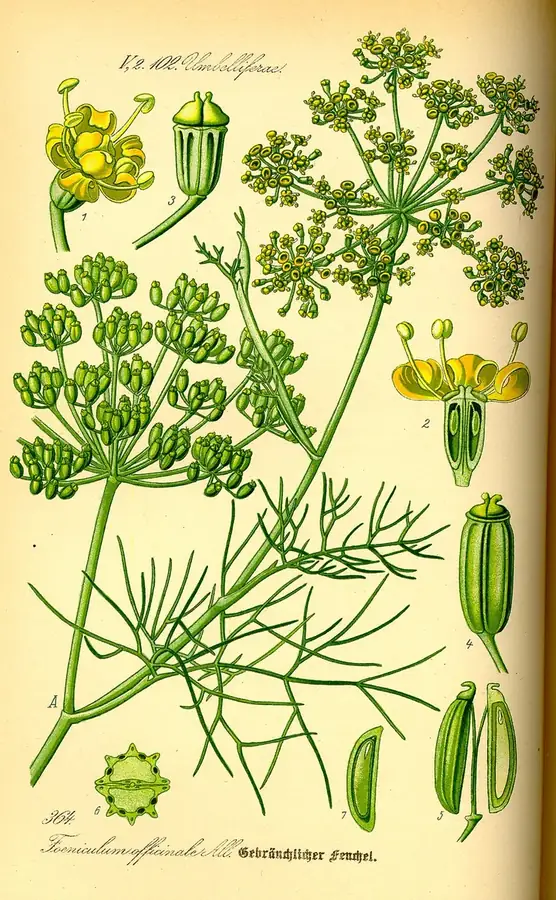
Illustration: Otto Wilhelm Thomé · Public domain. View the original image and its licence. Image resized and converted to WebP.
A TOUCH OF SOLÉA
Myriam’s tip
Myriam is reviewing the tip for this profile.
Myriam