BOTANICAL IDENTITY
The right name is the first step.
Also known as: No synonyms listed.
The botanical name and part used must match the profile; a photograph alone is not sufficient grounds for consuming a plant.
An illustration is not enough to identify a plant for consumption. Do not forage for a species based solely on this profile.
01 · UNDERSTAND
Properties & uses.
The traditional uses described are not clinical proof of effectiveness. Evidence for one preparation cannot automatically be applied to another.
02 · UNDERSTAND THE ACTION
How does the plant act?
Fenugreek seed is a food, a fibre-rich material and a plant with traditional uses. The recognised European indications are temporary loss of appetite and, externally, minor skin inflammation. Studies on blood glucose form a different dossier: they do not turn a herbal tea or dietary supplement into a diabetes treatment. Extracts, powder and whole seeds do not supply the same fractions.
Constituents to know.
Their presence and quantity depend on the plant part and preparation.
- Galactomannans
- Mucilaginous polysaccharides in the seed: their viscosity contributes to hypotheses concerning the intestinal passage of nutrients.Read the reference
- Trigonelline and saponins
- Several families coexist; no isolated constituent summarizes the traditional uses recognized.Read the reference
Appetite and topical use
Two distinct traditional uses, with different preparations and routes; efficacy for appetite is not supported by sufficient clinical trials.
Read the referenceGlucose metabolism
Experiments suggest changes in intestinal absorption or insulin secretion, depending on the fraction studied. These mechanisms are not definitively established in humans.
Read the referenceWhat this means for preparation.
Allergy to legumes, particularly peanuts or soy, deserves particular attention. In someone being treated for diabetes, an additional effect on blood glucose requires professional review.
03 · EXAMINE THE EVIDENCE
What the research shows.
A laboratory or animal result alone does not demonstrate a benefit in humans. Each result must be read alongside the preparation studied and its limitations.
Why metabolic research remains difficult to generalize
- Type of research
- EMA assessment of experimental and clinical research.
- Preparation concerned
- Seeds, powders and aqueous or alcoholic extracts of different compositions.
- Observed results
- Blood glucose signals have motivated several studies.
- Limitations to consider
- Heterogeneous preparations and methods; these results do not establish a European indication for the treatment of diabetes.
What can we take from this?
Neither stimulation of lactation nor increased testosterone is established by the traditional indications in this profile. Pregnancy and breastfeeding are not situations for personal experimentation.
Documentary review dated 09/10/2026. The references remain available to check the context.
04 · CHOOSE A PREPARATION
One plant, several preparations.
Only forms documented in this profile’s sources are presented.
Herbal tea or powderSeed · Route: oral
Whole, comminuted or powdered seed.
Please note: When taking antidiabetic treatment, monitor blood glucose.
Read the sourceExternal preparationSeed · Route: topical
Infusion prepared from seeds or powder.
Please note: Allergy risk, even with local use.
Read the source05 · BEFORE ANY USE
Precautions & contraindications.
This guidance does not cover every individual situation. Missing information is not a guarantee of safety.
Contraindications
- Allergy to fenugreek, peanuts, soy or other Fabaceae.
Medicine interactions
- None reported, but a possible blood glucose-lowering effect: monitor if taking diabetes treatment.
Adverse effects
- Gas, diarrhea, dizziness; allergies sometimes affecting breathing or involving facial swelling.
Pregnancy & breastfeeding
Not recommended during pregnancy and breastfeeding, or in women who could conceive without contraception: reproductive toxicity observed in animals.
Children & adolescents
Medicinal use for adults only.
If symptoms persist, worsen or are unusual, consult a healthcare professional. In an emergency, contact the emergency services.
06 · PUTTING KNOWLEDGE INTO PRACTICE
Preparations & recipes.
No home recipe is provided in this profile. For an appropriate preparation, refer to the product leaflet and ask your pharmacist for advice.
07 · CHECK THE SOURCES
Sources for this profile.
- EMA — Trigonellae foenugraeci semen: dossier and documentsAccessed on 09/10/2026
- EMA — monograph: Trigonellae foenugraeci semenAccessed on 09/10/2026
- ANSES — precautions for herbal supplements, June 2023 tableAccessed on 09/10/2026
- EMA — Scientific assessment report: Trigonella foenum-graecumAccessed on 09/10/2026
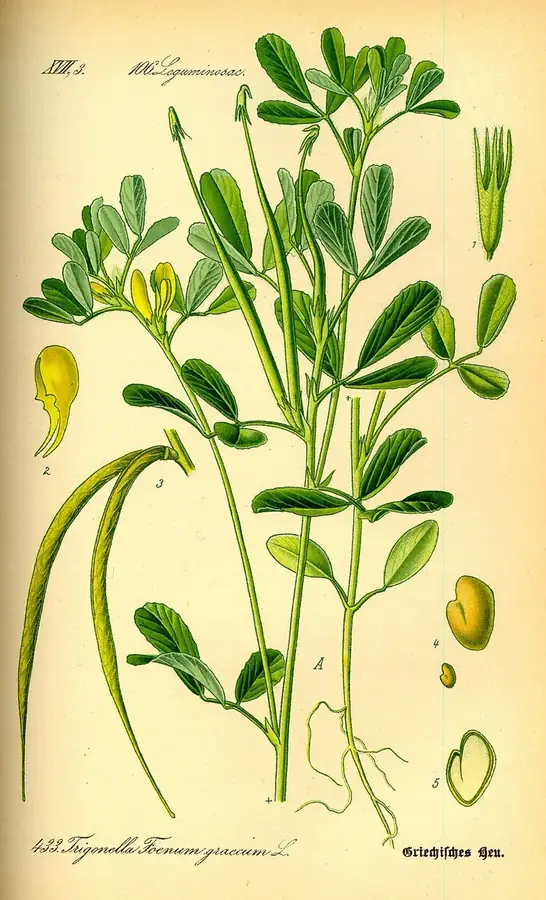
Illustration: Prof. Dr. Otto Wilhelm Thomé Flora von Deutschland, Österreich und der Schweiz 1885, Gera, Germany · Public domain. View the original image and its licence. Image resized and converted to WebP.
A TOUCH OF SOLÉA
Myriam’s tip
Myriam is reviewing the tip for this profile.
Myriam