Identity & origin
BOTANICAL IDENTITY
The right name is the first step.
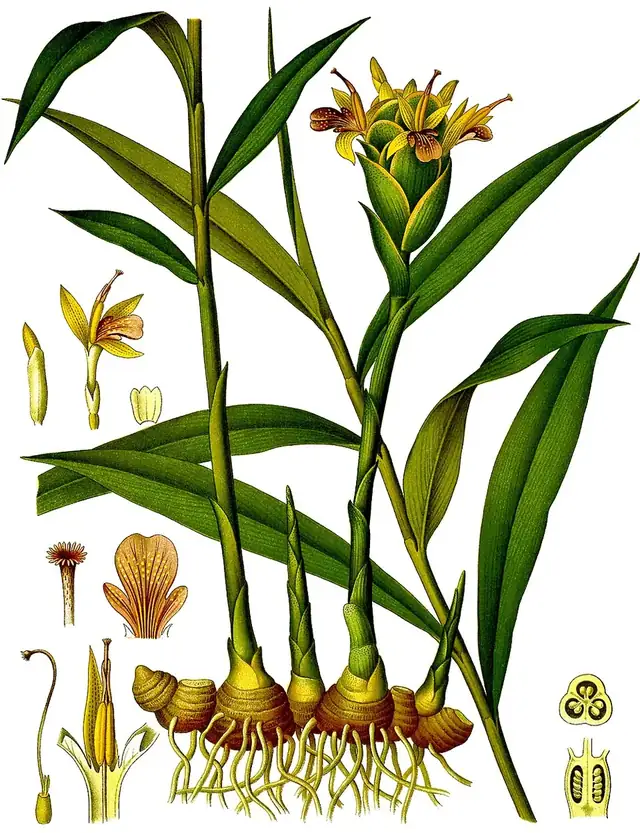
Ginger is documented in the form of dried rhizome. The monograph distinguishes prevention of motion sickness and several traditional uses.
Also known as: No synonyms listed.
A common name and photograph do not guarantee identification. Check the botanical name and part indicated on a traceable product.
An illustration is not enough to identify a plant for consumption. Do not forage for a species based solely on this profile.
Uses & evidence
UNDERSTANDING THE USES
Properties & uses.
Motion sickness
Well-established medicinal use of powdered rhizome to prevent motion-sickness nausea and vomiting in adults. This does not extend to teas, sweets or every cause of nausea.
EMA status applies only to the described preparation and indication, not every form of the plant.
Read the sourceBloating and mild digestive spasms
Traditional use; clinical benefit not established for all preparations.
Use considered plausible in a traditional-use monograph. That status alone does not demonstrate clinical efficacy.
Read the sourceThe traditional uses described are not clinical proof of effectiveness. Evidence for one preparation cannot automatically be applied to another.
Precautions before use
BEFORE ANY USE
Precautions & contraindications.
This guidance does not cover every individual situation. Missing information is not a guarantee of safety.
Contraindications & precautions
- Source-listed contraindicationAllergy to the active substance.Source
Medicine interactions
- No interaction reported in the sourceNo interactions are reported in the monograph for the specified preparations; this does not establish compatibility with every medicine.Source
“Reported” does not prove causality; “possible” may reflect indirect evidence. “None reported” means none in the cited source, not that all combinations have been studied. Do not stop a prescribed treatment based on this profile.
Adverse effects
- Nausea and digestive disturbances are possible.
Pregnancy & breastfeeding
The current EMA summary advises against medicinal use during pregnancy and breastfeeding; this does not automatically apply to food quantities.
SourceChildren & adolescents
The EMA summary reserves powdered-rhizome prevention of motion-sickness nausea/vomiting and digestive uses to adults. Traditional symptomatic motion-sickness relief includes specified preparations from age 6; check the medicine, without extrapolating adult doses.
SourceIf symptoms persist, worsen or are unusual, consult a healthcare professional. In an emergency, contact the emergency services.
Forms & how they are used
DOCUMENTED FORMS
One plant, several preparations.
Only forms documented in this profile’s sources are presented.
PowderRhizome · Route: oral
Preparation described in the shared monograph.
Please note: Follow the product's package leaflet; concentrations are not interchangeable.
Read the sourceTinctureRhizome · Route: oral
Hydroalcoholic form falling under traditional uses.
Please note: Contains alcohol; do not transfer powder doses.
Read the sourceUnderstanding the plant’s actions
EXPLORE THE EVIDENCE
How does the plant act?
Ginger does not have a single digestive action applicable to all its products. The EMA distinguishes dried rhizome powder used for motion sickness from traditional uses for mild digestive complaints. A result obtained with a specific preparation therefore describes neither ginger candy, herbal tea nor essential oil. The objective studied is prevention of movement-related nausea and vomiting, not treatment of every unexplained episode of nausea.
Constituents to know.
Their presence and quantity depend on the plant part and preparation.
- Gingerols
- The report examines these constituents and their transformations; their presence is not enough to establish equivalence between extracts and powder.Read the reference
Prevention of motion sickness
The clinical evidence concerns certain rhizome powders in adults. This finding relates to an indication and a form, without validating all products bearing the name ginger.
A human study may be positive, negative or inconclusive. Read the findings, preparation and limitations.
Read the referenceRelief of mild digestive discomfort
Bloating and mild spasms fall within traditional use; this status does not measure the extent of benefit for each person.
Use considered plausible in a traditional-use monograph. That status alone does not demonstrate clinical efficacy.
Read the referenceWhat this means for preparation.
To compare two products, note whether the rhizome is fresh or dried, whether it is powder or extract, and the indication in the leaflet. Pungent taste does not measure antiemetic activity.
Studies, findings & limitations
THE RESEARCH
What the research shows.
A laboratory or animal result alone does not demonstrate a benefit in humans. Each result must be read alongside the preparation studied and its limitations.
Seasickness: a trial in real-life conditions
A human study may be positive, negative or inconclusive. Read the findings, preparation and limitations.
- Type of research
- Randomized, double-blind, placebo-controlled trial; 80 naval cadets followed for 4 hours
- Preparation concerned
- Dried Zingiber officinale rhizome powder administered orally before observation at sea.
- Observed results
- Significant reduction in vomiting and cold sweats compared with placebo; differences in nausea and dizziness were not statistically significant.
- Limitations to consider
- An older trial, a particular population and short observation. It does not demonstrate effectiveness for all symptoms, all travellers or another preparation.
Results inconsistent across models
A human study may be positive, negative or inconclusive. Read the findings, preparation and limitations.
- Type of research
- Comparative motion-sickness provocation study
- Preparation concerned
- Powdered or fresh ginger, placebo and a medicinal comparator; rotating chair with head movements.
- Observed results
- In this protocol, ginger did not protect against motion sickness and the powder did not alter measured gastric emptying.
- Limitations to consider
- The laboratory model differs from a sea journey. These negative results prevent the response from being presented as consistent.
Interactions: laboratory and clinical practice
This entry describes a risk or interaction, not a beneficial property.
- Type of research
- EMA assessment of experimental studies
- Preparation concerned
- Gingerols and ginger preparations studied in vitro.
- Observed results
- Effects on drug-metabolizing enzymes and P-glycoprotein are reported.
- Limitations to consider
- Clinical relevance and concentrations actually reached remain uncertain; a cellular experiment allows neither a systematic interaction to be asserted nor its absence to be guaranteed.
What can we take from this?
Efficacy for motion sickness cannot be generalized to medicine-induced vomiting, persistent nausea or all pregnancy situations.
Documentary review dated 09/10/2026. The references remain available to check the context.
Sources & last review
CHECKING REFERENCES
Sources for this profile.
- EMA — document officiel relu : usages et sécurité, GingembreAccessed on 09/10/2026
- EMA — Final assessment of ginger rhizome, revision 1Accessed on 09/10/2026
- Grøntved et al. — Ginger root against seasickness: a controlled trial on the open sea (1988)Accessed on 09/10/2026
- Stewart et al. — Effects of ginger on motion sickness susceptibility and gastric function (1991)Accessed on 09/10/2026
Image: Franz Eugen Köhler, Köhler's Medizinal-Pflanzen · Public domain. View the original image and its licence. Image resized and converted to WebP.