BOTANICAL IDENTITY
The right name is the first step.
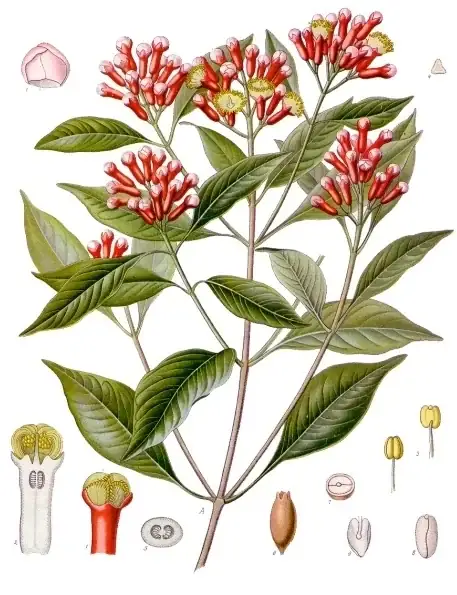
Also known as: clove
The botanical name and part used must match the profile; a photograph alone is not sufficient grounds for consuming a plant.
An illustration is not enough to identify a plant for consumption. Do not forage for a species based solely on this profile.
01 · UNDERSTAND
Properties & uses.
Temporary toothache
Traditional use of an essential oil preparation for pain related to tooth decay while awaiting dental care.
Read the sourceMouth and throat
Traditional local use for minor inflammation; the whole clove has no equivalent monograph.
Read the sourceThe traditional uses described are not clinical proof of effectiveness. Evidence for one preparation cannot automatically be applied to another.
02 · UNDERSTAND THE ACTION
How does the plant act?
The clove tree shows why food use and a medicinal preparation must be distinguished. The EMA assessment mainly concerns the flower bud essential oil for certain temporary local uses in the mouth. The whole clove has not received the same therapeutic monograph. Antimicrobial or anesthetic activity observed in the laboratory does not make it safe to apply concentrated oil to a mucous membrane.
Constituents to know.
Their presence and quantity depend on the plant part and preparation.
- Eugenol
- A major constituent of the essential oil, studied for local effects on pain and microorganisms; it can also irritate and sensitise.Read the reference
Temporary dental relief
Traditional use of local formulations does not treat the cause of toothache or remove the need for a dentist.
Read the referenceLaboratory activities
Antimicrobial and analgesic observations with the oil or eugenol do not demonstrate treatment of an oral infection.
Read the referenceWhat this means for preparation.
A pure essential oil is not a ready-to-use mouthwash. Products must be formulated for the intended use and their tolerability checked, particularly in cases of allergy.
03 · EXAMINE THE EVIDENCE
What the research shows.
A laboratory or animal result alone does not demonstrate a benefit in humans. Each result must be read alongside the preparation studied and its limitations.
Flower bud or oil?
- Type of research
- Shared EMA report examining the flower bud and its essential oil.
- Preparation concerned
- Syzygium aromaticum, forms and compositions assessed separately.
- Observed results
- The accepted traditional-use framework for the oil concerns a specific local oromucosal route.
- Limitations to consider
- The whole clove dossier is insufficient for a positive monograph; neither herbal tea nor ingestion of essential oil can be inferred from the local findings.
What can we take from this?
A temporary reduction in pain can mask dental damage. The guide provides no home protocol for anesthesia or ingestion of essential oil.
Documentary review dated 09/10/2026. The references remain available to check the context.
04 · CHOOSE A PREPARATION
One plant, several preparations.
Only forms documented in this profile’s sources are presented.
Formulated dental preparationFlower bud / Flower bud essential oil · Route: mouth
Distilled essential oil incorporated into a suitable product.
Please note: Do not ingest or apply undiluted; avoid the gums.
Read the source05 · BEFORE ANY USE
Precautions & contraindications.
This guidance does not cover every individual situation. Missing information is not a guarantee of safety.
Contraindications
- Allergy to clove or cross-allergy to balsam of Peru.
Medicine interactions
- None reported in the monograph; have treatments checked.
Adverse effects
- Irritation and allergy possible; this profile does not define a safe dilution.
Pregnancy & breastfeeding
Pregnancy and breastfeeding: medicinal use is not recommended due to insufficient data.
Children & adolescents
Medicinal use for adults only.
If symptoms persist, worsen or are unusual, consult a healthcare professional. In an emergency, contact the emergency services.
06 · PUTTING KNOWLEDGE INTO PRACTICE
Preparations & recipes.
No home recipe is provided in this profile. For an appropriate preparation, refer to the product leaflet and ask your pharmacist for advice.
07 · CHECK THE SOURCES
Sources for this profile.
- EMA — Caryophylli flos: dossier and documentsAccessed on 09/10/2026
- EMA — public statement: Caryophylli flosAccessed on 09/10/2026
- EMA — Caryophylli floris aetheroleum: dossier and documentsAccessed on 09/10/2026
- EMA — monograph: Caryophylli floris aetheroleumAccessed on 09/10/2026
- ANSES — precautions for herbal supplements, June 2023 tableAccessed on 09/10/2026
- EMA — scientific assessment report: Syzygium aromaticumAccessed on 09/10/2026
Illustration: Franz Eugen Köhler, Köhler's Medizinal-Pflanzen · Public domain. View the original image and its licence. Image resized and converted to WebP.
A TOUCH OF SOLÉA
Myriam’s tip
Myriam is reviewing the tip for this profile.
Myriam