BOTANICAL IDENTITY
The right name is the first step.
Also known as: No synonyms listed.
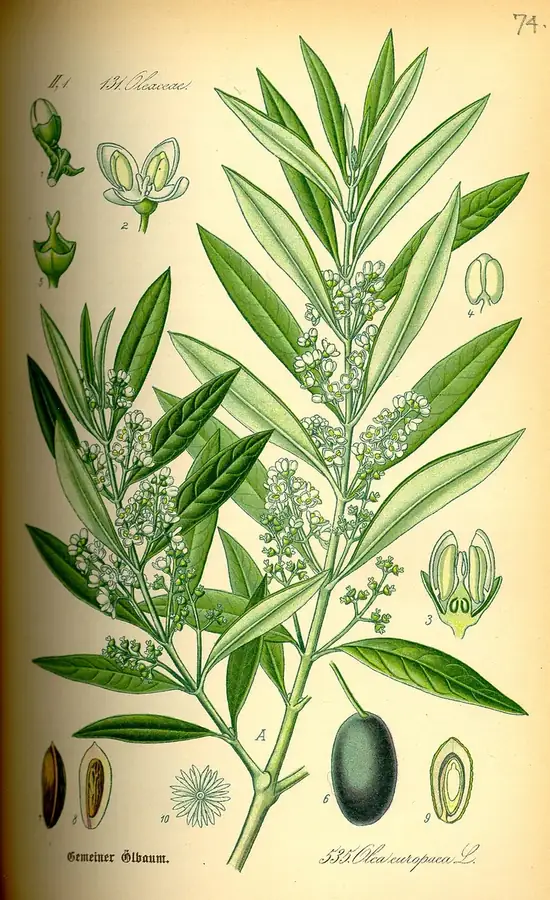
This profile concerns leaves; olive oil and olives are other parts/preparations.
An illustration is not enough to identify a plant for consumption. Do not forage for a species based solely on this profile.
01 · UNDERSTAND
Properties & uses.
Mild water retention
Traditional use to promote renal elimination, after medical exclusion of a serious cause.
Read the sourceThe traditional uses described are not clinical proof of effectiveness. Evidence for one preparation cannot automatically be applied to another.
02 · UNDERSTAND THE ACTION
How does the plant act?
Olive leaf has a traditional use for increasing water elimination in mild fluid retention, after a serious cause has been excluded. Concentrated extracts have also been studied for blood pressure. This research is interesting, but concerns a characterized formulation and a specific population, not all leaf herbal teas. Edible olive oil and leaf extracts are two further distinct products.
Constituents to know.
Their presence and quantity depend on the plant part and preparation.
- Oleuropein and hydroxytyrosol
- These polyphenols were quantified in the extract used in a clinical trial. Their presence provides a characterization marker without demonstrating that each individually explains the result.Read the reference
Urinary elimination
Traditional leaf use is intended as an adjunct for mild fluid retention. Edema of cardiac or renal origin falls outside this framework.
Read the referenceBlood pressure
A polyphenol-rich leaf extract modestly reduced blood pressure in a controlled study. This signal does not amount to a recommendation to self-treat hypertension.
Read the referenceWhat this means for preparation.
A label must specify the leaf, the nature of the extract and its purpose. Do not change blood pressure treatment on the basis of this trial.
03 · EXAMINE THE EVIDENCE
What the research shows.
A laboratory or animal result alone does not demonstrate a benefit in humans. Each result must be read alongside the preparation studied and its limitations.
A trial in men with slightly elevated blood pressure
- Type of research
- Randomized, double-blind, controlled crossover trial: 60 men, six-week periods separated by four weeks.
- Preparation concerned
- Olive leaf extract with measured oleuropein and hydroxytyrosol levels.
- Observed results
- The difference in mean 24-hour blood pressure was approximately −3.33 mmHg systolic and −2.42 mmHg diastolic compared with the control.
- Limitations to consider
- Short-term results in men only; these are intermediate measurements, not a demonstration of heart attack prevention. Herbal tea was not tested in this trial.
What can we take from this?
The result for a concentrated extract must not be attributed to olives, culinary oil or every infusion. New water retention first requires its cause to be understood.
Documentary review dated 09/10/2026. The references remain available to check the context.
04 · CHOOSE A PREPARATION
One plant, several preparations.
Only forms documented in this profile’s sources are presented.
Herbal teaLeaves · Route: oral
Leaves prepared according to a package leaflet; check their freshness and dry condition.
Please note: Follow the product's package leaflet; preparations are not interchangeable.
Read the sourcePowderLeaves · Route: oral
Preparation of powdered leaves.
Please note: Follow the product's package leaflet; preparations are not interchangeable.
Read the source05 · BEFORE ANY USE
Precautions & contraindications.
This guidance does not cover every individual situation. Missing information is not a guarantee of safety.
Contraindications
- Allergy to olive.
- Do not use if fluid restriction is prescribed, particularly for severe heart or kidney disease.
Medicine interactions
- No established interaction is included in this entry; this does not guarantee compatibility with a treatment.
Adverse effects
- Adverse effects insufficiently documented in the sources used here.
Pregnancy & breastfeeding
Pregnancy and breastfeeding: medicinal use is not recommended because of insufficient data.
Children & adolescents
For adults only in this leaflet; insufficient pediatric data.
If symptoms persist, worsen or are unusual, consult a healthcare professional. In an emergency, contact the emergency services.
06 · PUTTING KNOWLEDGE INTO PRACTICE
Preparations & recipes.
No home recipe is provided in this profile. For an appropriate preparation, refer to the product leaflet and ask your pharmacist for advice.
07 · CHECK THE SOURCES
Sources for this profile.
- EMA — Oleae folium: assessment and documentsAccessed on 09/10/2026
- ANSES — summary of precautions for food supplements (June 2023)Accessed on 09/10/2026
- Lockyer et al., 2017 — polyphenol-rich olive leaf extract: randomised trial on blood pressureAccessed on 09/10/2026
Illustration: Flora von Deutschland, Österreich und der Schweiz — Otto Wilhelm Thomé (1885), via Wikimedia Commons · Public domain. View the original image and its licence. Image resized and converted to WebP.
A TOUCH OF SOLÉA
Myriam’s tip
Myriam is reviewing the tip for this profile.
Myriam