BOTANICAL IDENTITY
The right name is the first step.
Also known as: No synonyms listed.
Evening primrose oil is a fatty seed oil, not an essential oil.
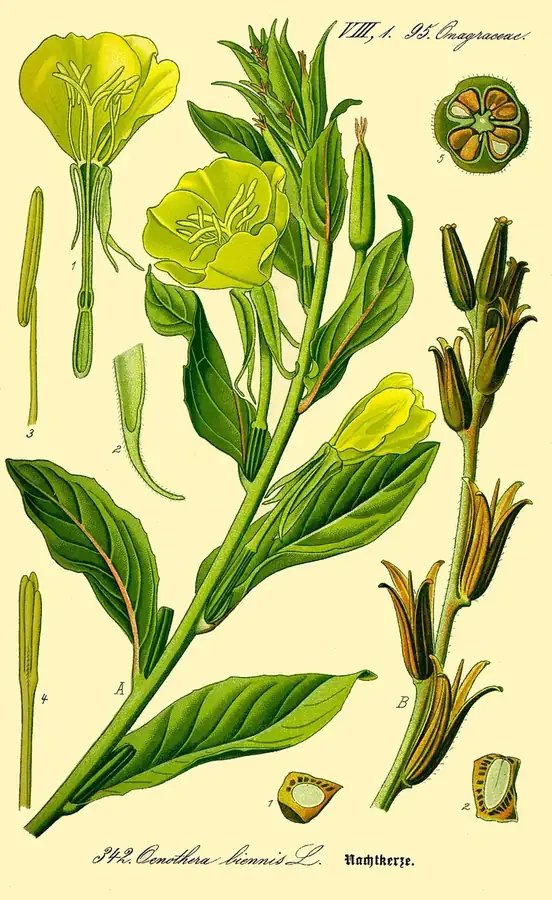
An illustration is not enough to identify a plant for consumption. Do not forage for a species based solely on this profile.
01 · UNDERSTAND
Properties & uses.
Itching of dry skin
Traditional oral use of the oil; clinical evidence is insufficient for general efficacy.
Read the sourceThe traditional uses described are not clinical proof of effectiveness. Evidence for one preparation cannot automatically be applied to another.
02 · UNDERSTAND THE ACTION
How does the plant act?
Evening primrose is mainly studied as oil extracted from the seeds. Its fatty acid content does not demonstrate a hormonal or dermatological effect. The EMA recognizes a traditional oral use for itching associated with dry skin. Research on atopic eczema, breast pain and other situations provides results far less convincing than some commercial presentations suggest: this traditional use must be distinguished from a demonstrated clinical benefit.
Constituents to know.
Their presence and quantity depend on the plant part and preparation.
- Gamma-linolenic acid
- The oil contains this omega-6 fatty acid, often abbreviated GLA. Its presence does not mean a therapeutic effect has been established in every condition studied.Read the reference
Itching associated with dry skin
Traditional oral use of the oil aims at symptomatic relief; it does not constitute general validation for inflammatory skin diseases.
Read the referenceAtopic eczema
Despite several studies, oral oil has shown no demonstrated benefit in the NCCIH summary. A negative result remains useful evidence.
Read the referenceWhat this means for preparation.
Look for “seed oil” and distinguish the traditional dry-skin objective from hormone claims. An oil capsule must not be equated with a herbal tea made from the plant.
03 · EXAMINE THE EVIDENCE
What the research shows.
A laboratory or animal result alone does not demonstrate a benefit in humans. Each result must be read alongside the preparation studied and its limitations.
Insufficiently supported popular indications
- Type of research
- NCCIH institutional summary of human studies.
- Preparation concerned
- Evening primrose seed oil, mainly oral, in trials covering different situations.
- Observed results
- The results do not support a benefit in eczema; for breast pain, the oil probably appears no more effective than placebo.
- Limitations to consider
- Data on premenstrual syndrome, menopause or polyarthritis remain insufficient. These indications should not be grouped under a promise of hormonal balance.
What can we take from this?
Trials to induce or facilitate labor have conflicting results and do not justify self-directed use during pregnancy. The biological role of a fatty acid alone does not demonstrate the benefit of a supplement.
Documentary review dated 09/10/2026. The references remain available to check the context.
04 · CHOOSE A PREPARATION
One plant, several preparations.
Only forms documented in this profile’s sources are presented.
Oil in capsulesSeed oil · Route: oral
Fatty oil obtained from the seeds by pressing or extraction.
Please note: Do not extrapolate to an essential oil or to every hormonal indication.
Read the source05 · BEFORE ANY USE
Precautions & contraindications.
This guidance does not cover every individual situation. Missing information is not a guarantee of safety.
Contraindications
- Allergy to evening primrose or components of the product.
Medicine interactions
- No established interaction is included in this entry; this does not guarantee compatibility with a treatment.
Adverse effects
- Adverse effects insufficiently documented in the sources used here.
Pregnancy & breastfeeding
Pregnancy and breastfeeding: medicinal use is not recommended because of insufficient data.
Children & adolescents
From age 12, according to the package leaflet.
If symptoms persist, worsen or are unusual, consult a healthcare professional. In an emergency, contact the emergency services.
06 · PUTTING KNOWLEDGE INTO PRACTICE
Preparations & recipes.
No home recipe is provided in this profile. For an appropriate preparation, refer to the product leaflet and ask your pharmacist for advice.
07 · CHECK THE SOURCES
Sources for this profile.
- EMA — Oenotherae oleum: assessment and documentsAccessed on 09/10/2026
- ANSES — summary of precautions for food supplements (June 2023)Accessed on 09/10/2026
- NCCIH — Evening Primrose Oil: state of research and safetyAccessed on 09/10/2026
Illustration: Flora von Deutschland, Österreich und der Schweiz — Otto Wilhelm Thomé (1885), via Wikimedia Commons · Public domain. View the original image and its licence. Image resized and converted to WebP.
A TOUCH OF SOLÉA
Myriam’s tip
Myriam is reviewing the tip for this profile.
Myriam