BOTANICAL IDENTITY
The right name is the first step.
Also known as: Rosa damascena
A common name and photograph do not guarantee identification. Check the botanical name and part indicated on a traceable product.
An illustration is not enough to identify a plant for consumption. Do not forage for a species based solely on this profile.
01 · UNDERSTAND
Properties & uses.
Minor irritation of the skin, mouth and throat
Use of the monographed group; the source does not demonstrate a benefit specific to each species.
Read the sourceThe traditional uses described are not clinical proof of effectiveness. Evidence for one preparation cannot automatically be applied to another.
02 · UNDERSTAND THE ACTION
How does the plant act?
Damask rose has a small clinical trial of local use, which should be distinguished from the promises often associated with its fragrance. The preparation studied is an aqueous mouthwash, while the essential oil, hydrosol and petals for infusion are different products. The usual medicinal uses of the petals remain within a traditional framework shared with other roses.
Constituents to know.
Their presence and quantity depend on the plant part and preparation.
- Petal polyphenols
- The report describes quercetin and kaempferol derivatives and tannins. The essential oil's aroma does not summarize this aqueous profile.Read the reference
Mouth ulcers: local clinical signal
One study observes symptom improvement with a defined mouthwash. This suggests a possible local use without demonstrating lasting prevention of recurrence.
Read the referenceWhat this means for preparation.
Choose a product intended for the mouth if this route is contemplated. A cosmetic fragrance or decorative hydrosol does not reproduce the mouthwash used in the trial.
03 · EXAMINE THE EVIDENCE
What the research shows.
A laboratory or animal result alone does not demonstrate a benefit in humans. Each result must be read alongside the preparation studied and its limitations.
A mouthwash studied over two weeks
- Type of research
- Randomized, double-blind, placebo-controlled trial, 50 people
- Preparation concerned
- Aqueous preparation of R. damascena in people with recurrent aphthous stomatitis.
- Observed results
- Improvement in pain and the number and size of lesions reported at certain assessments.
- Limitations to consider
- Small, short trial; no validation of all rose waters, no evidence transferable to R. gallica or R. centifolia.
What can we take from this?
These results do not demonstrate a general hormonal, anxiolytic or anti-infective action of the petals. Persistent or unusual oral lesions must be examined.
Documentary review dated 09/10/2026. The references remain available to check the context.
04 · CHOOSE A PREPARATION
One plant, several preparations.
Only forms documented in this profile’s sources are presented.
Infusion for local applicationPetals · Route: topical
Mouth rinsePetals · Route: oromucosal
Preparation described in the shared monograph.
Please note: Local preparation: do not equate it with a beverage.
Read the source05 · BEFORE ANY USE
Precautions & contraindications.
This guidance does not cover every individual situation. Missing information is not a guarantee of safety.
Contraindications
- Allergy to rose.
Medicine interactions
- The selected data do not allow compatibility with your treatments to be guaranteed. Ask a pharmacist to check.
Adverse effects
- Stop use if an unexpected reaction occurs; limited data do not mean absence of risk.
Pregnancy & breastfeeding
Pregnancy and breastfeeding: medicinal use is not recommended; insufficient data.
Children & adolescents
Medicinal use is not recommended under 12 years.
If symptoms persist, worsen or are unusual, consult a healthcare professional. In an emergency, contact the emergency services.
06 · PUTTING KNOWLEDGE INTO PRACTICE
Preparations & recipes.
No home recipe is provided in this profile. For an appropriate preparation, refer to the product leaflet and ask your pharmacist for advice.
07 · CHECK THE SOURCES
Sources for this profile.
- EMA — rosae flosAccessed on 09/10/2026
- Kew POWO — nomenclature of Rosa × damascenaAccessed on 09/10/2026
- EMA — final assessment of rose petalsAccessed on 09/10/2026
- Hoseinpour et al. — Rosa damascena mouthwash for recurrent aphthous ulcers (2011)Accessed on 09/10/2026
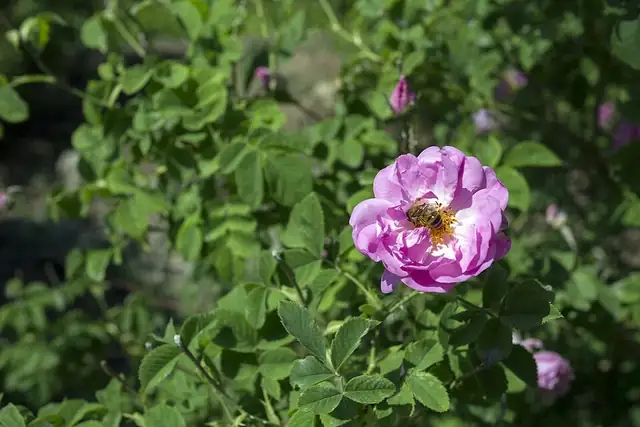
Illustration: Mostafameraji · CC BY-SA 4.0. View the original image and its licence. Image resized and converted to WebP.
A TOUCH OF SOLÉA
Myriam’s tip
Myriam is reviewing the tip for this profile.
Myriam