Identity & origin
BOTANICAL IDENTITY
The right name is the first step.
This profile covers flowering aerial parts. The uses described depend on the preparation.
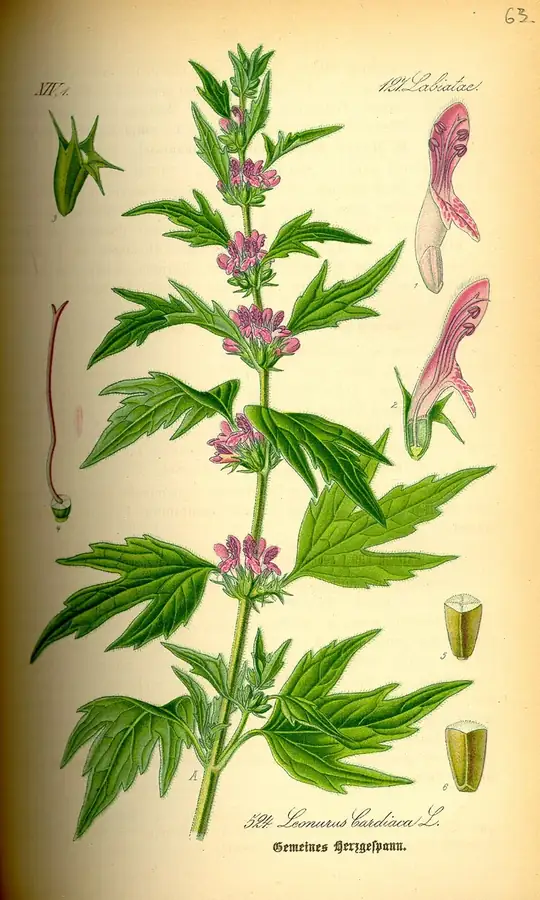
Also known as: Motherwort
Check the scientific name and the part used; a photograph is not sufficient for foraging plants intended for consumption.
An illustration is not enough to identify a plant for consumption. Do not forage for a species based solely on this profile.
Uses & evidence
UNDERSTANDING THE USES
Properties & uses.
Nervous tension
Traditional use for nervous tension and palpitations of nervous origin, only after medical exclusion of a serious cause.
Use considered plausible in a traditional-use monograph. That status alone does not demonstrate clinical efficacy.
Read the sourceThe traditional uses described are not clinical proof of effectiveness. Evidence for one preparation cannot automatically be applied to another.
Precautions before use
BEFORE ANY USE
Precautions & contraindications.
This guidance does not cover every individual situation. Missing information is not a guarantee of safety.
Contraindications & precautions
- Source-listed contraindicationPregnancy is contraindicated in the source.Source
Medicine interactions
- Insufficient dataInteraction reassessment is incomplete: the accessible source does not allow a conclusion. Ask a pharmacist to review the exact preparation and medicines.Source
Other retained warnings · review incomplete
These existing warnings remain relevant to consult. Their exhaustive reassessment is outside this targeted review.
Restrictions and precautions
- Allergy to motherwort.
- Pregnancy: contraindicated.
Medicine interactions
- No established interaction is included in this entry; this does not guarantee compatibility with a treatment.
Pregnancy, breastfeeding and children
Contraindicated during pregnancy; breastfeeding use not recommended due to lack of data.
For adults only in this leaflet; insufficient pediatric data.
“Reported” does not prove causality; “possible” may reflect indirect evidence. “None reported” means none in the cited source, not that all combinations have been studied. Do not stop a prescribed treatment based on this profile.
Adverse effects
- Adverse effects insufficiently documented in the sources used here.
Pregnancy & breastfeeding
Pregnancy: contraindicated. Breastfeeding: not recommended because evidence is insufficient.
SourceChildren & adolescents
Medicinal use is not recommended below age 18 because evidence is insufficient; do not scale down an adult dose.
SourceIf symptoms persist, worsen or are unusual, consult a healthcare professional. In an emergency, contact the emergency services.
Forms & how they are used
DOCUMENTED FORMS
One plant, several preparations.
Only forms documented in this profile’s sources are presented.
InfusionFlowering aerial parts · Route: oral
Cut flowering parts.
Please note: Follow the product's package leaflet; preparations are not interchangeable.
Read the sourcePowder or liquid extractFlowering aerial parts · Route: oral
Documented preparations with a package leaflet.
Please note: Follow the product's package leaflet; preparations are not interchangeable.
Read the sourceUnderstanding the plant’s actions
EXPLORE THE EVIDENCE
How does the plant act?
The name “cardiac motherwort” may suggest a medicine for heart rhythm, whereas the recognized framework is narrower: nervous tension and the perception of nervous palpitations, after a doctor has excluded a serious cause. One human study provided signals, but its lack of a control group prevents the effect of the preparation from being distinguished from the course of the symptoms. Recognition remains based on traditional use.
Constituents to know.
Their presence and quantity depend on the plant part and preparation.
- Iridoids
- The oil extract studied contained measured iridoids; this analytical marker does not demonstrate that they explain a cardiovascular benefit.Read the reference
Nervous tension
Traditional use concerns mild nervous discomfort, with defined oral preparations of flowering aerial parts.
Use considered plausible in a traditional-use monograph. That status alone does not demonstrate clinical efficacy.
Read the referencePalpitations of nervous origin
Prior exclusion of heart disease is part of the conditions of use. The plant is not presented as an antiarrhythmic.
Use considered plausible in a traditional-use monograph. That status alone does not demonstrate clinical efficacy.
Read the referenceWhat this means for preparation.
Do not interpret the word “cardiac” as an invitation to treat new palpitations. Check the form and the contraindication during pregnancy.
Studies, findings & limitations
THE RESEARCH
What the research shows.
A laboratory or animal result alone does not demonstrate a benefit in humans. Each result must be read alongside the preparation studied and its limitations.
A before-and-after study without a comparator
A human study may be positive, negative or inconclusive. Read the findings, preparation and limitations.
- Type of research
- Study of 50 hypertensive patients, 28 days, described by the EMA.
- Preparation concerned
- Leonurus cardiaca extract prepared in soybean oil.
- Observed results
- Blood pressure and some anxiety or sleep scores decreased compared with baseline; no significant effect on heart rate.
- Limitations to consider
- Without a control group and over a short period, the study does not allow a conclusion of efficacy; the extract is not equivalent to an herbal tea.
What can we take from this?
Results for Leonurus japonicus or traditional medicine mixtures are not those of L. cardiaca alone. No indication for replacing an antihypertensive is recognised.
Documentary review dated 09/10/2026. The references remain available to check the context.
Sources & last review
CHECKING REFERENCES
Sources for this profile.
- EMA — Leonuri cardiacae herba: assessment and documentsAccessed on 09/10/2026
- ANSES — summary of precautions for food supplements (June 2023)Accessed on 09/10/2026
- EMA — assessment report on Leonurus cardiaca, aerial partsAccessed on 09/10/2026
Image: Flora von Deutschland, Österreich und der Schweiz — Otto Wilhelm Thomé (1885), via Wikimedia Commons · Public domain. View the original image and its licence. Image resized and converted to WebP.