Identity & origin
BOTANICAL IDENTITY
The right name is the first step.
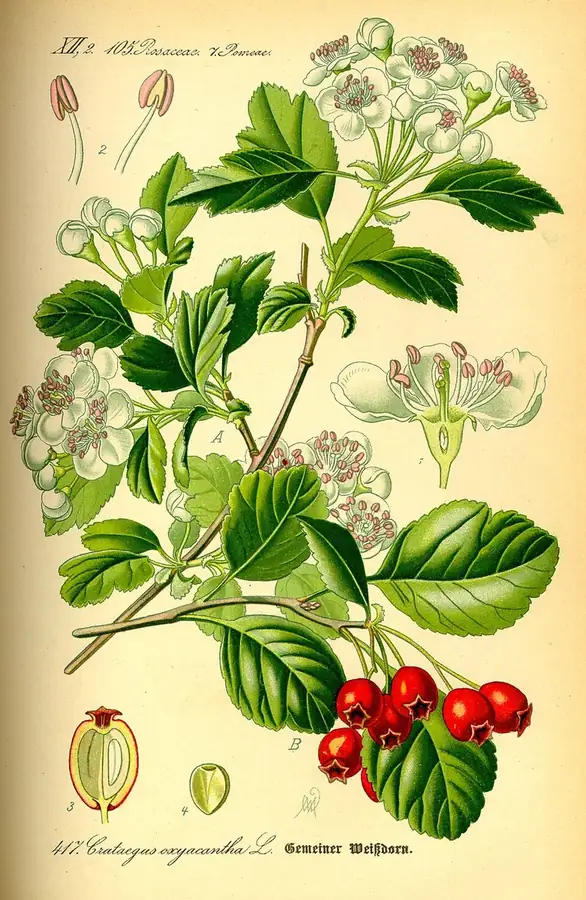
The shared monograph “crataegi folium cum flore” includes Crataegus laevigata (Poir.) DC. This profile is limited to the parts and preparations described there.
Inclusion in a collective monograph does not prove that each species has been studied separately in humans. The form and pharmaceutical quality described remain decisive.
Also known as: Midland hawthorn
A common name and photograph do not guarantee identification. Check the botanical name and part indicated on a traceable product.
An illustration is not enough to identify a plant for consumption. Do not forage for a species based solely on this profile.
Uses & evidence
UNDERSTANDING THE USES
Properties & uses.
Mild stress and sleep
Use of the monographed group; the source does not demonstrate a benefit specific to each species.
Use considered plausible in a traditional-use monograph. That status alone does not demonstrate clinical efficacy.
Read the sourcePalpitations associated with nervousness
Only after medical exclusion of heart disease.
Use considered plausible in a traditional-use monograph. That status alone does not demonstrate clinical efficacy.
Read the sourceThe traditional uses described are not clinical proof of effectiveness. Evidence for one preparation cannot automatically be applied to another.
Precautions before use
BEFORE ANY USE
Precautions & contraindications.
This guidance does not cover every individual situation. Missing information is not a guarantee of safety.
Contraindications & precautions
- Source-listed contraindicationAllergy to the plant or preparation: contraindication.Source
- PrecautionPalpitations require medical assessment first. Chest pain, breathlessness or swollen legs require urgent assessment.Source
Medicine interactions
- No interaction reported in the sourceNo interactions are reported in the source for the assessed preparations. Evidence is limited; compatibility with medicines is not guaranteed.Source
“Reported” does not prove causality; “possible” may reflect indirect evidence. “None reported” means none in the cited source, not that all combinations have been studied. Do not stop a prescribed treatment based on this profile.
Adverse effects
- Stop use if an unexpected reaction occurs; limited data do not mean absence of risk.
Pregnancy & breastfeeding
Medicinal use is not recommended during pregnancy or breastfeeding because evidence is insufficient; missing evidence establishes neither harm nor safety.
SourceChildren & adolescents
Palpitations: not recommended below 18 because medical assessment is needed. Mild stress/sleep: not established below 12 owing to insufficient data.
SourceIf symptoms persist, worsen or are unusual, consult a healthcare professional. In an emergency, contact the emergency services.
Forms & how they are used
DOCUMENTED FORMS
One plant, several preparations.
Only forms documented in this profile’s sources are presented.
InfusionLeaves with flowers · Route: oral
Preparation described in the shared monograph.
Please note: Follow the product's package leaflet; concentrations are not interchangeable.
Read the sourceExtractLeaves with flowers · Route: oral
Preparation described in the shared monograph.
Please note: Follow the product's package leaflet; concentrations are not interchangeable.
Read the sourceUnderstanding the plant’s actions
EXPLORE THE EVIDENCE
How does the plant act?
Midland hawthorn belongs to the leaves-with-flowers group monographed by EMA. This botanical entry does not mean that every study of a commercial hawthorn extract used C. laevigata alone. The traditional scope concerns mild stress, sleep and cardiac sensations of nervous origin after medical exclusion of disease.
Constituents to know.
Their presence and quantity depend on the plant part and preparation.
- Phenolic compounds
- An analytical study compares hydroxycinnamic derivatives in Crataegus material, including authenticated C. laevigata. Chemical identification is not a therapeutic result.Read the reference
Comfort related to nervousness
Traditional use does not allow you to decide for yourself that palpitations are benign. The cause of symptoms must be distinguished from the plant's presumed action.
Use considered plausible in a traditional-use monograph. That status alone does not demonstrate clinical efficacy.
Read the referenceWhat this means for preparation.
To relate a product to a study, check leaves and flowers, declared species, extraction and standardization. The name “hawthorn” alone does not allow comparison.
Studies, findings & limitations
THE RESEARCH
What the research shows.
A laboratory or animal result alone does not demonstrate a benefit in humans. Each result must be read alongside the preparation studied and its limitations.
Identity checks before efficacy
Laboratory or animal observation. A human benefit cannot be inferred from this finding alone.
- Type of research
- Chromatographic study
- Preparation concerned
- Leaves and flowers of several authenticated hawthorns, including C. laevigata; a commercial extract also examined.
- Observed results
- Identification of phenolic compound profiles useful for characterization.
- Limitations to consider
- No patients were treated in this analysis; it does not demonstrate an effect on heart rhythm, sleep or heart failure.
What can we take from this?
This profile does not recommend treating heart disease with herbal tea. Data on specific extracts must not be converted into universal properties of the species.
Documentary review dated 09/10/2026. The references remain available to check the context.
Sources & last review
CHECKING REFERENCES
Sources for this profile.
- EMA — crataegi folium cum floreAccessed on 09/10/2026
- Analysis of hydroxycinnamic derivatives in Crataegus leaves and flowers (2015)Accessed on 09/10/2026
- EMA — document relu pour usages et sécurité : final european union herbal monograph crataegus spp folium cum floreAccessed on 09/10/2026
Image: Flora von Deutschland, Österreich und der Schweiz — Otto Wilhelm Thomé (1885), via Wikimedia Commons · Public domain. View the original image and its licence. Image resized and converted to WebP.