BOTANICAL IDENTITY
The right name is the first step.
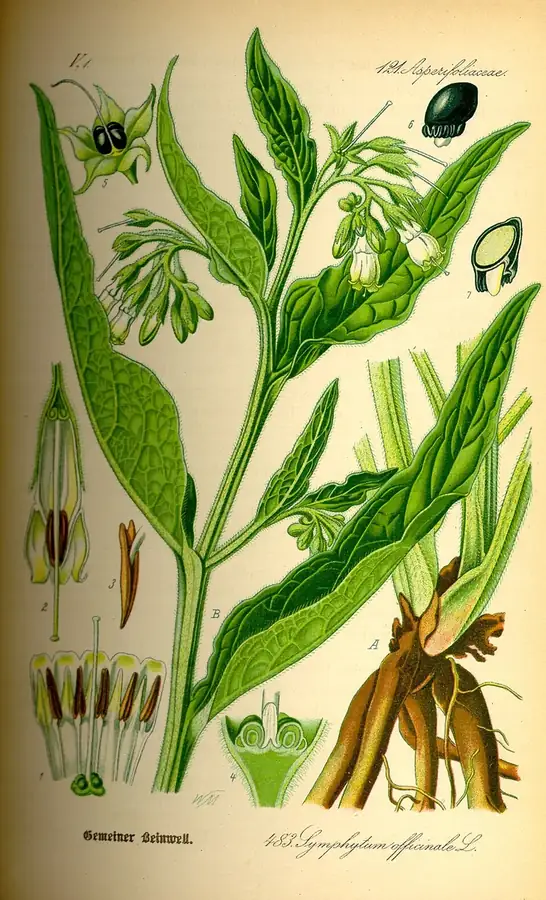
Also known as: common comfrey
The botanical name and part used must match the profile; a photograph alone is not sufficient grounds for consuming a plant.
An illustration is not enough to identify a plant for consumption. Do not forage for a species based solely on this profile.
01 · UNDERSTAND
Properties & uses.
Minor injuries
Traditional external use of defined preparations for minor sprains and bruises.
Read the sourceThe traditional uses described are not clinical proof of effectiveness. Evidence for one preparation cannot automatically be applied to another.
02 · UNDERSTAND THE ACTION
How does the plant act?
Comfrey is studied mainly as external preparations for minor injuries. Trials have reported relief with specific formulations, but their composition is not always described well enough to extend the conclusion to the raw root. The presence of pyrrolizidine alkaloids, of concern for the liver and genotoxicity, requires particular control even with topical application.
Constituents to know.
Their presence and quantity depend on the plant part and preparation.
- Allantoin and phenolic compounds
- Described in the root, they contribute to hypotheses of local action; they do not allow the effect of an unstudied balm to be predicted.Read the reference
- Pyrrolizidine alkaloids
- Their content must be controlled in every preparation; an artisan product does not guarantee their elimination.Read the reference
Minor external injuries
The monograph recognises traditional use for minor sprains and bruises, with a controlled root preparation.
Read the referenceWhat this means for preparation.
Choose only a controlled preparation intended for external use; a root infusion or an improvised poultice does not reproduce an evaluated medicine.
03 · EXAMINE THE EVIDENCE
What the research shows.
A laboratory or animal result alone does not demonstrate a benefit in humans. Each result must be read alongside the preparation studied and its limitations.
Why trials do not validate every balm
- Type of research
- EMA assessment of trials of topical formulations and toxicological risks.
- Preparation concerned
- Creams or ointments containing comfrey preparations of varying composition.
- Observed results
- Favorable effects were observed with certain studied products.
- Limitations to consider
- Insufficient characterization prevents generalization; alkaloid content, skin absorption and application route remain crucial.
What can we take from this?
“Repairs bones” is not a scientific conclusion of this entry. A suspected fracture or significant injury requires assessment, even if pain decreases.
Documentary review dated 09/10/2026. The references remain available to check the context.
04 · CHOOSE A PREPARATION
One plant, several preparations.
Only forms documented in this profile’s sources are presented.
Medicinal creamRoot · Route: topical
Extract with controlled pyrrolizidine alkaloid content.
Please note: No homemade macerate; do not ingest.
Read the source05 · BEFORE ANY USE
Precautions & contraindications.
This guidance does not cover every individual situation. Missing information is not a guarantee of safety.
Contraindications
- Allergy.
- Do not apply to damaged skin; a controlled preparation is essential.
Medicine interactions
- Interactions insufficiently characterized here.
Adverse effects
- Pyrrolizidine alkaloids pose a liver risk; skin reactions are possible depending on the product.
Pregnancy & breastfeeding
Pregnancy and breastfeeding: medicinal use is not recommended due to insufficient data.
Children & adolescents
For adults only.
If symptoms persist, worsen or are unusual, consult a healthcare professional. In an emergency, contact the emergency services.
06 · PUTTING KNOWLEDGE INTO PRACTICE
Preparations & recipes.
No home recipe is provided in this profile. For an appropriate preparation, refer to the product leaflet and ask your pharmacist for advice.
07 · CHECK THE SOURCES
Sources for this profile.
- EMA — Symphyti radix: dossier and documentsAccessed on 09/10/2026
- EMA — Monograph: Symphyti radixAccessed on 09/10/2026
- EMA — scientific assessment report: Symphytum officinaleAccessed on 09/10/2026
Illustration: Flora von Deutschland, Österreich und der Schweiz — Otto Wilhelm Thomé (1885), via Wikimedia Commons · Public domain. View the original image and its licence. Image resized and converted to WebP.
A TOUCH OF SOLÉA
Myriam’s tip
Myriam is reviewing the tip for this profile.
Myriam