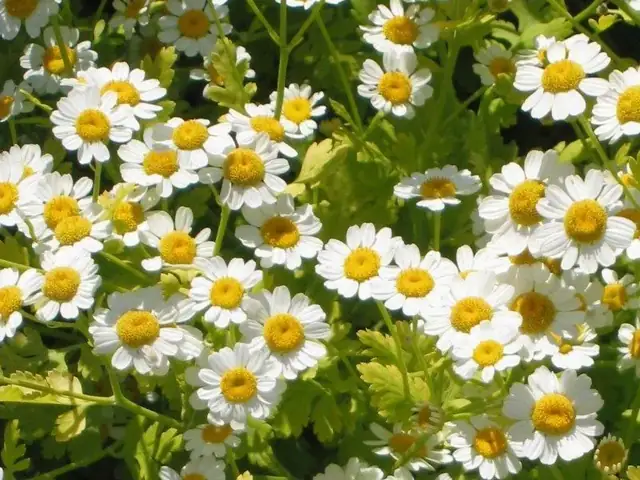
BOTANICAL IDENTITY
The right name is the first step.
Also known as: feverfew
Distinct from Matricaria recutita and Chamaemelum nobile.
An illustration is not enough to identify a plant for consumption. Do not forage for a species based solely on this profile.
01 · UNDERSTAND
Properties & uses.
Migraine prevention
Traditional use after a doctor has excluded a serious condition; does not treat a neurological emergency.
Read the sourceThe traditional uses described are not clinical proof of effectiveness. Evidence for one preparation cannot automatically be applied to another.
02 · UNDERSTAND THE ACTION
How does the plant act?
Feverfew, Tanacetum parthenium, is studied for migraine prevention, not immediate treatment of an attack. Trials have used aerial-part powder or very different extracts, making results difficult to combine. The EMA retains a traditional indication for the powder, without transferring all results from particular extracts to this form.
Constituents to know.
Their presence and quantity depend on the plant part and preparation.
- Parthenolide and other sesquiterpene lactones
- Substances studied for effects on inflammatory or platelet pathways; they may also contribute to contact allergies.Read the reference
Traditional migraine prevention
Use is considered after medical identification of migraine; it does not extend to every headache.
Read the referenceWhat this means for preparation.
Look for Tanacetum parthenium: it is not German chamomile. Any combination with medicines affecting coagulation must be discussed; the interaction risk mentioned remains mainly theoretical.
03 · EXAMINE THE EVIDENCE
What the research shows.
A laboratory or animal result alone does not demonstrate a benefit in humans. Each result must be read alongside the preparation studied and its limitations.
Noninterchangeable preparations
- Type of research
- EMA assessment of controlled trials of powder and extracts, including MIG-99.
- Preparation concerned
- Aerial parts of Tanacetum parthenium, with different extraction processes and contents.
- Observed results
- Some trials have shown favorable results for migraine frequency; other results are less conclusive.
- Limitations to consider
- Heterogeneous preparations and methodological limitations: a particular extract does not prove the effect of a powder or herbal tea.
What can we take from this?
The plant is not an emergency treatment for a sudden or unusual headache. The marker parthenolide alone does not guarantee a clinical response.
Documentary review dated 09/10/2026. The references remain available to check the context.
04 · CHOOSE A PREPARATION
One plant, several preparations.
Only forms documented in this profile’s sources are presented.
Powder in solid dosage formAerial parts · Route: oral
Powdered aerial parts.
Please note: The dossier does not validate an equivalent herbal tea.
Read the source05 · BEFORE ANY USE
Precautions & contraindications.
This guidance does not cover every individual situation. Missing information is not a guarantee of safety.
Contraindications
- Allergy to the plant or to Asteraceae.
Medicine interactions
- None reported in the monograph; check medications.
Adverse effects
- Digestive disturbances reported.
Pregnancy & breastfeeding
Not recommended during pregnancy and breastfeeding; signals of reproductive toxicity in animals.
Children & adolescents
Not recommended under 18 years.
If symptoms persist, worsen or are unusual, consult a healthcare professional. In an emergency, contact the emergency services.
06 · PUTTING KNOWLEDGE INTO PRACTICE
Preparations & recipes.
No home recipe is provided in this profile. For an appropriate preparation, refer to the product leaflet and ask your pharmacist for advice.
07 · CHECK THE SOURCES
Sources for this profile.
- EMA — Tanaceti parthenii herba: dossier and documentsAccessed on 09/10/2026
- EMA — Monograph: Tanaceti parthenii herbaAccessed on 09/10/2026
- ANSES — precautions for herbal supplements, June 2023 tableAccessed on 09/10/2026
- EMA — scientific assessment report: Tanacetum partheniumAccessed on 09/10/2026
Illustration: Vsion (2005) — Wikimedia Commons · CC BY 2.5. View the original image and its licence. Image resized and converted to WebP.
A TOUCH OF SOLÉA
Myriam’s tip
Myriam is reviewing the tip for this profile.
Myriam