BOTANICAL IDENTITY
The right name is the first step.
Also known as: Yerba mate, Paraguay tea
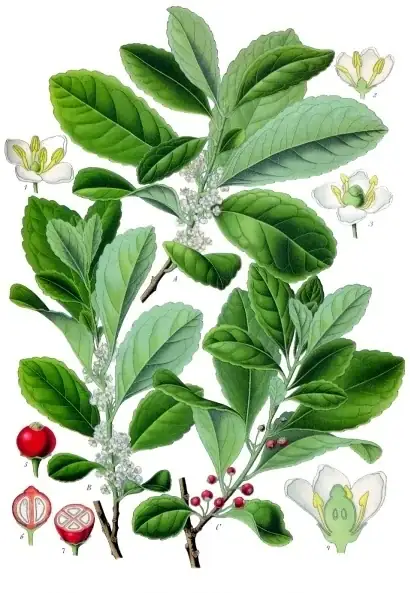
Check the scientific name and the part used; a photograph is not sufficient for foraging plants intended for consumption.
An illustration is not enough to identify a plant for consumption. Do not forage for a species based solely on this profile.
01 · UNDERSTAND
Properties & uses.
Temporary fatigue
Traditional use of leaf preparations; contains caffeine.
Read the sourceUrinary elimination
Traditional adjunctive use; does not treat an infection.
Read the sourceThe traditional uses described are not clinical proof of effectiveness. Evidence for one preparation cannot automatically be applied to another.
02 · UNDERSTAND THE ACTION
How does the plant act?
Maté combines a tradition as a beverage with traditional medicinal uses for temporary fatigue and urinary elimination. Its caffeine helps explain stimulation, but a pharmacological action of caffeine does not demonstrate that all leaves or extracts produce lasting improvements in general health. Repeated intake and other caffeinated drinks matter as much as the plant’s name.
Constituents to know.
Their presence and quantity depend on the plant part and preparation.
- Caffeine
- This methylxanthine acts particularly by antagonizing adenosine receptors in the central nervous system. Sensitivity and elimination vary between individuals.Read the reference
Alertness and temporary fatigue
Caffeine-related stimulation may reduce the feeling of fatigue; it does not replace sleep or correct a medical cause of fatigue.
Read the referenceUrinary elimination
The urinary use of mate remains traditional and adjunctive. It demonstrates neither treatment of an infection nor benefit where fluid intake is restricted.
Read the referenceWhat this means for preparation.
Take into account total caffeine from maté, coffee, tea, energy drinks and medicines. A concentrated form may substantially change exposure.
03 · EXAMINE THE EVIDENCE
What the research shows.
A laboratory or animal result alone does not demonstrate a benefit in humans. Each result must be read alongside the preparation studied and its limitations.
What is known about caffeine, rather than whole mate
- Type of research
- EMA report: pharmacology and pharmacokinetics of the constituents.
- Preparation concerned
- Caffeine, distinguished from maté leaf preparations.
- Observed results
- Caffeine is absorbed and crosses, among others, the placental and brain barriers, and passes into breast milk.
- Limitations to consider
- The report does not have complete pharmacokinetic data specific to the herbal preparation; these two levels of knowledge must not be merged.
What can we take from this?
Experimental antioxidant activity does not demonstrate cancer prevention, weight loss or cardiovascular protection. Palpitations and sleep difficulties are not signs of better balance.
Documentary review dated 09/10/2026. The references remain available to check the context.
04 · CHOOSE A PREPARATION
One plant, several preparations.
Only forms documented in this profile’s sources are presented.
InfusionLeaves · Route: oral
05 · BEFORE ANY USE
Precautions & contraindications.
This guidance does not cover every individual situation. Missing information is not a guarantee of safety.
Contraindications
- Avoid in cases of ulcers, hypertension, heart rhythm disorders, hyperthyroidism or fluid restriction.
Medicine interactions
- Caution with sedatives, sympathomimetics and MAOIs; pharmacist review.
Adverse effects
- Caffeine can cause nervousness, palpitations and insomnia.
Pregnancy & breastfeeding
Pregnancy and breastfeeding: medicinal use is not recommended because of insufficient data.
Children & adolescents
For adults only in this leaflet; insufficient pediatric data.
If symptoms persist, worsen or are unusual, consult a healthcare professional. In an emergency, contact the emergency services.
06 · PUTTING KNOWLEDGE INTO PRACTICE
Preparations & recipes.
No home recipe is provided in this profile. For an appropriate preparation, refer to the product leaflet and ask your pharmacist for advice.
07 · CHECK THE SOURCES
Sources for this profile.
- EMA — Mate folium: assessment and documentsAccessed on 09/10/2026
- ANSES — summary of precautions for food supplements (June 2023)Accessed on 09/10/2026
- EMA — reference document consultedAccessed on 09/10/2026
- EMA — assessment report on Ilex paraguariensis, leafAccessed on 09/10/2026
Illustration: Franz Eugen Köhler, Köhler's Medizinal-Pflanzen · Public domain. View the original image and its licence. Image resized and converted to WebP.
A TOUCH OF SOLÉA
Myriam’s tip
Myriam is reviewing the tip for this profile.
Myriam