BOTANICAL IDENTITY
The right name is the first step.
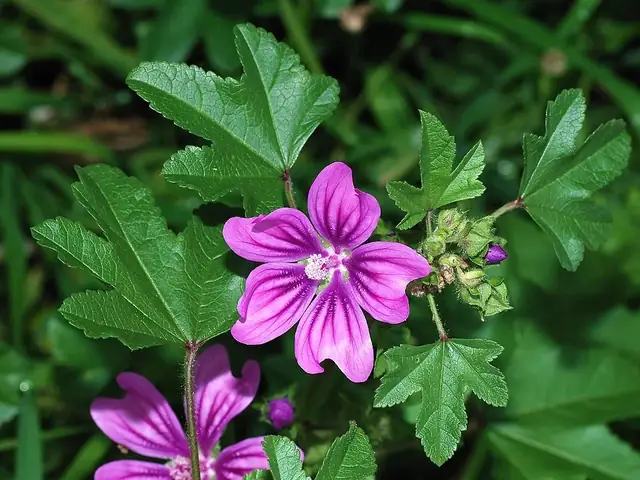
Also known as: Common mallow
Common mallow is not marshmallow; leaves, flowers and roots cannot be exchanged.
An illustration is not enough to identify a plant for consumption. Do not forage for a species based solely on this profile.
01 · UNDERSTAND
Properties & uses.
Irritated throat
Traditional use for irritation of the mouth or throat with a dry cough.
Read the sourceThe traditional uses described are not clinical proof of effectiveness. Evidence for one preparation cannot automatically be applied to another.
02 · UNDERSTAND THE ACTION
How does the plant act?
Common mallow is a soothing plant whose flower and leaf must be distinguished. The European flower dossier concerns Malva sylvestris; the leaf dossier also includes M. neglecta. Their uses for an irritated throat, dry cough or mild digestive discomfort remain traditional. Mucilages provide a plausible explanation for certain effects, but experimental observations do not measure the relief obtained with a herbal tea in a person.
Constituents to know.
Their presence and quantity depend on the plant part and preparation.
- Mucilage and polysaccharides
- Mucilaginous fractions and acidic polysaccharides from the flowers have been studied; a fractionated extract does not represent all the substances present in an infusion.Read the reference
Soothing the throat
Traditional use targets mouth or throat irritation and associated dry cough. It does not amount to antibiotic action or asthma management.
Read the referenceRelief of mild digestive discomfort
Use of aqueous preparations for minor digestive discomfort rests on longstanding use; clinical efficacy is not quantified.
Read the referenceExperimental cough reflex
Flower fractions reduced measures of mechanically induced cough in animals. The region stimulated and fraction used influenced the results.
Read the referenceWhat this means for preparation.
Look for “flowers” or “leaves” on the product. A preparation intended for contact with the throat must not be confused with a cosmetic extract or a plant simply sold as mallow.
03 · EXAMINE THE EVIDENCE
What the research shows.
A laboratory or animal result alone does not demonstrate a benefit in humans. Each result must be read alongside the preparation studied and its limitations.
An experiment on induced cough
- Type of research
- Animal study reviewed by the EMA.
- Preparation concerned
- Mucilage and an acidic polysaccharide fraction isolated from Malva sylvestris flowers.
- Observed results
- A decrease in the number or intensity of coughing efforts was observed in the model.
- Limitations to consider
- This setup reproduces neither all causes of human cough nor the composition of an infusion; it does not prove efficacy comparable to a cough suppressant medicine.
What can we take from this?
Laboratory findings on constituents do not justify promises of lung repair or skin rejuvenation. A persistent cough requires investigation of its cause.
Documentary review dated 09/10/2026. The references remain available to check the context.
04 · CHOOSE A PREPARATION
One plant, several preparations.
Only forms documented in this profile’s sources are presented.
InfusionFlowers · Route: oral
Dried, cut flowers; check a leaf preparation separately.
Please note: Follow the product's package leaflet; preparations are not interchangeable.
Read the sourceOromucosal preparationFlowers · Route: mouth
Liquid form suitable for mucous membranes.
Please note: Follow the product's package leaflet; preparations are not interchangeable.
Read the source05 · BEFORE ANY USE
Precautions & contraindications.
This guidance does not cover every individual situation. Missing information is not a guarantee of safety.
Contraindications
- Allergy to mallow.
Medicine interactions
- No established interaction is included in this entry; this does not guarantee compatibility with a treatment.
Adverse effects
- No effect reported in the EMA summary for flowers; limited data.
Pregnancy & breastfeeding
Pregnancy and breastfeeding: medicinal use is not recommended because of insufficient data.
Children & adolescents
Flower: from age 12, depending on the preparation.
If symptoms persist, worsen or are unusual, consult a healthcare professional. In an emergency, contact the emergency services.
06 · PUTTING KNOWLEDGE INTO PRACTICE
Preparations & recipes.
A DOCUMENTED PREPARATION
Mallow flower infusion
Traditional soothing use for an irritated throat with dry cough. Mucilage supports the traditional rationale; a definite clinical benefit from the tea has not been demonstrated.
Plant part: Dried flowers, not leaves
Ingredients & quantities
- 1–2 g dried, fragmented Malva sylvestris L. flowers
- 250 ml boiling drinking water
Preparation steps
- Check that the material is common mallow flowers, not leaves or another species.
- Pour the 250 ml boiling water over the weighed flowers.
- Steep for 5–15 minutes: the EMA glossary’s general method, as the monograph gives no plant-specific time. Follow the tea’s leaflet first.
- Strain, then allow to cool to a comfortable temperature before use.
Use: Adults aged 18+. EMA reference: one preparation per dose, 2–3 times daily; cited average daily dose: 5 g flowers. Seek advice for irritation or cough lasting over one week.
Storage: Prepare immediately before use (EMA glossary). The monograph establishes no storage period; do not prepare a stock batch.
Before you start. Contraindicated with mallow allergy. Medicinal use in pregnancy or breastfeeding is not recommended because data are insufficient. No reported interaction does not mean no risk. Seek medical advice for fever, breathing difficulty, purulent sputum or worsening symptoms.
A DOCUMENTED PREPARATION
Common mallow leaf infusion
Demulcent reference for throat irritation with dry cough, or mild digestive discomfort. Traditional use; robust clinical trials have not established this preparation’s efficacy.
Plant part: Dried leaves
Ingredients & quantities
- 1.8 g dried, cut Malva sylvestris L. leaves
- 150 ml boiling drinking water
Preparation steps
- Weigh the identified, dried, cut plant part supplied for this use.
- Pour 150 ml boiling drinking water over the herb.
- Steep for 5–15 minutes: the EMA glossary’s general reference, as the monograph gives no specific duration. Follow the product leaflet first.
- Strain and allow to cool to a comfortable temperature before use.
Use: For adults aged 18+ in this collection. One preparation per dose, 3 times daily, giving 5.4 g leaves daily. Seek advice after one week for throat symptoms or 2 weeks for digestive discomfort, earlier if worsening. Fever, breathing difficulty or purulent sputum needs medical advice.
Storage: Prepare immediately before use. No storage period is established here; do not make a stock batch (EMA glossary, §4).
Before you start. Do not use with mallow allergy. The monograph reports no interactions, which does not guarantee their absence. Leaves cannot replace the flowers in the other recipe gram for gram. Use is not recommended during pregnancy or breastfeeding because data are insufficient.
A DOCUMENTED PREPARATION
Mallow leaf mouth rinse
Local demulcent reference for mild mouth or throat irritation. Traditional use; robust clinical trials have not established this preparation’s efficacy.
Plant part: Dried leaves
Ingredients & quantities
- 1.8 g dried, cut Malva sylvestris L. leaves
- 150 ml boiling drinking water
Preparation steps
- Weigh the identified, dried, cut plant part supplied for this use.
- Pour 150 ml boiling drinking water over the herb.
- Steep for 5–15 minutes: the EMA glossary’s general reference, as the monograph gives no specific duration. Follow the product leaflet first.
- Strain and allow to cool to a comfortable temperature before use.
- Use as a mouth rinse, then spit out. This entry does not describe a drink.
Use: For adults aged 18+ in this collection. Use the cooled infusion as a mouth rinse 3 times daily, then spit out. The monograph gives no duration for each rinse. Seek advice if symptoms last over one week, worsen, or if fever, breathing difficulty or purulent sputum develops.
Storage: Prepare immediately before use. No storage period is established here; do not make a stock batch (EMA glossary, §4).
Before you start. Do not use with mallow allergy. The monograph reports no interactions, which does not guarantee their absence. Leaves cannot replace the flowers in the other recipe gram for gram. Do not use if unable to spit out reliably; never put this non-sterile infusion in the eyes. Use is not recommended during pregnancy or breastfeeding because data are insufficient.
07 · CHECK THE SOURCES
Sources for this profile.
- EMA — Malvae sylvestris flos: assessment and documentsAccessed on 09/10/2026
- EMA — Malvae folium: assessment and documentsAccessed on 09/10/2026
- EMA — assessment report on mallow leaves and flowers, first versionAccessed on 09/10/2026
- EMA — Malva sylvestris L., flos monograph: preparation and precautionsAccessed on 09/10/2026
- EMA — Glossary on herbal teas: general preparation method, §4Accessed on 09/10/2026
- EMA — Malva sylvestris L. et/ou Malva neglecta Wallr., folium: monograph, preparation and precautionsAccessed on 09/10/2026
Illustration: Alvesgaspar · CC BY-SA 3.0. View the original image and its licence. Image resized and converted to WebP.
A TOUCH OF SOLÉA
Myriam’s tip
Myriam is reviewing the tip for this profile.
Myriam