BOTANICAL IDENTITY
The right name is the first step.
Also known as: No synonyms listed.
Check the scientific name and the part used; a photograph is not sufficient for foraging plants intended for consumption.
An illustration is not enough to identify a plant for consumption. Do not forage for a species based solely on this profile.
01 · UNDERSTAND
Properties & uses.
Depressive episodes
Some dry extracts have well-established use in mild to moderate episodes; medical diagnosis and follow-up are necessary.
Read the sourceSkin
Traditional local use of suitable preparations for minor irritations or superficial wounds.
Read the sourceThe traditional uses described are not clinical proof of effectiveness. Evidence for one preparation cannot automatically be applied to another.
02 · UNDERSTAND THE ACTION
How does the plant act?
St. John's wort has human data for certain dry extracts in mild to moderate depressive episodes. This medical context differs from a simple relaxation ritual: diagnosis, other treatments and interaction risks change the benefit–risk balance. The external oil macerate belongs to a different, traditional use. A product effective for a symptom can also significantly alter what happens to other medicines in the body.
Defined depressive episodes
Specific extracts have well-established medicinal use. This conclusion does not extend to every form of sadness, every herbal tea or severe depression.
Read the referenceElimination of medicines
Induction of cytochrome P450 enzymes and intestinal P-glycoprotein can reduce exposure to certain medicines and diminish their effect. This mechanism is relevant to safety.
Read the referenceSerotonin-related effects
Combining it with certain antidepressants may increase potentially serious serotonergic effects; combining two products does not only combine their benefits.
Read the referenceWhat this means for preparation.
Before oral use, have all treatments reviewed, including contraception and self-medication. Changing or stopping St. John’s wort can also alter interactions: do not reorganize your treatment on your own.
03 · EXAMINE THE EVIDENCE
What the research shows.
A laboratory or animal result alone does not demonstrate a benefit in humans. Each result must be read alongside the preparation studied and its limitations.
Favourable but heterogeneous human findings
- Type of research
- NCCIH institutional summary of trials and reviews.
- Preparation concerned
- Oral St John's wort preparations studied in mild to moderate depression.
- Observed results
- Efficacy superior to placebo is reported in several reviews, but not all trials agree.
- Limitations to consider
- Uncertainties in severe depression and beyond the short periods studied; variable products and care settings.
What can we take from this?
The existence of studies does not justify self-treatment of depression. Oral-extract data do not demonstrate the efficacy of a topical macerate for this indication, and photosensitivity is also a precaution for use.
Documentary review dated 09/10/2026. The references remain available to check the context.
04 · CHOOSE A PREPARATION
One plant, several preparations.
Only forms documented in this profile’s sources are presented.
Defined dry extractFlowering tops · Route: oral
Specific extracts assessed; no self-treatment of depression.
Please note: Follow the product's package leaflet; preparations are not interchangeable.
Read the sourceFormulated oil macerateFlowering tops · Route: topical
Documented external preparation.
Please note: Avoid intense UV exposure of the treated area.
Read the source05 · BEFORE ANY USE
Precautions & contraindications.
This guidance does not cover every individual situation. Missing information is not a guarantee of safety.
Contraindications
- Allergy.
- Many combinations are contraindicated, including certain immunosuppressants, antivirals, anticoagulants and anticancer medicines.
Medicine interactions
- May reduce the effectiveness of hormonal contraception and many medicines.
- With certain antidepressants: risk of serotonin syndrome.
Adverse effects
- Photosensitivity, digestive complaints, agitation and allergies possible.
Pregnancy & breastfeeding
Not recommended during pregnancy/breastfeeding; insufficient data and signals of reproductive toxicity in animals.
Children & adolescents
Oral use is not recommended under 18 years; topical use under 12 years.
If symptoms persist, worsen or are unusual, consult a healthcare professional. In an emergency, contact the emergency services.
06 · PUTTING KNOWLEDGE INTO PRACTICE
Preparations & recipes.
No home recipe is provided in this profile. For an appropriate preparation, refer to the product leaflet and ask your pharmacist for advice.
07 · CHECK THE SOURCES
Sources for this profile.
- EMA — Hyperici herba: assessment and documentsAccessed on 09/10/2026
- EMA — monograph or final opinion consultedAccessed on 09/10/2026
- ANSES — summary of precautions for food supplements (June 2023)Accessed on 09/10/2026
- NCCIH — Herb-Drug Interactions: What the Science Says, St. John’s wort sectionAccessed on 09/10/2026
- NCCIH — St. John’s Wort: Usefulness and SafetyAccessed on 09/10/2026
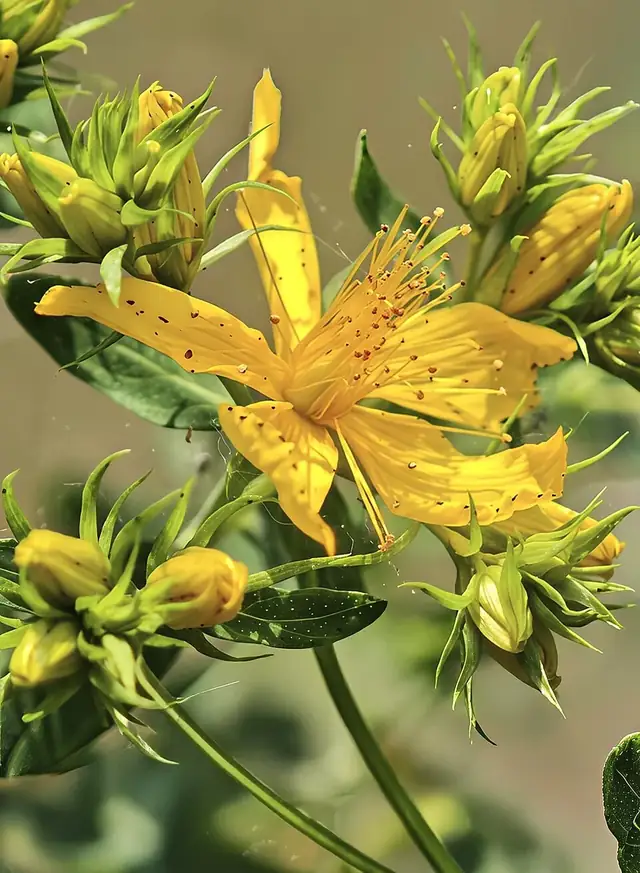
Illustration: Didier Descouens · CC BY-SA 4.0. View the original image and its licence. Image resized and converted to WebP.
A TOUCH OF SOLÉA
Myriam’s tip
Myriam is reviewing the tip for this profile.
Myriam