BOTANICAL IDENTITY
The right name is the first step.
Also known as: No synonyms listed.
Primula elatior is also included in the monograph; this does not validate all primroses.
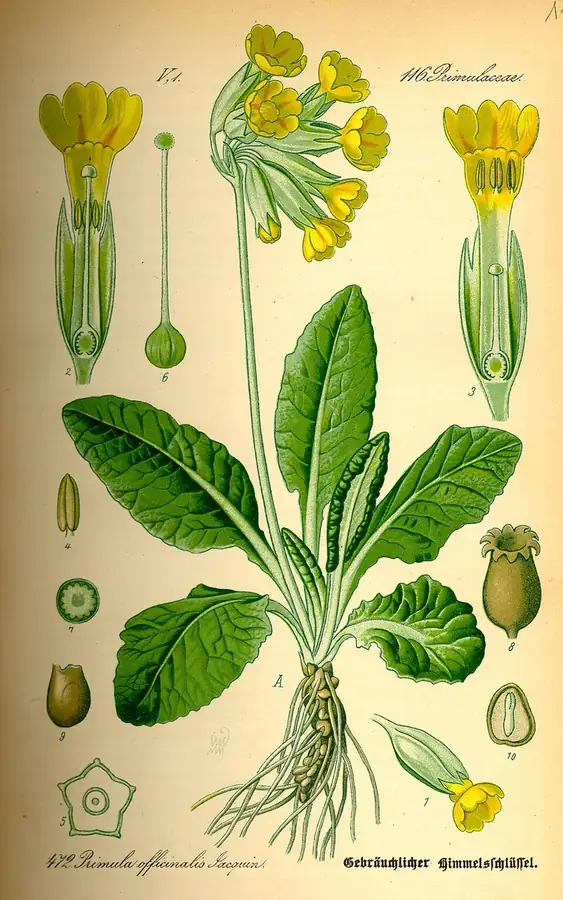
An illustration is not enough to identify a plant for consumption. Do not forage for a species based solely on this profile.
01 · UNDERSTAND
Properties & uses.
Traditional expectoration
The root has a history of use for cough associated with a cold; this does not justify a promise to cure an infection.
Read the sourceCowslip flower infusion
Expectorant reference for cough associated with a cold. Traditional use; robust clinical trials have not established this preparation’s efficacy.
Read the sourceThe traditional uses described are not clinical proof of effectiveness. Evidence for one preparation cannot automatically be applied to another.
02 · UNDERSTAND THE ACTION
How does the plant act?
For cowslip, the root and flowers must be studied separately. The details here mainly concern Primula veris root, in a joint assessment with Primula elatior. The traditional benefit is expectorant action for cough associated with a cold. The mechanism often suggested for saponins remains a hypothesis, and results for medicines combining primrose and thyme do not prove the effect of primrose alone.
Constituents to know.
Their presence and quantity depend on the plant part and preparation.
- Root saponins
- Poorly absorbed compounds; the dosage form and their digestive transformation influence exposure. The flowers have a different profile.Read the reference
Bronchial secretions: reflex hypothesis
Mild irritation of the gastric mucosa by saponins might trigger a reflex that increases bronchial secretions; the mechanism is not elucidated.
Read the referenceTraditional expectoration
The root has a history of use for cough associated with a cold; this does not justify a promise to cure an infection.
Read the referenceWhat this means for preparation.
The choice must specify root or flower and check for the presence of other plants. Permitted ages depend on the preparation; those of a combination medicine do not transfer to a herbal tea.
03 · EXAMINE THE EVIDENCE
What the research shows.
A laboratory or animal result alone does not demonstrate a benefit in humans. Each result must be read alongside the preparation studied and its limitations.
Why thyme–primrose trials are insufficient
- Type of research
- EMA assessment of clinical trials of combination products.
- Preparation concerned
- Primrose root extracts combined with thyme preparations.
- Observed results
- Combinations have been the subject of published trials.
- Limitations to consider
- The root's own contribution, and then that of Primula veris compared with P. elatior, cannot be isolated. No trial of the root alone had been published in the assessment.
What can we take from this?
Antibacterial and antifungal observations on saponins are not evidence of treatment for human respiratory infection.
Documentary review dated 09/10/2026. The references remain available to check the context.
04 · CHOOSE A PREPARATION
One plant, several preparations.
Only forms documented in this profile’s sources are presented.
Cowslip flower infusionDried flowers · Route: oral
Expectorant reference for cough associated with a cold. Traditional use; robust clinical trials have not established this preparation’s efficacy.
Please note: Contraindicated with allergy to cowslip or another Primula species. Seek advice for gastritis or a gastric ulcer. Allergic reactions are possible; excessive doses may cause stomach upset, vomiting or diarrhoea. Do not use ornamental primulas or replace flowers with roots. Use is not recommended during pregnancy or breastfeeding because data are insufficient.
Read the source05 · BEFORE ANY USE
Precautions & contraindications.
This guidance does not cover every individual situation. Missing information is not a guarantee of safety.
Contraindications
- Allergy to primroses.
- Caution in cases of gastritis or gastric ulcer.
Medicine interactions
- None reported; check treatments.
Adverse effects
- Digestive disturbances, particularly nausea, are possible.
Pregnancy & breastfeeding
Pregnancy and breastfeeding: medicinal use is not recommended due to insufficient data.
Children & adolescents
Minimum age varies by part and preparation; seek professional advice for children.
If symptoms persist, worsen or are unusual, consult a healthcare professional. In an emergency, contact the emergency services.
06 · PUTTING KNOWLEDGE INTO PRACTICE
Preparations & recipes.
A DOCUMENTED PREPARATION
Cowslip flower infusion
Expectorant reference for cough associated with a cold. Traditional use; robust clinical trials have not established this preparation’s efficacy.
Plant part: Dried flowers
Ingredients & quantities
- 1 g dried, cut Primula veris L. flowers, supplied for herbal tea
- 150 ml boiling drinking water
Preparation steps
- Weigh the identified, dried, cut plant part supplied for this use.
- Pour 150 ml boiling drinking water over the herb.
- Steep for 5–15 minutes: the EMA glossary’s general reference, as the monograph gives no specific duration. Follow the product leaflet first.
- Strain and allow to cool to a comfortable temperature before use.
Use: For adults aged 18+ in this collection. One preparation per dose, 3 times daily. Seek advice if symptoms last over one week, worsen, or if fever, breathing difficulty or purulent sputum develops.
Storage: Prepare immediately before use. No storage period is established here; do not make a stock batch (EMA glossary, §4).
Before you start. Contraindicated with allergy to cowslip or another Primula species. Seek advice for gastritis or a gastric ulcer. Allergic reactions are possible; excessive doses may cause stomach upset, vomiting or diarrhoea. Do not use ornamental primulas or replace flowers with roots. Use is not recommended during pregnancy or breastfeeding because data are insufficient.
07 · CHECK THE SOURCES
Sources for this profile.
- EMA — Primulae radix: dossier and documentsAccessed on 09/10/2026
- EMA — Primulae flos: dossier and documentsAccessed on 09/10/2026
- EMA — scientific assessment report: Primula verisAccessed on 09/10/2026
- EMA — Primula veris L. et/ou Primula elatior (L.) Hill, flos: monograph, preparation and precautionsAccessed on 09/10/2026
- EMA — Glossary on herbal teas: general preparation method, §4Accessed on 09/10/2026
Illustration: Otto Wilhelm Thomé · Public domain. View the original image and its licence. Image resized and converted to WebP.
A TOUCH OF SOLÉA
Myriam’s tip
Myriam is reviewing the tip for this profile.
Myriam